
Yellow lonchopterid
Lonchoptera lutea
Description
How to identify
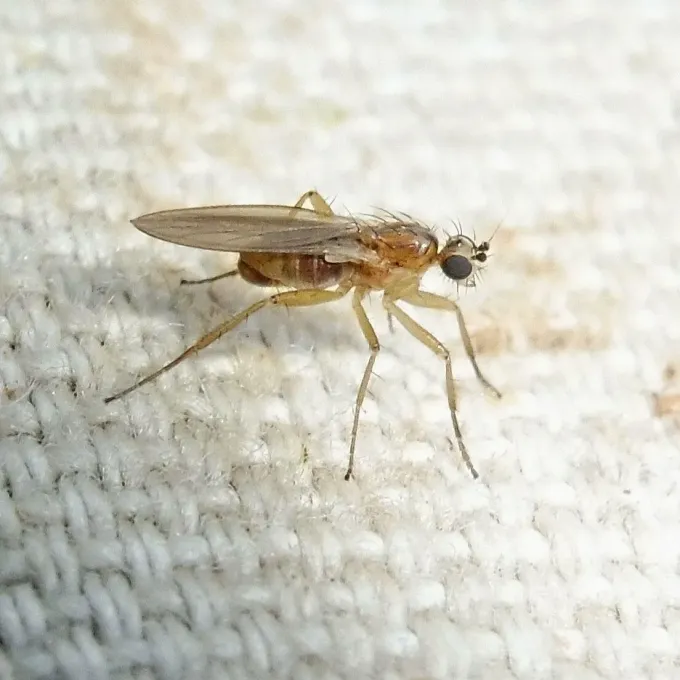
The yellow lonchopterid (Lonchoptera lutea) belongs to the family Lonchopteridae, commonly known as the pointed-wing flies. These small insects are characterized by their lanceolate wings and generally slender, yellowish-brown bodies.
Adult flies are highly active and are frequently observed in shaded, damp habitats. They are known for their rapid, darting movements across the foliage or surface of the soil.
Larvae are flattened and typically inhabit moist environments rich in organic matter. They possess specific physiological adaptations that allow them to thrive in damp agricultural soils.
Morphological identification is often based on the wing venation and the shape of the genitalia, which are standard diagnostic features for this species of dipteran.
The species is noted for parthenogenesis in several populations, a survival strategy that enhances its reproductive success and rapid colonization of favorable habitats.
What it damages
Lonchoptera lutea acts primarily as a secondary pest, often targeting plants that are already stressed or growing in waterlogged conditions.
The larvae feed on plant tissues, specifically around the roots and stem bases, which can lead to stunted growth and reduced vigor of the affected seedlings.
Direct damage provides pathways for opportunistic pathogens, leading to secondary fungal or bacterial infections that are often more destructive than the feeding activity of the fly itself.
Crop losses are most significant in fields with poor drainage or during seasons with excessive precipitation, which favor the increase of the larval population.
While not a primary pest of robust crops, the yellow lonchopterid can contribute to substantial losses in seedbeds and young plantations if infestation density is high.
When it appears
Adults emerge in spring once temperatures are consistently favorable. They remain active throughout the summer, with population numbers peaking in mid-to-late summer.
Multiple generations can occur within a single growing season, contingent upon the availability of moisture and organic food sources for the developing larvae.
Winter survival is typically achieved by the adult stage. They seek refuge in leaf litter, debris, or the top layer of the soil to escape harsh winter conditions.
The early vegetative stage is the most critical time for monitoring, as young, tender shoots are highly susceptible to the initial infestation from the overwintering generation.
Environmental conditions during the spring transition significantly dictate the population trajectory for the rest of the year, emphasizing the need for timely field assessments.
Signs of infestation
Initial signs include uneven crop emergence and patches of plants exhibiting chlorosis (yellowing), which often leads farmers to suspect nutrient deficiencies first.
Close inspection of the crown and root area reveals characteristic necrotic lesions and tissue erosion, indicating larval feeding activity in the subsurface layer.
Plants may show signs of wilting during the heat of the day, as the damaged root systems are unable to sustain adequate water uptake for the growing plant.
The presence of adult flies in the field can be detected by sweeping or visual monitoring in the early morning or during overcast, humid days.
Stunted development of specific plant clusters in a field, which do not respond to fertilization, is a primary indicator of localized larval activity in the soil.
Control measures
Cultural control is the most effective management strategy. Implementing deep autumn tillage helps disrupt the overwintering sites of the adult flies.
Improving field drainage is essential to minimize the moist micro-habitats that Lonchoptera lutea requires for optimal development and reproduction.
Crop rotation should be employed to break the pest cycle, as continuous cropping of susceptible plants creates stable environments for larval growth.
If economic thresholds are reached, chemical management using systemic insecticides can provide control by targeting larvae before they cause significant root damage.
Sanitation practices, such as removing weeds and excessive crop debris, reduce the availability of shelter and breeding sites for both larvae and adults.
Taxonomy
- Latin name
- Lonchoptera lutea
- Order
- Diptera (flies)
- Family
- Lonchopteridae
- EPPO code
- LNCPLU
Discussion
No discussions yet — be the first.