
European grapevine moth
Lobesia
Description
How to identify
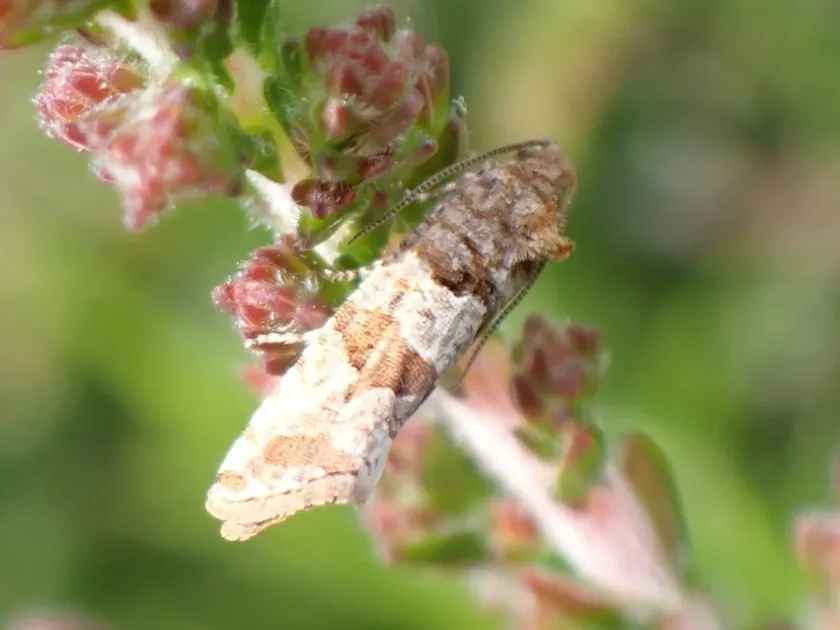
The European grapevine moth (Lobesia botrana) is a small moth belonging to the Tortricidae family. The adult moth has a wingspan of 12-13 mm and is characterized by a marbled appearance with shades of olive, grey, and brown on its forewings.
The larvae, which are responsible for the damage, reach a length of about 10-12 mm. They typically exhibit a greenish body with a dark-colored head, enabling them to blend into the foliage and the grape clusters effectively.
The life cycle consists of four stages: egg, larva, pupa, and adult. Depending on local climate conditions, the species typically completes 2 to 3 generations per year within vineyard ecosystems.
Overwintering occurs in the pupal stage, usually hidden within a silk cocoon under the bark of the grapevine or in other protected areas on the trellis structure, waiting for the spring temperatures to rise.
Adult moths are nocturnal and are highly sensitive to temperature. Their activity patterns are commonly tracked by viticulturists using pheromone traps to time pesticide applications precisely.
What it damages
While primarily a pest of grapevines, the European grapevine moth can occasionally affect other plants. The larvae cause direct destruction to the reproductive parts of the vine, primarily the flowers and fruits.
The first generation of larvae feeds on the flower buds, webbing them together with fine silk threads. This feeding behavior often causes the blossoms to dry up and fall off, leading to a significant loss of potential fruit yield.
Second and third generations of larvae focus their feeding on the developing grape berries. They bore into the fruit to consume the pulp and seeds, which severely compromises the bunch integrity.
Physical damage to the berries creates open wounds that serve as entry points for secondary pathogens, most notably the grey mold fungus (Botrytis cinerea), which can ruin entire clusters.
Economic losses can be substantial, as the combination of larval feeding and subsequent fungal rot significantly degrades both the quantity and the commercial quality of the harvest.
Signs of infestation
The presence of webbed blossom clusters in late spring is a primary indicator of an infestation. These webbed bundles often contain the small, active larvae feeding inside.
During the berry development and ripening stages, symptomatic "hollowed-out" berries appear. These are typically accompanied by frass (larval excrement) visible near the entry holes on the skin.
The presence of necrotic patches or clusters exhibiting signs of grey mold infection is another common indicator, as the pest acts as a vector or facilitator for these fungal diseases.
Adult moth activity can be monitored visually during dusk hours or, more accurately, by inspecting commercial pheromone traps placed in the vineyard blocks.
Inspection of the vine trunks and trellis posts during winter pruning may reveal the presence of overwintering pupae, providing a baseline for the following season's pest pressure.
Control measures
Integrated Pest Management (IPM) is essential for controlling Lobesia botrana. This includes the use of mating disruption techniques, which involve the placement of pheromone dispensers to interfere with male-female location.
Biological control involves the application of specific formulations of Bacillus thuringiensis (Bt), which are effective against young larvae while posing minimal risk to beneficial insects.
Chemical control remains a common practice, focusing on timely applications of insecticides during the period when larvae are active but have not yet bored deep into the grape berries.
Cultural practices such as leaf thinning and maintaining good airflow in the canopy help reduce humidity levels, making the vineyard environment less conducive to both the moth and the associated grey mold.
- Monitor flight patterns consistently with pheromone traps.
- Remove old bark during winter pruning to eliminate overwintering sites.
- Ensure spray coverage reaches the cluster zone for maximum efficacy.
Taxonomy
- Latin name
- Lobesia
- Order
- Lepidoptera (butterflies)
- Family
- Tortricidae
- EPPO code
- LOBESP
Discussion
No discussions yet — be the first.