
Beet stem weevil
Lixus subtilis
Description
How to identify
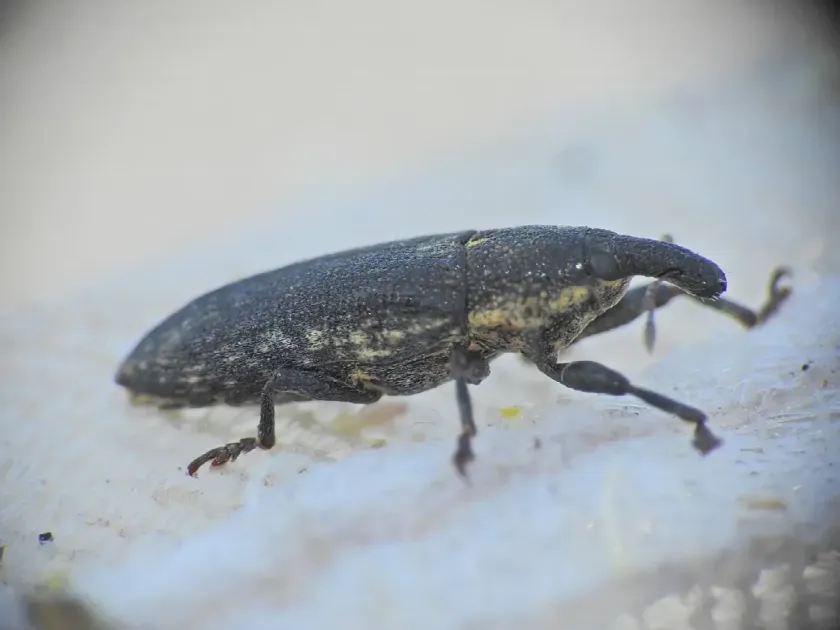
The beet stem weevil (Lixus subtilis) belongs to the order Coleoptera and the family Curculionidae. It is an elongated beetle typically measuring 10–15 mm in length, with a coloration ranging from grey to yellowish-brown.
Adults possess a characteristic long rostrum (snout) used for feeding on plant tissues and for boring holes where the female deposits its eggs.
The body is densely covered with scales, providing excellent camouflage against the foliage of the host plants, which makes them difficult to spot in the field.
The larva is apodous (legless), creamy-white in color with a brown head, and has a curved body shape suited for living inside plant stems.
The life cycle is univoltine, meaning one generation per year, with adults overwintering in the soil or under plant debris to emerge in the spring.
What it damages
The primary host plants for this pest are members of the Amaranthaceae family, with sugar beet, fodder beet, and red beet being the most economically affected crops.
While adult beetles feed on leaves, the significant economic impact is caused by the larvae, which bore through and feed on the internal tissues of the stems and petioles.
By consuming the internal parenchyma and vascular tissues, larvae disrupt the plant's ability to transport water and nutrients, severely weakening the plant.
Heavy infestations lead to premature wilting and death of leaves, which significantly reduces the photosynthetic area and decreases sugar content in the root crops.
Internal damage also creates openings for pathogens, increasing the susceptibility of the crop to secondary bacterial and fungal infections that lead to root rot.
When it appears
Adults emerge from their overwintering sites in the spring when average daily temperatures reach approximately 10–12 degrees Celsius.
The arrival of the weevils in beet fields usually coincides with the development of the first true leaves, exposing young, vulnerable plants to colonization.
Mating and egg-laying activities are prolonged, typically peaking in late May and throughout June, depending on local climatic conditions.
Larval development occurs inside the stems during June and July, where they feed continuously and grow before transitioning to the pupal stage.
New generation adults emerge in late summer, feed for a short period, and then migrate to suitable areas to enter diapause for the winter.
Signs of infestation
Early warning signs include small, distinct feeding holes on the leaves, created by adults during their initial maturation feeding period after hibernation.
Petioles may show localized swellings or longitudinal scarring, which are clear indicators of oviposition sites where eggs have been deposited.
The presence of frass (larval excrement) near holes in the stem provides direct evidence that larvae are actively feeding and mining inside the plant.
General yellowing or sudden wilting of the plant canopy in localized patches is a common symptom of severe stem infestation and structural failure.
When investigating a plant, splitting the stem often reveals internal galleries filled with waste and the creamy-white larvae, confirming Lixus subtilis presence.
Control measures
Integrated pest management starts with crop rotation, ensuring that new sugar beet fields are spatially isolated from previous years' sites by at least 1–2 kilometers.
Thorough autumn plowing and soil cultivation effectively destroy the overwintering population of adults residing in the topsoil and plant residue.
Chemical control is most effective when targeted at adults during their mass migration into the fields, using systemic and contact insecticides.
- Utilizing insecticide-treated seeds to provide early-stage crop protection.
- Applying insecticides to field margins where initial populations congregate.
- Effective weed management to eliminate alternative host plants near the field.
Treatment should be triggered by economic injury thresholds, typically when populations exceed one beetle per square meter during the emergence of young beet seedlings.
Taxonomy
- Latin name
- Lixus subtilis
- Order
- Coleoptera (beetles)
- Family
- Curculionidae
- EPPO code
- LIXUSU
Discussion
No discussions yet — be the first.