
Stem weevil
Lixus scabricollis
Description
How to identify
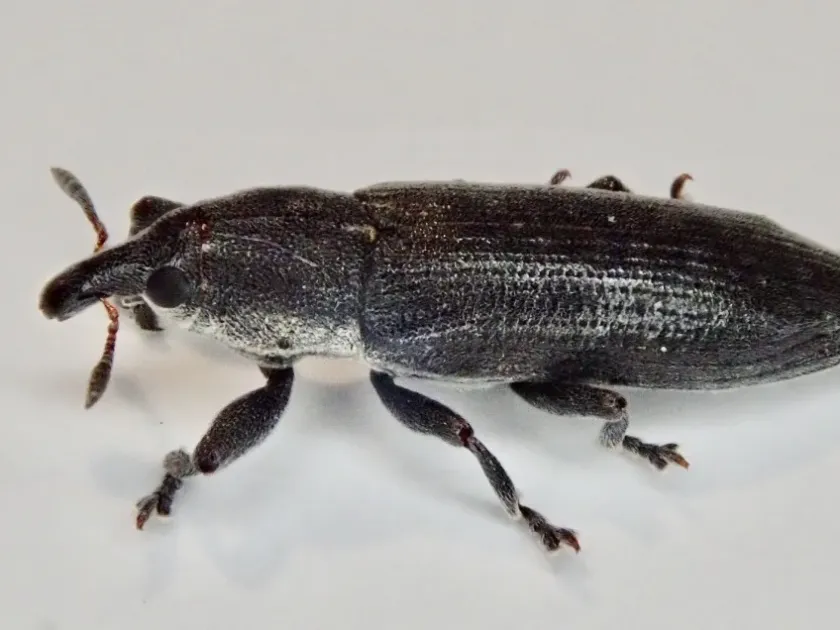
The stem weevil (Lixus scabricollis) is a member of the Curculionidae family within the order Coleoptera. Adult beetles are 12–16 mm long, possessing a cylindrical body covered with a characteristic greyish-brown powdery bloom.
The rostrum is of medium length and slightly curved. The larvae are legless, cream-colored with a yellow head, specifically adapted for survival within the internal tissues of the host plant.
Adults hibernate in the soil or under crop residues, emerging in the spring when temperatures consistently rise. Their activity period is closely linked to the development of early leaf stages in host plants.
Females lay eggs directly into the plant stalks, providing both food and protection for the developing larvae. This internal habitat makes them difficult to target with conventional contact insecticides.
The life cycle encompasses four distinct stages: egg, larva, pupa, and adult. The insect typically completes one generation per year, with pupation occurring inside the damaged stalks.
What it damages
The primary hosts for Lixus scabricollis are plants in the Amaranthaceae family, most notably sugar and fodder beets. Both larvae and adults contribute to the total economic damage.
Larvae feed on the pith of the stalks, creating tunnels that disrupt the transport of water and nutrients. This internal feeding leads to physiological stress and significant loss of biomass.
Adult feeding involves skeletonizing or notching the leaves, which causes aesthetic and minor functional damage, though this is usually less harmful than the larval boring activity.
In seed-producing crops, the damage to flower stalks can lead to premature wilting, breaking of the stalks, and a dramatic reduction in seed quality and yield quantity.
Severe infestations often cause lodging of the stalks, making mechanical harvesting impossible and resulting in substantial harvest losses for agricultural enterprises.
Signs of infestation
Early-season signs include irregular notches and holes on leaves caused by adult feeding. As the season progresses, visible structural changes occur in the plant stalks.
Exit holes on the surface of the stems indicate where mature adults have emerged. Internally, the stalk is filled with frass (larval excrement), leaving the plant hollow and fragile.
Wilting of entire plants or specific branches in the mid-summer period is a classic sign of internal colonization by Lixus scabricollis larvae.
Bent or broken flower stalks in beet seed fields are highly indicative of weevil damage, often preventing the proper maturation of the seed-bearing parts of the plant.
Careful inspection of the base of the stems may reveal the presence of entry points or the larvae themselves if the stalk is dissected during the active growth phase.
Control measures
Effective management relies on a combination of cultural practices, such as crop rotation, which prevents the build-up of local weevil populations in the soil.
Deep autumn tillage is a crucial control measure, as it disrupts the hibernation sites and destroys pupae that would otherwise emerge as adults the following spring.
Rigorous weed management, particularly focusing on the removal of wild Amaranthaceae species, is essential to deprive the weevil of alternative breeding sites outside the main crop.
Chemical control should be employed only when monitoring reveals that population levels have exceeded the economic threshold, using systemic insecticides applied during the early adult activity phase.
Integrated Pest Management (IPM) strategies, including the use of pheromone or sticky traps, should be used for early detection and to ensure that chemical applications are timely and localized.
Taxonomy
- Latin name
- Lixus scabricollis
- Order
- Coleoptera (beetles)
- Family
- Curculionidae
- EPPO code
- LIXUSC
Discussion
No discussions yet — be the first.