
Beet stem weevil
Lixus rubicundus
Description
How to identify
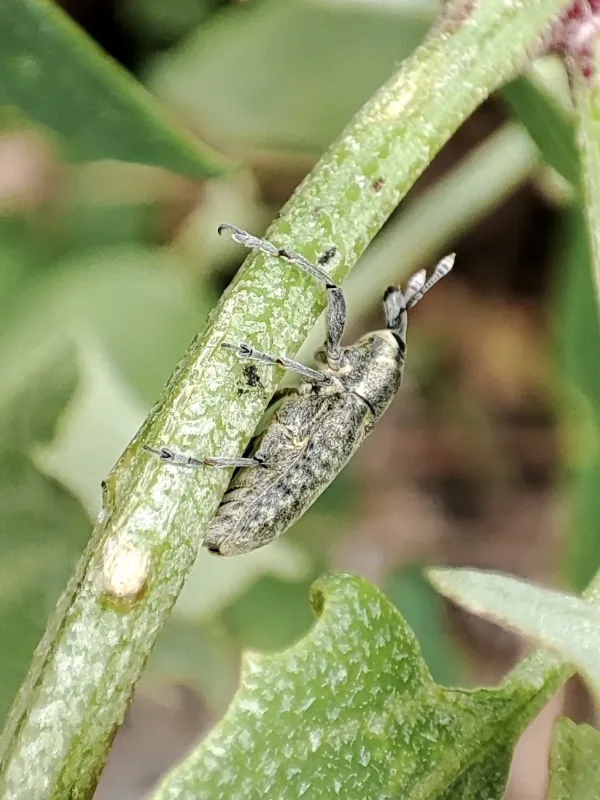
The beet stem weevil (Lixus rubicundus) is a member of the Curculionidae family within the order Coleoptera. Adult beetles are characterized by an elongated body, typically measuring 12–16 mm, covered with dense gray or yellowish-gray scales.
Their snout is long and slightly curved, which is a key morphological feature for this genus. Larvae are legless, dirty-white, with a distinct brown head, reaching up to 20 mm in length when mature.
The life cycle involves four stages: egg, larva, pupa, and adult. There is typically one generation per year, with adults overwintering in the soil or protected debris.
Emerging in early spring, the adults feed on host plant tissues before mating. The cryptic nature of the larvae makes them difficult to detect until significant plant damage has occurred.
Accurate identification is essential for timing interventions, as the window for effective chemical control is often limited to the period before egg-laying.
What it damages
The primary hosts for this pest include sugar beets, fodder beets, and table beets. It also thrives on various weed species belonging to the Amaranthaceae family.
While adults consume leaf tissue, the most severe damage is caused by larvae, which burrow into the central part of the plant stems to feed on internal tissues.
This internal feeding disrupts nutrient and water transport, leading to stunted growth, reduced biomass, and in severe cases, the eventual death of the affected plant.
Plants weakened by larval infestations are highly susceptible to wind breakage and secondary infections, which further reduces the harvestable yield.
Economic losses are significant as the damage affects both the size of the root crop and its quality, impacting sugar content and overall processing utility.
When it appears
Adult beetles emerge from overwintering sites in early spring when soil temperatures reach approximately 8–10 degrees Celsius, matching the emergence of crop seedlings.
The mating and egg-laying period occurs during late spring and early summer. Females carefully place their eggs inside the stems of young, healthy beet plants.
Larval development occurs throughout the summer months, with larvae actively burrowing and feeding within the stem structures until they reach maturity.
Pupation takes place inside the stem, and the new generation of adults emerges towards the end of summer or early autumn to prepare for winter dormancy.
Hot, dry climatic conditions are known to be favorable for the survival and rapid development of the larvae, leading to higher infestation rates in such years.
Signs of infestation
Early symptoms include small, round feeding punctures on the leaves, indicating the presence of active adult beetles in the field.
Evidence of egg-laying can often be found as small brown spots or localized scarring on the stalks, where the female has penetrated the plant tissue.
Stunted growth or wilting of individual leaves, especially during the hottest parts of the day, is a classic sign of internal larval damage to the stem.
Dissecting the stems reveals longitudinal tunnels packed with larval frass, which provides clear confirmation of the pest's presence and activity.
In cases of heavy infestation, plants may show abnormal curvature or brittleness, and the entire stem structure may collapse during strong winds.
Control measures
Implementing a robust crop rotation strategy is the primary cultural practice to minimize the risk of infestation by limiting the presence of suitable hosts.
Deep autumn plowing of the fields is highly effective in disrupting the overwintering cycle and reducing the survival rate of adult beetles in the soil.
Consistent management and removal of weed reservoirs, particularly those from the Amaranthaceae family, help to reduce the overall pest population in the landscape.
Chemical control involving systemic insecticides is recommended when population thresholds are exceeded, as these products penetrate the plant to kill internal larvae.
Seed treatment with high-quality systemic insecticides provides crucial protection for young seedlings, preventing early-season damage and ensuring optimal plant establishment.
Taxonomy
- Latin name
- Lixus rubicundus
- Order
- Coleoptera (beetles)
- Family
- Curculionidae
- EPPO code
- LIXUFL
Discussion
No discussions yet — be the first.