
Chenopodium weevil
Lixus mucidus
Description
How to identify
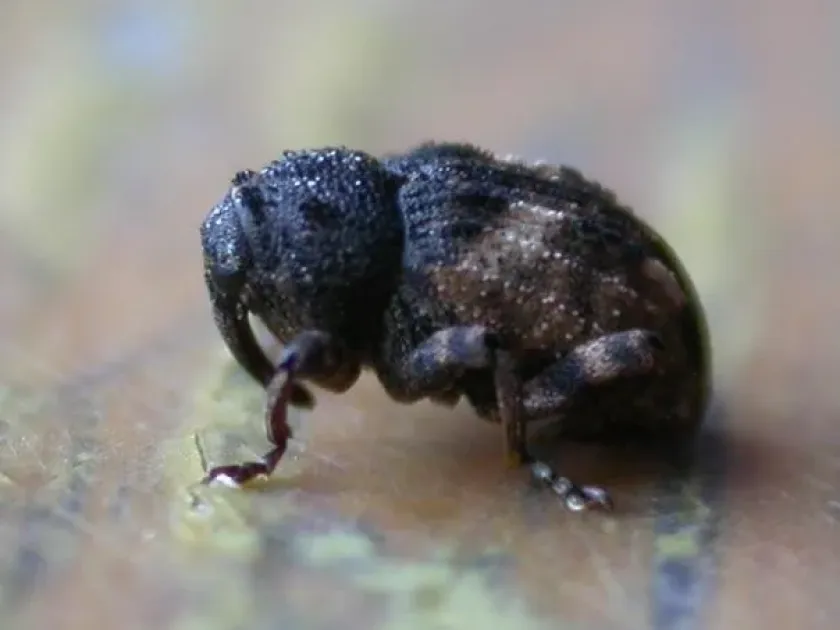
The Chenopodium weevil (Lixus mucidus) belongs to the order Coleoptera and the family Curculionidae. The adult beetle features an elongated body, reaching 15–20 mm in length, and is covered with a dense coating that gives it a greyish-yellow appearance.
The insect possesses a long, slightly curved rostrum, which is a key morphological characteristic of the genus Lixus. Its eyes are oval, and the pronotum is narrower than the elytra, featuring a distinct longitudinal groove.
The larvae are typical for weevils: legless, white-colored with a yellowish head. Their bodies are strongly curved and covered with sparse hairs, perfectly adapted for a life inside plant tissues.
The pupa is free and usually develops within a chamber constructed by the larva in the lower part of the plant stem just before pupation occurs.
The life cycle is closely linked to weeds of the Chenopodiaceae family, which act as primary host plants during the early stages of the insect's development.
What it damages
The primary crops affected by this pest include various species from the Amaranthaceae family, most notably sugar beet, garden beet, and fodder beet.
Beyond cultivated fields, the pest actively colonizes wild plants like lamb's quarters (Chenopodium) and amaranth, which serve as reservoirs throughout the growing season.
Adult beetles feed primarily on the leaves, consuming small holes or gnawing the edges of the leaf blades, which reduces the total photosynthetic area of the crop.
Larvae cause significantly more severe damage by boring into the stems and taproots, creating galleries that disrupt nutrient transport and impede normal plant development.
Extensive larval feeding can lead to plant deformation, reduced sugar content in the roots, and significant overall yield losses in infested fields.
When it appears
Adults overwinter in plant debris, under soil clods, or within the root zone of perennial weeds, providing them with shelter against harsh weather conditions.
In spring, once temperatures remain consistently favorable (typically in April or May), the beetles emerge to feed on wild hosts and young crop sprouts.
The egg-laying period is extended, occurring throughout the late spring and first half of the summer, as females bore holes into host stems to deposit eggs.
Larvae develop throughout the summer, passing through several instars while remaining safely protected inside the plant stems from external environmental pressures.
Pupation occurs in August or September, after which the new generation of adults emerges to feed briefly before seeking shelter for the winter months.
Signs of infestation
Initial signs of infestation often include small holes or notched leaf edges, which are frequently overlooked by growers during routine field scouting.
Larval activity is often indicated by the wilting of specific stems or entire plants during the hottest hours of the day, resulting from vascular system damage.
Upon closer inspection, one may find small entrance holes on the stems, often surrounded by darkened tissue caused by larval feeding and secondary infections.
- Internal galleries within stems filled with larval excrement.
- Stunted plant growth compared to healthy neighboring crops.
- Premature yellowing and desiccation of the lower rosette leaves.
Upon completing their development, adult beetles create clearly visible circular holes as they exit the stems or the crown of the root crop.
Control measures
The primary control strategy involves agricultural practices, specifically the diligent removal and destruction of Chenopodiaceae weeds in and around fields.
Deep autumn plowing after harvest is an effective mechanical measure to bury and destroy overwintering adults remaining in the soil or crop residues.
Strict crop rotation, avoiding the continuous cultivation of beets on the same plot, helps significantly in reducing local population buildup.
Chemical control using systemic insecticides is most effective during the initial mass emergence of adults in spring, before they have a chance to lay eggs.
Regular field monitoring using pheromone traps or systematic scouting allows for timely decision-making and precise application of protective treatments.
Taxonomy
- Latin name
- Lixus mucidus
- Order
- Coleoptera (beetles)
- Family
- Curculionidae
- EPPO code
- LIXUMU
Discussion
No discussions yet — be the first.