
Beet Stem Weevil
Lixus latro
Description
How to identify
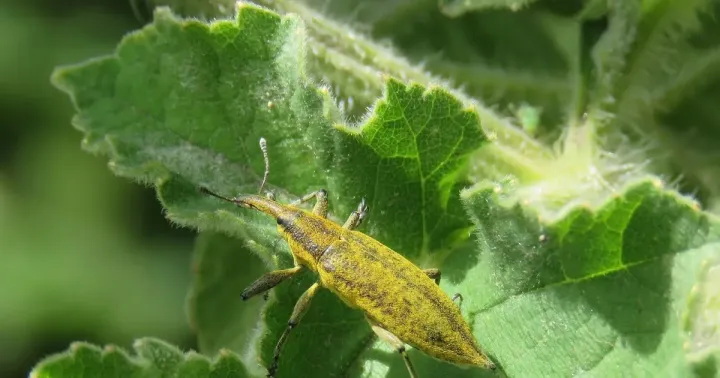
The beet stem weevil (Lixus latro) belongs to the order Coleoptera and the family Curculionidae. The adult weevil has an elongated body, typically measuring between 12 and 18 mm, and is covered with a fine, powdery coating that gives it a greyish or yellowish-brown appearance.
A distinctive feature of this species is its long, slightly curved rostrum (snout), which is roughly equal in length to the pronotum. The eyes are slightly convex, and the elytra feature distinct longitudinal grooves, which are key characteristics for professional entomological identification in the field.
The larva of the beet stem weevil is legless, white to yellowish-white in color, with a brown head capsule. Its body is slightly curved and segmented with sparse, short hairs, a typical morphology for Lixus larvae that develop endophytically within plant tissues.
The life cycle includes a complete metamorphosis: egg, larva, pupa, and adult (imago). Each stage is highly adapted to its environment, ensuring the species can survive across different seasons and weather conditions.
Adults primarily overwinter in the topsoil layer or under dense plant debris, exhibiting significant cold tolerance, which allows them to emerge as soon as spring temperatures begin to rise.
What it damages
The beet stem weevil primarily targets plants within the Chenopodiaceae family, most notably sugar beet, fodder beet, and red beet. It may also utilize various weeds as secondary hosts, facilitating its survival in the absence of primary crops.
Both adults and larvae inflict damage. While adults feed on leaves and petioles by chewing small holes, the most severe damage is caused by larvae feeding internally within the stems and the upper crown area of the root crop.
Females create punctures in the plant stem to deposit eggs, which physically disrupts the plant's vascular system. Upon hatching, the larvae tunnel into the petioles and stems, significantly impeding nutrient transport and inhibiting overall plant growth.
Severe infestations lead to the deformation and premature wilting of the leaves, reducing the plant's photosynthetic surface. This directly results in lower root yields and decreased sugar accumulation, leading to significant economic losses.
In high-density populations, the cumulative effect of larval tunneling can lead to the total collapse of plants or provide entry points for secondary fungal and bacterial pathogens, exacerbating the damage to the harvest.
When it appears
Overwintered adults typically emerge in the spring, usually between late April and May, coinciding with the seedling stage of beet plants. This is the period when they are most active and visible on the leaf surfaces.
Mating and oviposition are spread over a significant timeframe, depending heavily on the prevailing weather. Favorable development occurs during periods of warm, moderately humid weather, which encourages both adult feeding and successful larval colonization.
Larval development occurs throughout the summer months as they feed internally. The intensity of internal feeding is generally highest during the mid-summer period when the plants are at their peak vegetative growth.
Pupation takes place inside the larval tunnels within the stem or the crown. New adults emerge from late summer, typically July or August, and feed briefly before beginning their migration toward overwintering sites.
Migration to overwintering sites occurs in autumn as temperatures drop and the food supply becomes scarce. The adults then enter a period of diapause, burying themselves in soil or hiding under protective plant residue until the following spring.
Signs of infestation
Presence of the pest can be detected by identifying characteristic punctures on the petioles, often surrounded by larval frass (excrement). These petioles may look pinched, withered, or show localized brown discoloration.
Dissecting the petiole or the upper root crown will reveal longitudinal tunnels filled with brown larval excrement. Finding these tunnels is the most reliable evidence of a Lixus latro infestation.
Externally, the plants often appear stunted, with foliage wilting during the hottest parts of the day. Severe stem damage may cause the plant to lean or develop abnormal lateral shoots as the main growth point is compromised.
- Wilting and yellowing of individual leaves.
- Visible necrotic spots and holes on leaf petioles.
- Exit holes on the stem surface where adults emerged.
- Reduced plant density due to the loss of severely compromised seedlings.
Because the larvae weaken the plant's structural integrity and immune defenses, secondary root rots frequently develop, which can sometimes lead to misdiagnosis where the primary pest activity is overlooked.
Control measures
Effective management begins with robust cultural practices, primarily strict crop rotation (avoiding beets on the same plot for at least 3-4 years) and maintaining spatial isolation from previous years' fields.
Deep autumn plowing is a critical mechanical control method, as it exposes overwintering adults to surface conditions, drastically increasing their mortality rate due to temperature fluctuations and natural predation.
Chemical intervention involves the use of systemic insecticides. The most efficient timing is early in the season, during the mass emergence of adults but prior to the female's egg-laying, to prevent the larvae from entering the plant tissues.
Monitoring population levels through field inspections and the use of pheromone or visual traps is essential to determine the economic injury level and ensure that chemical control measures are applied only when necessary.
When selecting insecticides, preference should be given to products with long-lasting systemic activity, as internal-feeding larvae are generally shielded from contact-based pesticides, making systemic coverage vital for success.
Taxonomy
- Latin name
- Lixus latro
- Order
- Coleoptera (beetles)
- Family
- Curculionidae
- EPPO code
- LIXULA
Discussion
No discussions yet — be the first.