
Rhubarb curculio
Lixus concavus
Description
How to identify
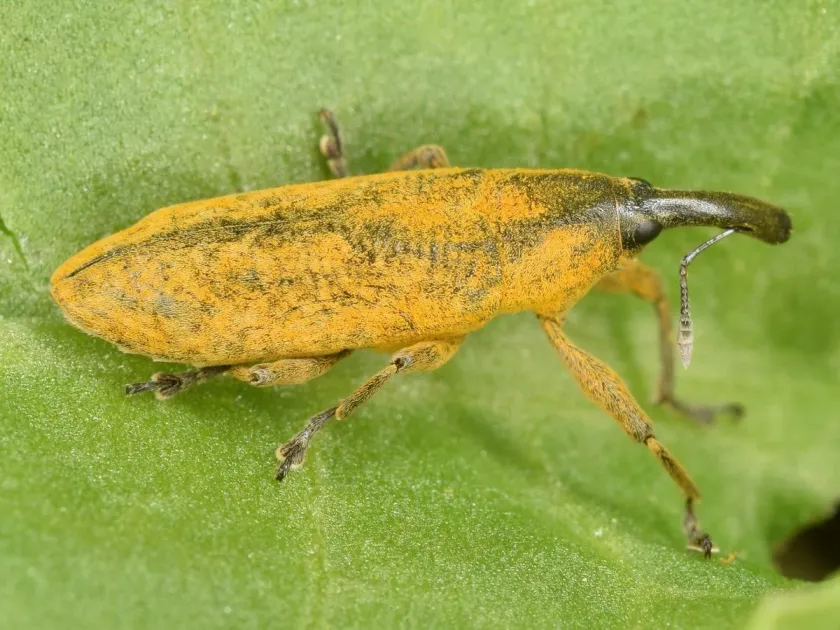
The Rhubarb curculio (Lixus concavus) is a member of the Curculionidae family, commonly known as snout beetles. Adults are roughly 10–13 mm long and possess a distinctive elongated, downward-curved snout, which is a hallmark of this genus.
The body of the adult beetle is covered in a fine, dust-like coating that ranges from grey to yellowish-brown, providing excellent camouflage against soil and plant debris. This dusty appearance often makes them difficult to detect during casual garden inspections.
The larvae are legless, C-shaped grubs with creamy-white bodies and prominent brown head capsules. They are specifically adapted to living and feeding within the structural tissues of plants, shielded from the external environment.
The lifecycle consists of four stages: egg, larva, pupa, and adult. Adult beetles overwinter in sheltered locations, such as plant debris, leaf litter, or loose soil, emerging in the spring once temperatures reach optimal levels for activity.
Identification often involves checking the base of plants for the characteristic snout beetle shape and monitoring for the specific feeding damage they leave behind, especially during late spring.
What it damages
As the name suggests, the Rhubarb curculio primarily targets rhubarb. However, it also feeds on other members of the Polygonaceae family, including various types of dock and sorrel, and occasionally on sunflowers, utilizing these plants as alternative hosts.
Adult beetles cause damage by feeding on the epidermis of stems and petioles. These small feeding punctures can lead to aesthetic damage and weakened structural integrity of the affected plant parts, reducing overall plant vigor.
Larval damage is far more severe, as they bore into the stalks to feed on the internal tissues. This tunneling activity disrupts the plant's vascular system, preventing the effective transport of water and nutrients throughout the stem.
Structural damage caused by tunneling often results in the stalks becoming hollowed out and brittle. Such stalks are highly prone to snapping under the weight of leaves or from wind, rendering them useless for culinary purposes.
Furthermore, the tunnels created by the larvae serve as entry points for various pathogens. Fungal and bacterial infections often thrive in these damaged tissues, leading to rot and potentially causing the entire plant to collapse or die.
Signs of infestation
The most reliable sign of an infestation is the presence of distinct feeding or egg-laying punctures on the stems. These punctures are often roughly circular and may be accompanied by a localized darkening of the plant tissue.
Exudation of plant sap, often described as "bleeding," at the site of the puncture is a clear indicator of insect activity. The sap often hardens near the hole, signaling that a larva is currently developing inside the stalk.
Affected plants often display signs of stress, such as yellowing, wilting, or a stunted growth habit. Because the vascular system is interrupted, the plant may wilt even when soil moisture levels are otherwise adequate.
Inspection of the stalk interior usually reveals frass (insect excrement), which looks like a brownish, sawdust-like material. This is a definitive sign that larvae have been actively hollowing out the stalk's interior.
- Circular punctures on stalks and petioles.
- Sap bleeding and hardening at puncture sites.
- Yellowing foliage and drooping stems.
- Brittleness leading to stalks snapping off.
- Presence of brownish frass inside stems.
Control measures
The most effective management strategy involves thorough sanitation. Removing and destroying all infested stalks and clearing away plant debris at the end of the season drastically reduces the available overwintering sites for the adults.
Cultivation practices such as deep hoeing or tilling the soil around the base of rhubarb plants can help expose overwintering beetles to environmental stressors, thereby reducing the population density for the upcoming year.
Hand-picking adults when they appear in the spring is a viable option for small garden patches. Consistent monitoring allows for the early detection and manual removal of beetles before they have a chance to lay eggs.
If chemical control is necessary, systemic insecticides are generally required to reach larvae protected within the stem tissue. Always follow label instructions and observe required pre-harvest intervals to ensure food safety.
Crop rotation and avoiding planting susceptible species in the same location for prolonged periods are essential preventive measures. This minimizes the build-up of larval populations in the soil and promotes a healthier garden ecosystem.
Taxonomy
- Latin name
- Lixus concavus
- Order
- Coleoptera (beetles)
- Family
- Curculionidae
- EPPO code
- LIXUCO
Discussion
No discussions yet — be the first.