
Beet curculio
Lixus brevirostris
Description
How to identify
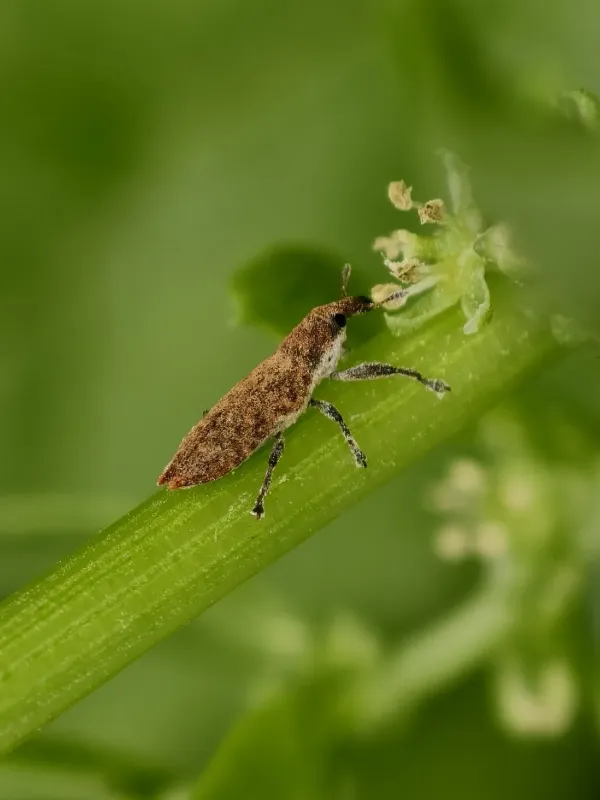
The beet curculio (Lixus brevirostris) belongs to the Curculionidae family of beetles. Adult individuals typically reach 10–15 mm in length and feature an elongated body covered in fine greyish-yellow scales.
Its most distinguishing characteristic is a relatively short rostrum compared to other members of the Lixus genus. The elytra are punctate, providing a distinct texture that helps in camouflaging the beetle on host plants.
Larvae are legless, C-shaped, and creamy white with a dark head capsule. Their development occurs exclusively within the plant tissues, making them elusive for most of their juvenile life cycle.
Adult beetles are highly mobile in sunny conditions but exhibit a defensive behavior of dropping to the ground and feigning death, which makes detection during field inspections quite challenging.
The biology of this species is intricately linked to the Chenopodiaceae family, meaning its lifecycle timing often mirrors the physiological development of the sugar beet crop.
What it damages
The beet curculio feeds primarily on plants in the Chenopodiaceae family, with sugar beet, fodder beet, and table beet being the most economically significant hosts for this insect.
Adults consume foliage, causing irregular holes in the leaves. Severe infestations can lead to substantial defoliation, which reduces the plant's photosynthetic capacity and slows overall biomass accumulation.
Larvae feed internally by boring tunnels into leaf petioles or the upper section of the root. This activity disrupts the transport of water and nutrients, severely weakening the plant.
Root damage leads to reduced crop quality, and the tunnels created by larvae often serve as entry points for pathogens, potentially resulting in soft rots and secondary infections.
The cumulative economic impact includes reduced root weight and lower sugar content, which directly affects the profitability of sugar beet production and industrial processing efficiency.
When it appears
Overwintering adults emerge in the spring once temperatures are sufficient to sustain their activity, usually coinciding with the emergence of young beet plants.
The peak feeding and mating period for adults typically occurs throughout May and June, as they prepare for egg-laying by scouting for suitable host plant stems and petioles.
Larval development takes place during the summer months. Throughout this stage, the larvae remain protected inside the plant tissue, which limits the effectiveness of topical insecticide applications.
Pupation occurs within the plant tissues, providing a sheltered environment for the insect to complete its transformation before the next generation of adults emerges.
New adults emerge late in the summer or early autumn. These individuals prepare for the coming winter by seeking shelter in soil crevices or under dense plant residue.
Signs of infestation
The initial signs of infestation are recognizable by the presence of irregular chewing marks or holes on the beet leaves, often concentrated along the margins of the leaf blades.
Inspecting the base of the petioles and the crown of the beet often reveals entry holes created by females during oviposition, as well as accumulated larval frass near these spots.
Unexplained wilting of specific leaves or individual plants, despite adequate soil moisture, is a strong indicator of internal damage to the vascular system caused by feeding larvae.
Deformation of the root neck and the presence of necrotic spots are definitive signs of advanced larval burrowing, indicating that the infestation has reached a severe level.
Early morning surveys are the best method for detecting adult presence, as the beetles are less active and more likely to be found resting on the foliage or the soil surface.
Control measures
Effective management begins with aggressive weed control, specifically targeting Chenopodiaceae weeds like lamb's-quarters that serve as alternate hosts and infestation reservoirs.
Crop rotation is a fundamental practice; avoiding consecutive years of sugar beet cultivation in the same plot is essential to break the insect's life cycle and reduce populations.
Deep autumn plowing helps disturb overwintering habitats, exposing larvae and pupae to predators and environmental conditions that significantly decrease survival rates.
Chemical control with systemic insecticides should be considered if monitoring indicates that populations have exceeded the economic threshold, ensuring proper timing for maximum impact.
Integrated Pest Management (IPM) strategies, including pheromone traps and regular field scouting, are crucial for making informed decisions on when and how to apply protective measures.
Taxonomy
- Latin name
- Lixus brevirostris
- Order
- Coleoptera (beetles)
- Family
- Curculionidae
- EPPO code
- LIXUBR
Discussion
No discussions yet — be the first.