
Burdock weevil
Lixus bardanae
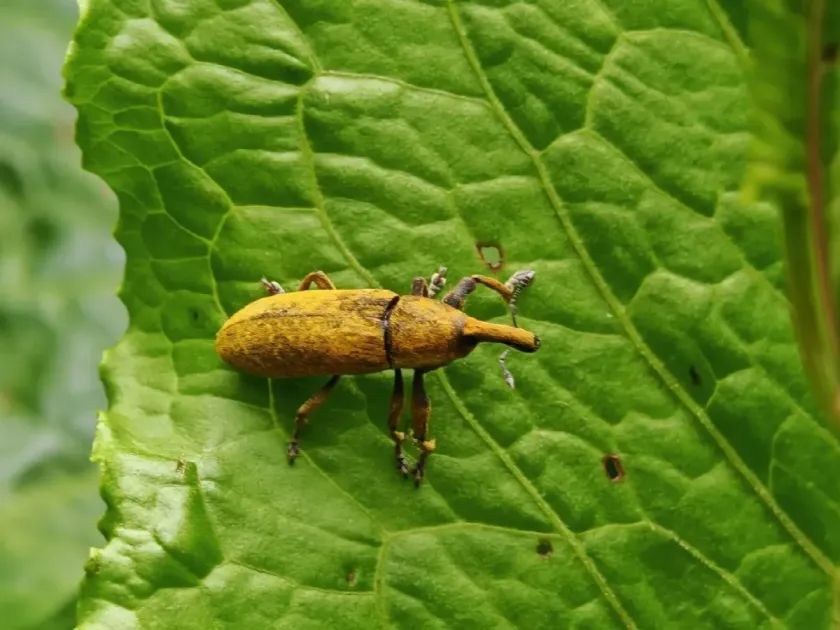
Description
How to identify
The burdock weevil (Lixus bardanae) is a species of beetle belonging to the Curculionidae family, commonly found across Europe and parts of Asia.
Adult weevils are characterized by their elongated bodies, usually measuring between 10 to 15 millimeters, with a distinctive long, curved snout or rostrum.
Their coloration typically consists of muted grey or brown tones, often covered in a fine, dusty pubescence that provides excellent camouflage on their host plants.
The larvae are legless, white-colored grubs with a well-developed head capsule, perfectly adapted for a concealed lifestyle within plant stems.
Recognition of this pest is primarily based on the presence of the adults on host plants during spring or the observation of larval galleries inside stems.
What it damages
This pest mainly targets plants within the Asteraceae and Polygonaceae families, with rhubarb and wild burdock being among the most common hosts.
Damage is inflicted by both adults, which feed on leaves and petioles, and larvae, which tunnel through the inner tissues of the stem or stalk.
The larvae are considered the most destructive stage, as their internal feeding disrupts the plant's vascular system, hindering the transport of water and nutrients.
This internal tunneling leads to structural weakness in the stems, making the plants prone to breaking under wind pressure or heavy foliage.
Severe infestations often result in stunted growth, premature wilting, and in some cases, the total loss of the flower stalk or commercial harvest.
When it appears
Adult weevils emerge from their overwintering sites in the spring as soon as temperatures rise, signaling the start of their active feeding and mating period.
Egg-laying typically takes place from late spring through early summer, coinciding with the rapid vegetative growth phase of host plants.
The larval stage lasts throughout the summer months, with the larvae progressively consuming the pith of the stem as they reach maturity.
Pupation occurs in late summer or early autumn inside the plant tissue, marking the final stage of the development cycle before the next generation emerges.
Adults of the new generation enter diapause in the fall, seeking shelter in soil debris or under organic matter to survive the winter season.
Signs of infestation
Visible signs of infestation often include small puncture holes on the stem or petiole where the female has deposited eggs.
Plants may show symptoms of poor health, including yellowing leaves, drooping, or localized distortions and swellings along the stems.
Upon closer inspection, the interior of the stem may reveal the presence of tunnels and frass, which are clear indicators of larval activity.
During the early season, adults can often be found resting on the undersides of leaves or near the base of the plant during the cooler parts of the day.
- Puncture marks on stems.
- Wilting or yellowing of the foliage.
- Deformation of the main stalks.
- Presence of larvae upon dissection of damaged stems.
Control measures
The most effective management strategy involves rigorous field sanitation, including the removal and destruction of wild host plants like burdock.
Cultural practices, such as deep plowing in the autumn, help to disrupt the wintering sites of the weevil, reducing the population for the following year.
Crop rotation is recommended to prevent the buildup of pest populations, particularly in fields dedicated to susceptible crops like rhubarb.
In cases of high infestation, chemical control using approved systemic insecticides may be necessary to target adults before they can lay eggs.
Constant monitoring of the field is crucial; early detection allows for the removal of infested stalks, preventing the larvae from completing their life cycle.
Taxonomy
- Latin name
- Lixus bardanae
- Order
- Coleoptera (beetles)
- Family
- Curculionidae
- EPPO code
- LIXUBA
Discussion
No discussions yet — be the first.