
Beet stem weevil
Lixus ascanii
Description
How to identify
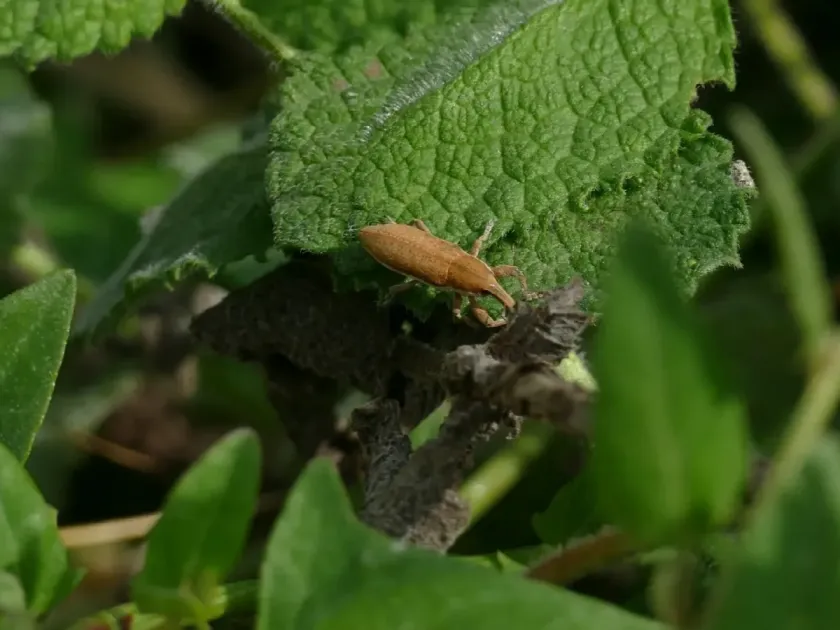
The Beet stem weevil (Lixus ascanii) is a coleopteran insect belonging to the Curculionidae family. Adult beetles reach 12–16 mm in length and are easily recognized by their elongated shape.
The body is covered in dense yellowish-gray or whitish scales, giving the insect a matte appearance. The head possesses a long, slightly curved rostrum used for feeding and egg-laying.
Larvae are legless, slightly curved, and white in color with a dark brown head capsule. They spend their entire developmental cycle hidden inside the host plant tissues.
These insects overwinter as adults, primarily in the soil or under plant debris near the edges of fields or in sheltered, undisturbed areas.
With the return of warm spring weather, adult weevils emerge from hibernation to begin their search for suitable host plants.
What it damages
The Beet stem weevil primarily affects crops in the Amaranthaceae family, with a strong preference for sugar beets, fodder beets, and Swiss chard.
Adults cause superficial damage by feeding on the edges of leaves, which typically does not lead to significant yield loss unless the population density is extreme.
The real damage is caused by the larvae, which tunnel into the petioles and stems of the beet plants, disrupting the transport of water and nutrients.
This internal damage weakens the plant structure, causing leaves to droop or break off under windy conditions or mechanical stress.
Extensive larval tunneling often leads to secondary infections and a reduction in the overall sugar content and weight of the root crop.
When it appears
Adult migration and mating typically occur in May and June. Females create small, distinct holes in the petioles where they deposit individual eggs.
Larvae hatch after about 8–10 days and immediately begin boring into the inner stem tissue to feed on the parenchyma.
The larval stage lasts for several weeks, during which the insects continue to tunnel through the stem, eventually creating a pupal chamber near the end of the summer.
New adults emerge from these chambers in late summer, feed for a short period on leaves, and then migrate to their overwintering sites.
The life cycle is univoltine, meaning there is usually only one generation produced per year in most temperate regions.
Signs of infestation
The earliest sign of an infestation is the presence of small, characteristic feeding scars on the edges of the leaves caused by adult beetles.
Dark, discolored spots on the petioles indicate sites where eggs were deposited by female weevils, often leading to slight swelling or deformation.
A sudden wilting of the leaves, despite adequate soil moisture, suggests that the stem or petiole integrity has been compromised by larval activity.
Upon splitting the petiole, one can observe internal galleries filled with fine, brown frass (larval excrement), which is the definitive sign of an infestation.
Premature leaf drop and stunted growth of the beet foliage are common symptoms observed in heavily infested fields during mid-summer.
Control measures
Effective management begins with thorough autumn tillage, which disturbs the soil and exposes overwintering adults to adverse weather conditions and predators.
Strict weed control, specifically targeting weeds such as lambsquarters, is essential to remove alternative food sources that support the weevil population.
Crop rotation practices should be implemented to ensure that new sugar beet fields are not planted adjacent to the previous year's infested sites.
Chemical control is most effective when timed with the emergence of adult weevils, targeting them before they have the opportunity to lay eggs.
Integrated Pest Management (IPM) programs often utilize regular scouting to monitor beetle counts and apply insecticides only when economic thresholds are exceeded.
Taxonomy
- Latin name
- Lixus ascanii
- Order
- Coleoptera (beetles)
- Family
- Curculionidae
- EPPO code
- LIXUAS
Discussion
No discussions yet — be the first.