
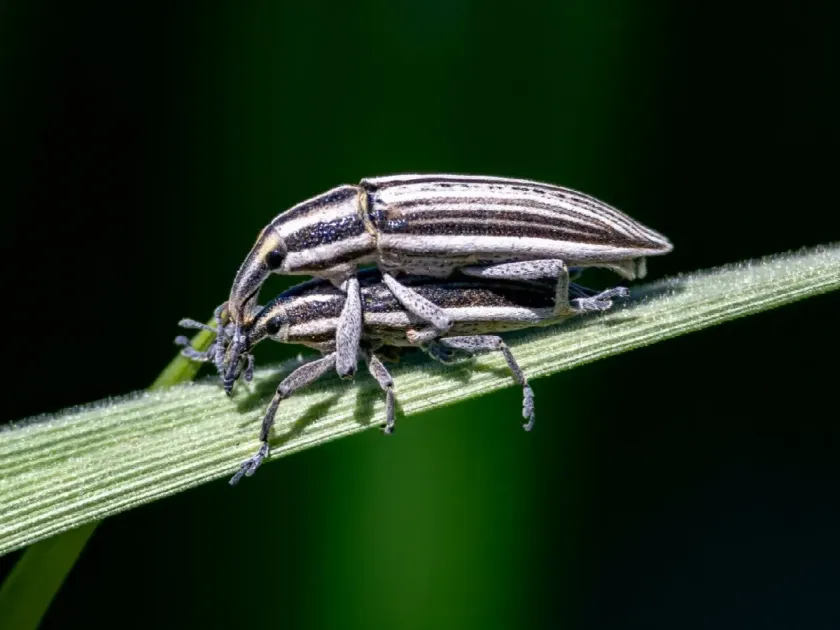
Snake weevil
Lixus anguinus
Description
How to identify
The snake weevil (Lixus anguinus) belongs to the Curculionidae family. Adult beetles have an elongated, cylindrical body, typically measuring 12–16 mm, often covered in a fine yellowish or greyish dust.
These insects possess a long, slightly curved rostrum used for feeding on plant tissues and creating oviposition sites. The larvae are legless, white-colored with a brown head, and spend their entire development cycle hidden within the plant stem.
The life cycle consists of egg, larva, pupa, and adult stages. They typically complete one generation per year, with adults overwintering in soil or under plant debris near host fields.
Identification is challenging due to the hidden nature of the larvae. Field scouting for adults requires close inspection of stems during the early morning or evening when they are more active.
The species is taxonomically grouped within the subfamily Lixinae, known for various stem-boring species that target wild and cultivated flora across temperate regions.
What it damages
The primary hosts for this pest include plants of the Brassicaceae family, particularly rapeseed (canola), mustard, and wild cruciferous weeds found near agricultural lands.
Larvae cause direct damage by tunneling through the interior of the stems, which disrupts the transport of water and nutrients, leading to physiological stress in the host plant.
The mechanical damage to the stem tissue often results in lodging, premature senescence, and overall yield loss due to poor grain filling and reduced green mass vigor.
Adult beetles also inflict damage by feeding on young stems and leaf petioles, creating small punctures that can serve as entry points for secondary fungal and bacterial infections.
Economic damage is most severe when infestation occurs at the early stem elongation stage, hindering the plant's ability to reach full development potential.
When it appears
Overwintered adults emerge in early spring, usually coinciding with the onset of favorable temperatures and the initiation of spring vegetation for cruciferous crops.
The period of mating and oviposition occurs during the rapid growth phase of the plant. Female beetles deposit eggs into the stems, and larvae hatch soon after to begin boring.
Pupation typically occurs within the stem during the mid-to-late summer months, following the larval feeding period that hollows out the stem interior.
New adults emerge by late summer, feed briefly, and then migrate toward overwintering sites in the soil or leaf litter as autumn approaches.
Monitoring should be most intense during the transition from the rosette stage to stem elongation, which is when crops are most vulnerable to initial egg-laying.
Signs of infestation
The first signs of infestation are small, circular or oval punctures on the stems, which represent the feeding sites or oviposition wounds made by the adult females.
External signs include localized wilting or stunting of the stems. Plants may appear bent or deformed compared to the surrounding healthy crop canopy.
Dissecting a stem often reveals longitudinal galleries filled with larval frass, confirming the presence of the snake weevil larvae rather than other stem-boring pests.
In later stages of the season, exit holes may appear on the stems where the new generation of adult weevils has emerged to move to wintering grounds.
Visible stress on specific plants, such as yellowing or uneven maturity of seeds, can serve as a strong indicator that the stem has been compromised by internal feeding.
Control measures
The most effective management strategy is crop rotation, which breaks the pest's cycle by distancing host crops from previously infested fields for several years.
Good agricultural practices, such as the destruction of volunteer rapeseed plants and wild cruciferous weeds, are essential to minimize local population reservoirs.
Chemical control involving systemic insecticides is recommended if monitoring reveals that the adult population has reached economic injury levels during the migration phase.
Maintaining soil fertility and ensuring optimal planting density promotes robust plant growth, allowing crops to withstand minor larval pressure with minimal yield loss.
- Deep autumn plowing to disturb overwintering larvae in the soil.
- Strict adherence to spatial isolation of Brassica fields.
- Using sticky yellow traps for early monitoring of adult activity.
- Removing crop residues promptly after harvest to reduce habitat.
Taxonomy
- Latin name
- Lixus anguinus
- Order
- Coleoptera (beetles)
- Family
- Curculionidae
- EPPO code
- LIXUAN
Discussion
No discussions yet — be the first.