
Lixus algirus
Lixus algirus
Description
How to identify
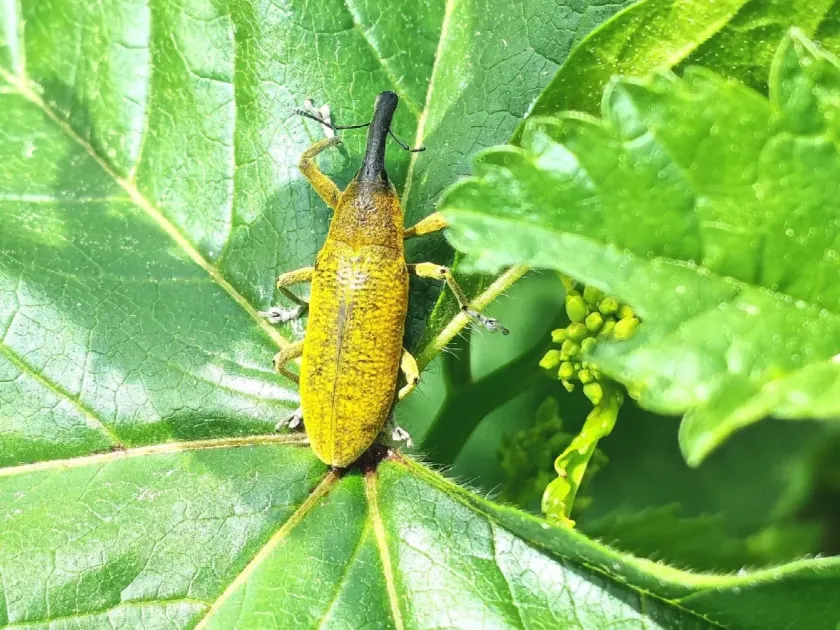
Lixus algirus is a species of weevil (family Curculionidae) within the order Coleoptera. Adult specimens feature an elongated body measuring 12 to 18 mm, which is covered in dense grey or yellowish-grey scales.
A distinctive characteristic of this beetle is its long, slightly curved snout, which it uses for feeding and depositing eggs into the plant stems. The elytra fit closely to the body and exhibit faint longitudinal grooves.
The larva is apodous (legless), cream-colored, and possesses a dark head capsule. It develops exclusively inside the stems of affected plants, making it largely inaccessible to many conventional contact insecticides.
The pupal stage occurs within the stem, after which the adult beetle emerges by boring an exit hole. The external appearance of the imago can vary depending on the density of the scale covering, which serves as camouflage.
Adult beetles are secretive and prefer to move along stems or hide in leaf axils, making them difficult to detect during routine crop inspections without implementing specific monitoring protocols.
What it damages
Lixus algirus primarily targets members of the Malvaceae, Fabaceae, and Linaceae families. It causes the most significant economic damage to flax crops, although it can also affect various wild and cultivated plant species.
Adult beetles feed on the epidermis of young shoots, creating small pits that weaken the plant's overall vigor. However, the larval stage, which develops within the pith of the stem, poses the greatest threat.
Upon hatching, larvae bore galleries within the stem, feeding on internal tissues and vascular systems. This disruption impairs the transport of nutrients and water to the upper parts of the plant.
Mass infestations lead to stunted growth, stem deformation, and thickening at the site of larval activity. Severely affected plants often lodge or dry out prematurely before reaching technical maturity.
The pest can significantly degrade fiber quality in flax and cause seed shriveling. The compromised stem integrity also creates entry points for secondary pathogens, such as fungi and bacteria, leading to further decay.
When it appears
The emergence of overwintering beetles usually begins in spring when average daily temperatures reach consistent positive levels. The active migration phase onto crops coincides with the start of vegetative growth in host plants.
The mating and oviposition period is extended, often occurring during the budding and early flowering phases of the host crops. Females bore into the stem to deposit one or more eggs.
Larval development occurs throughout the summer months while the plant is actively accumulating vegetative mass. This is when the pest remains most hidden from external environmental pressures.
Pupation typically takes place at the end of summer or early autumn, directly within the stem of the host plant. The new generation of adult beetles then emerges to move towards overwintering sites.
The pest primarily overwinters as an adult in the soil, under plant debris, or within bark crevices, exhibiting high tolerance to cold temperatures through a state of diapause.
Signs of infestation
The earliest signs of infestation are small lesions or punctures on the stems caused by adult feeding. These marks become visible upon careful visual inspection of the lower part of the plant.
Gradual wilting of the plant tops, particularly during hot midday hours, signals that internal vascular integrity has been disrupted by larval activity within the stem.
Local stem swelling or bulging is frequently observed where larval clusters develop; these areas may eventually crack. Cutting open these sections usually reveals the larva or its frass.
General yellowing and premature desiccation of plants, whether occurring singly or in groups, indicate a critical level of infestation where the plant can no longer sustain healthy development.
The presence of small, circular holes on the stem surface at the end of the season confirms that the life cycle has been completed and the new generation of adults has emerged.
Control measures
Agronomic practices form the foundation of Lixus algirus population management. Maintaining proper crop rotation and spatial isolation from fields where susceptible crops were grown in previous years is essential.
Thorough eradication of weeds from the Malvaceae and Fabaceae families, which act as secondary reservoirs for the pest, significantly lowers the potential infestation pressure on the fields.
Deep autumn plowing helps destroy a significant portion of the overwintering beetle population by burying them at depths from which they cannot emerge in the spring.
Chemical control is justified during periods of mass adult migration before egg-laying commences. Systemic or contact-stomach insecticides registered for use on specific crops should be employed.
Monitoring pest density using yellow sticky traps or visual counts on sample plots allows for timely decision-making regarding insecticide applications, thereby minimizing potential yield losses.
Taxonomy
- Latin name
- Lixus algirus
- Order
- Coleoptera (beetles)
- Family
- Curculionidae
- EPPO code
- LIXUAL
Discussion
No discussions yet — be the first.