
Lixus weevil
Lixus
Description
How to identify
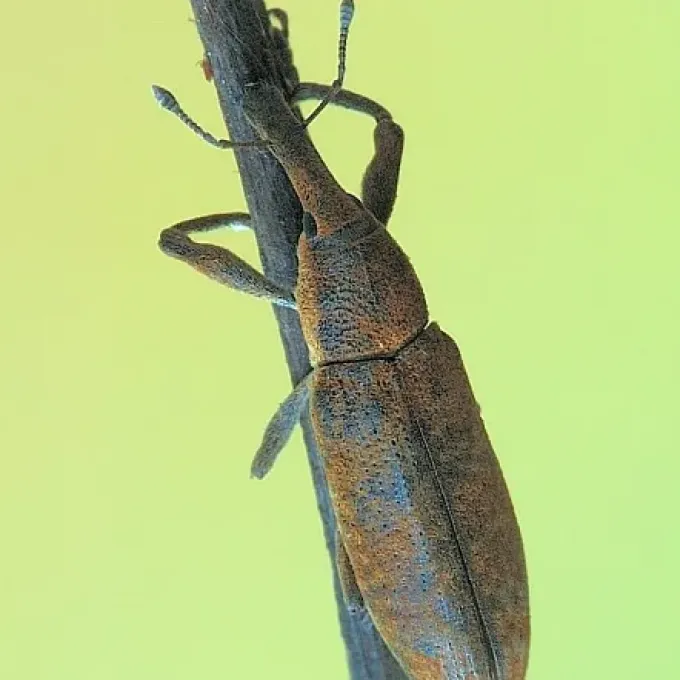
The Lixus genus, commonly known as stem weevils, consists of relatively large beetles with elongated bodies. A key diagnostic feature is their long, slightly curved rostrum (snout), which is typical for the Curculionidae family.
Their bodies are often covered with fine scales or a dusty coating, resulting in gray, brown, or black coloration. The larvae are legless, C-shaped, and usually white or yellowish with a dark, sclerotized head capsule.
Adult weevils are strong fliers, which allows them to migrate over significant distances to locate host plants. This mobility makes them challenging to contain within a single field once an infestation has begun.
These insects belong to the order Coleoptera and the family Curculionidae. Their lifecycle involves complete metamorphosis, progressing through egg, larval, pupal, and adult stages, each requiring specific environmental conditions.
Identifying the exact species within the Lixus genus often requires professional examination of morphological details, such as the structure of the rostrum and the pattern of scales on the pronotum, due to their visual similarity.
What it damages
Lixus weevils pose a significant threat to various agricultural crops, with sugar beets, fodder beets, and certain legumes being particularly susceptible to their feeding habits during the growing season.
Adult beetles feed on leaves and petioles, creating small holes that reduce the total photosynthetic area. While this initial damage is rarely fatal, it weakens the plant and stunts its growth in early stages.
The primary damage is caused by the larvae, which bore into the stems and petioles, creating internal galleries. This structural damage disrupts the plant's vascular system, hindering the transport of water and nutrients.
Heavily infested plants often become brittle and prone to lodging, especially under strong winds or the weight of the crop. This results in significant yield losses and reduced sugar content in root crops.
Furthermore, the internal feeding creates pathways for secondary infections, such as bacterial or fungal pathogens, which can lead to premature decay and the complete collapse of the affected plant tissues.
When it appears
Adult weevils typically emerge from their overwintering sites in the soil during early spring, coinciding with the warming of air and soil temperatures. Their activity level is highly dependent on local climatic conditions.
The mating and egg-laying period is extended, as females search for suitable plants to deposit their eggs. Females use their rostrum to cut small slits in the plant tissue, where they place their eggs individually.
Larval development occurs throughout the summer months. This is the period of highest risk, as the internal feeding by larvae coincides with the crop's peak growth phase and root accumulation period.
Pupation usually takes place towards the end of summer inside the plant stem or in the upper layers of the soil. New adults emerge in late summer and prepare for winter dormancy in the soil or under plant debris.
Monitoring adult weevil populations in the spring is a crucial agronomic task, allowing farmers to estimate the potential threat and implement necessary control measures before the larvae establish inside the stems.
Signs of infestation
The first observable sign of an infestation is the presence of small, circular holes on the leaves, which are caused by the supplementary feeding of adult weevils before the main reproductive cycle begins.
Upon closer inspection, one may notice small swellings or scars on the petioles or stems. These are the locations where the female weevil has incised the epidermis to lay her eggs during the mating season.
Wilting of individual leaves or entire plants, despite adequate soil moisture, often indicates that the vascular tissues inside the petiole or stem have been compromised by the larvae's feeding tunnels.
Carefully splitting an affected stem will reveal longitudinal tunnels packed with frass (insect excrement). The larva itself can usually be found inside these galleries, consuming the internal pith of the plant.
- Presence of circular holes on leaves.
- Swellings or scars on stems and petioles.
- Premature wilting of leaves.
- Internal galleries inside the stems.
- Accumulation of insect frass within plant tissues.
Control measures
Cultural control methods, such as deep autumn plowing, are highly effective as they disturb the soil, exposing overwintering adults to lethal cold temperatures and natural predators, thus breaking the life cycle.
Implementing proper crop rotation is vital to prevent the accumulation of the pest in one field over several years. Spatial isolation of new beet fields from previously infested areas further restricts the migration of the weevils.
Weed management, particularly targeting host plants from the Amaranthaceae family, is essential, as these weeds often serve as secondary reservoirs for the weevils between agricultural seasons.
Chemical control involving systemic insecticides is applied when the pest population exceeds the economic threshold, usually targeting the adult stage to prevent egg-laying or the early larval stages before they bore deep.
Monitoring using pheromone or sticky traps allows for precise timing of interventions, minimizing the impact on beneficial insects and ensuring that control measures are both economical and environmentally responsible.
Taxonomy
- Latin name
- Lixus
- Order
- Coleoptera (beetles)
- Family
- Curculionidae
- EPPO code
- LIXUSP
Discussion
No discussions yet — be the first.