
Stone centipede
Lithobius forficatus
Description
How to identify
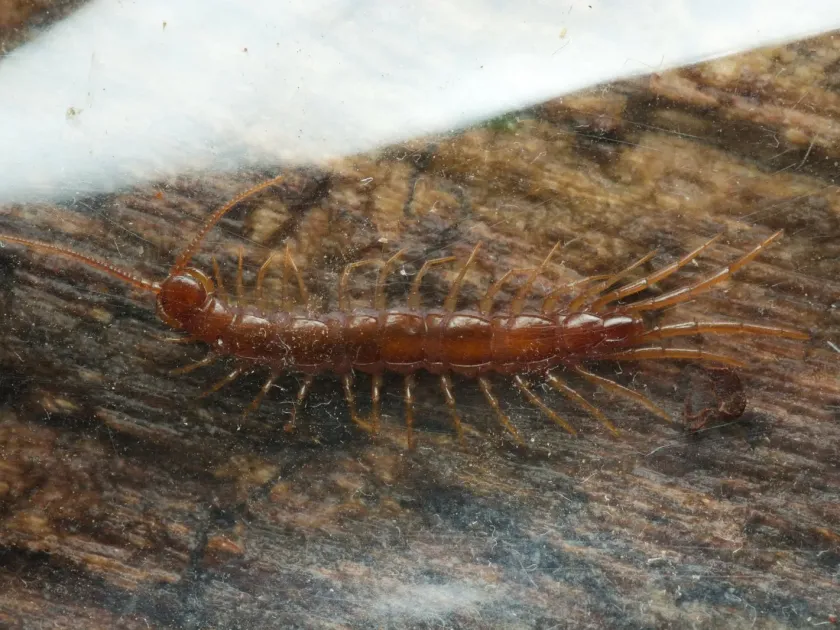
The stone centipede (Lithobius forficatus) belongs to the class Chilopoda, order Lithobiomorpha, and family Lithobiidae. It is a predatory arthropod with a flattened, reddish-brown body that can grow up to 30–40 mm in length.
The centipede features a pair of venomous forcipules on the first body segment, used to paralyze prey. Its body consists of 15 segments, each bearing a single pair of legs, allowing for rapid movement when the animal feels threatened.
These creatures are predominantly nocturnal and thrive in moist, shaded environments, often hiding under organic debris, stones, or within the top layer of soil during the day.
The life cycle involves incomplete metamorphosis. Unlike insects, larvae emerge with fewer segments and pairs of legs, gradually increasing their body segments through successive molts as they grow into adults.
Stone centipedes are highly resilient to temperature fluctuations and are ubiquitous inhabitants of gardens and vegetable plots, where they contribute to the local ecosystem but can become a nuisance under specific conditions.
What it damages
Although Lithobius forficatus is primarily a predator that feeds on small soil invertebrates like fly larvae, mites, and nematodes, it may consume tender plant tissues when its typical food source is scarce.
Significant damage is typically observed in greenhouses and nurseries, where these centipedes chew through germinating seeds, tender roots, and the shoots of young vegetable crops.
The most critical threat is the damage to the root collar of young seedlings, such as cucumbers, tomatoes, and cabbage, during their early development stage.
Injured plant tissues serve as entry points for secondary fungal and bacterial infections, which frequently lead to plant wilting, stunted growth, and eventual death.
High population densities in garden beds can lead to substantial losses, especially in high-moisture soil conditions that favor the activity and reproductive success of the centipede colony.
Signs of infestation
One of the earliest signs of infestation is the discovery of eaten or scarred roots and stem bases when inspecting the root system of wilting or dead seedlings.
During the evening hours or immediately after watering, one can observe these fast-moving reddish-brown centipedes scurrying away when exposed to light or vibrations.
In greenhouse settings, the presence of these pests is indicated by small, irregular tunnels in the topsoil or damp growing medium, often hidden beneath mulch or vegetation mats.
Persistent wilting during the day despite adequate irrigation, coupled with a lack of above-ground insect pests, strongly suggests damage by soil-dwelling arthropods.
The accumulation of waste products and discarded chitinous exoskeletons of other soil organisms near the root zone also serves as a diagnostic indicator of a centipede colony.
Control measures
Effective management begins with proper sanitation practices, such as clearing away debris, fallen leaves, wooden boards, and other hiding spots that centipedes use during the daylight hours.
Controlling soil moisture levels within greenhouses is a key preventive measure, as stone centipedes require a humid environment to prevent desiccation and survive effectively.
Simple trapping methods, such as placing slices of raw potato or moist burlap sacks on the soil surface overnight, allow for the manual collection and removal of centipedes in the morning.
The use of soil-applied insecticides should be considered a last resort, restricted to cases of severe infestation where biological and cultural methods have failed to mitigate the damage.
Autumn deep tillage is an essential cultural practice that exposes soil-dwelling pests to lower temperatures and natural predators, significantly reducing the population that survives the winter.
Taxonomy
- Latin name
- Lithobius forficatus
- Family
- Lithobiidae
- EPPO code
- LITOFO
Discussion
No discussions yet — be the first.