
Carrot weevil
Listronotus oregonensis
Description
How to identify
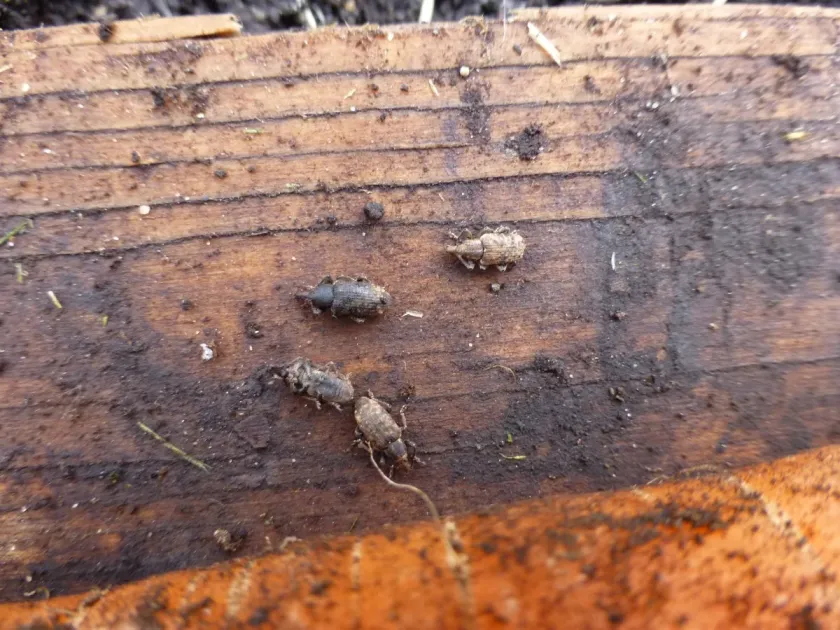
The carrot weevil (Listronotus oregonensis) is a significant agricultural pest belonging to the Curculionidae family. Adult beetles are small, typically ranging from 3 to 4 mm in length, and possess a dark brown to black coloration.
As true weevils, they are easily recognized by their distinct snout, which they use to feed and create small punctures in plant tissues for egg-laying. Their bodies are covered in scales that blend in with soil, making them difficult to spot.
The larvae are white, legless grubs with a well-defined brown head capsule. They typically grow to about 5-6 mm long while feeding internally within the roots of host plants.
The insects are primarily nocturnal or crepuscular, meaning they are most active during the night. During the day, they remain hidden in the soil or under debris, which complicates visual monitoring.
The developmental stages include egg, larva, pupa, and adult. The entire cycle is closely tied to the growing season of the host plants, ensuring the survival of the species from year to year.
What it damages
This pest mainly targets members of the Apiaceae family. While carrots are the primary host, the carrot weevil is also known to infest celery, parsley, and dill.
Adult feeding causes minor damage to the foliage and leaf stems, where they chew small holes. However, this damage is largely aesthetic compared to the destruction caused by the larvae.
Larval feeding is the most damaging phase. As they tunnel into the taproot, they create complex, winding galleries that severely degrade the quality and marketable value of the carrot.
These tunnels frequently become infection sites for various pathogens, leading to bacterial and fungal rot that can destroy the entire root from the inside out.
High infestations often lead to total crop loss, as the tunneling makes the carrots unpalatable and unsuitable for long-term storage or processing.
When it appears
Adult weevils overwinter in the soil or protected areas near former host fields. They emerge in the spring as temperatures rise, coinciding with the early development stages of the carrot crop.
The peak period of adult activity and egg-laying typically occurs during early to mid-summer, which is the most critical time for preventative management.
Depending on the region, the carrot weevil may complete one or two generations per year. The larvae feed throughout the mid-summer period, growing rapidly inside the host tissue.
By late summer and early autumn, the new generation of adults emerges. These beetles feed briefly before seeking shelter in the soil to enter diapause for the upcoming winter.
Environmental conditions, particularly moisture levels in the soil, play a significant role in the survival rate of pupae and the emergence timing of the adult population.
Signs of infestation
Early warning signs include small, crescent-shaped notches or punctures on the leaf stems where the female has deposited eggs.
Stunted growth and premature yellowing of the carrot foliage are often indicators that larval tunneling has compromised the root system or the main taproot.
When harvested, infested carrots display visible entrance or exit holes, often surrounded by dark, frass-filled galleries inside the root.
- Winding tunnels within the carrot flesh.
- Presence of brown, sawdust-like excrement.
- Abnormal, deformed root development.
In cases of severe infestation, the roots may appear rotten or soft to the touch, often emitting a foul odor due to secondary microbial decay.
Control measures
Crop rotation is a fundamental practice; planting carrots in fields where host plants were not grown for at least 3-4 years significantly reduces pest pressure.
Deep plowing or tilling the soil after harvest helps expose overwintering adults to adverse weather conditions and natural predators, reducing the population for the following year.
Application of recommended insecticides should be timed precisely with the period of adult emergence and egg-laying to prevent larvae from entering the roots.
Removing alternative host plants, such as wild carrots or other Apiaceae weeds in the field boundaries, helps eliminate secondary breeding grounds.
The use of physical barriers, such as floating row covers, can be highly effective in small-scale gardening by physically preventing the female from reaching the plants to lay eggs.
Taxonomy
- Latin name
- Listronotus oregonensis
- Order
- Coleoptera (beetles)
- Family
- Curculionidae
- EPPO code
- LISROR
Discussion
No discussions yet — be the first.