
Annual bluegrass weevil
Listronotus maculicollis
Description
How to identify
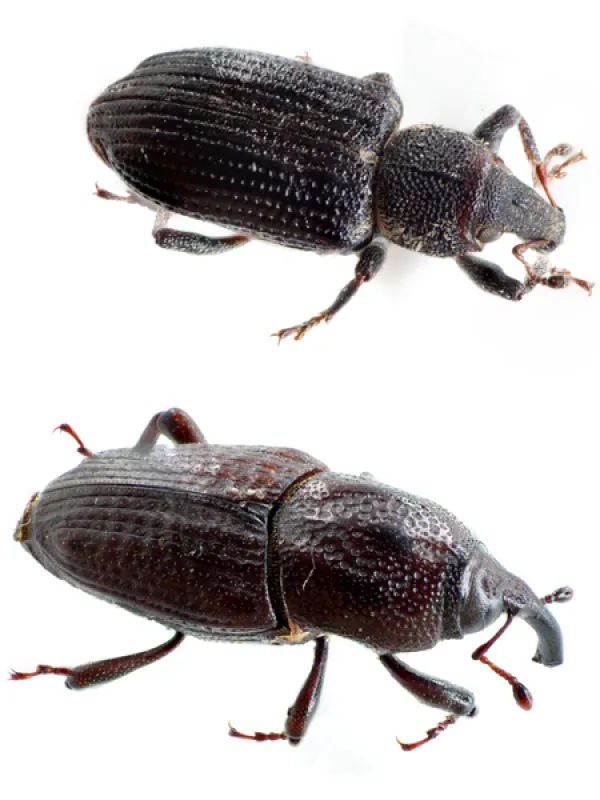
The annual bluegrass weevil (Listronotus maculicollis) is a destructive pest belonging to the Curculionidae family. Adult beetles are small, measuring approximately 3-4 mm in length, with a dark brown to black coloration.
They possess the characteristic elongated snout common to all weevil species. Their wing covers are covered in fine scales, which can make their appearance slightly variable under different light conditions.
The larvae are legless and creamy-white with a brown head capsule. They are responsible for the most severe damage, living within the stem tissues or the thatch-soil interface, which keeps them hidden from view.
The life cycle undergoes complete metamorphosis, including egg, larval stages, pupa, and adult. Adults overwinter in protected areas, such as leaf litter, tall grass, or the soil surface, becoming active during the spring warming.
Breeding usually begins early in the spring, leading to multiple generations in some regions, which allows the population to expand rapidly if left unchecked.
What it damages
The annual bluegrass weevil primarily targets turfgrasses, with a distinct preference for annual bluegrass (Poa annua), commonly found on golf courses and managed lawns.
Larval feeding is particularly devastating as they consume the interior of the grass stems and the crown area. This destroys the plant's ability to take up water and essential nutrients, causing it to wilt and die.
Adult feeding causes less immediate damage but contributes to the weakening of the turf. Their leaf-notching behavior can serve as an early indicator of their presence on a site.
High-density turf areas, such as putting greens, tees, and fairways, are especially susceptible to extensive damage because the close-mowing height reduces the plant's ability to recover from injury.
In severe infestations, the turf can turn brown and die, creating large, irregular patches that significantly impact the aesthetic and functional quality of the lawn.
Signs of infestation
Early signs of infestation often appear as small, yellowed spots that gradually turn brown. Over time, these spots coalesce, forming large, irregular areas of dead or thinning turf.
A key diagnostic sign is the ability to easily lift or pull the affected turf away from the soil, as the roots and crowns have been completely severed by larval activity.
Adult weevils produce distinct, small notches on the leaf blades. Observing these symptoms in the early spring can help in timing the applications for pest control before significant larval damage occurs.
As the damage progresses, the area may feel spongy or become easily detached, revealing a thatch layer that has been heavily disturbed by the feeding larvae.
If you observe thinning turf in the spring, it is highly recommended to perform a thorough inspection of the crown area and the upper soil layer to confirm the presence of larvae.
Control measures
Management of the annual bluegrass weevil requires an integrated approach that combines cultural practices, biological controls, and timely chemical interventions.
Cultural strategies such as proper irrigation management, balanced fertilization, and minimizing thatch buildup can significantly enhance the turf's ability to withstand and recover from pest pressure.
Physical removal of leaf debris in the fall is a simple but effective strategy to reduce the number of overwintering adult beetles, thereby lowering the next generation's population.
Chemical control focuses on targeting adult beetles before they lay eggs or applying systemic insecticides during the early stages of larval development to prevent widespread damage.
- Utilizing entomopathogenic nematodes as a biological control agent.
- Monitoring adult activity with traps to determine the best application timing.
- Maintaining a healthy turf canopy through regular aeration and maintenance.
- Careful rotation of insecticide chemistries to prevent the development of resistance.
Taxonomy
- Latin name
- Listronotus maculicollis
- Order
- Coleoptera (beetles)
- Family
- Curculionidae
- EPPO code
- HYROMA
Discussion
No discussions yet — be the first.