
Listronotus latiusculus
Listronotus latiusculus
Description
How to identify
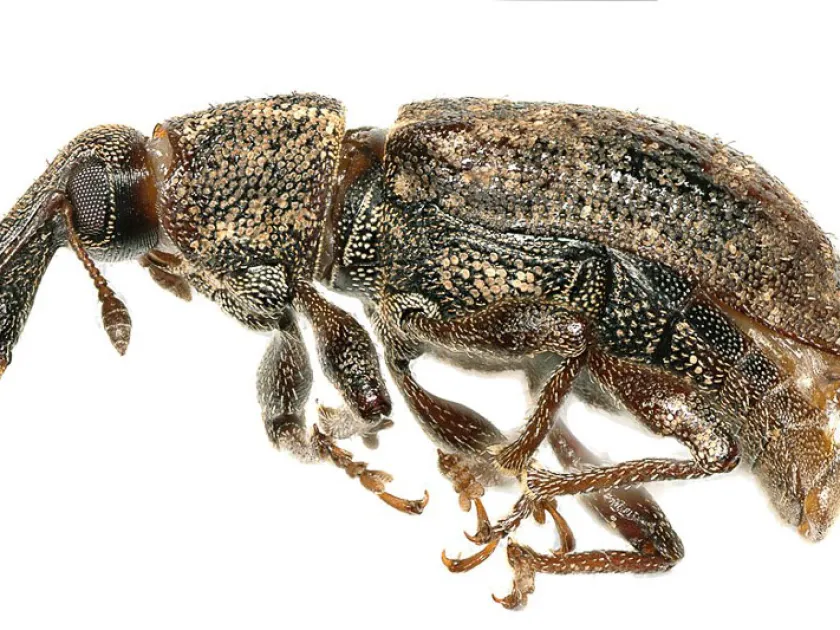
Listronotus latiusculus belongs to the Curculionidae family, commonly known as weevils. Adults are small beetles, typically 3–4 mm in length, characterized by an elongated snout typical of this family.
Their body color is usually dark brown to grayish-brown, providing excellent camouflage on soil surfaces and among plant debris. The elytra are covered with fine scales and setae.
The larvae are legless with a creamy-white to yellowish body and a distinct brown head capsule. They reside primarily within plant tissues, making detection difficult during early stages of infestation.
The species biology is closely linked to moist environments. They are frequently found in riparian zones or on poorly drained agricultural fields where high moisture levels support their population.
Adult beetles are capable of flight, allowing them to rapidly colonize new fields and create infestation hotspots throughout the growing season, which poses a risk for nearby crops.
What it damages
The pest primarily targets moisture-loving crops. Cereals and certain vegetable varieties grown in high-moisture conditions are the most susceptible to attack by this weevil species.
Larvae cause the most significant damage by feeding inside stems and on root systems. This disrupts the plant's vascular system, leading to wilting and reduced nutrient uptake from the soil.
Adult beetles feed on leaves and stems, leaving noticeable holes or notches. Severe infestations can cause significant thinning of crop stands, impacting overall plant development and yield.
The damage is particularly critical during the seedling stage, when young plants lack the vigor to recover from internal tissue feeding or root system destruction by the larvae.
Stunted growth and premature senescence are common outcomes of sustained feeding, leading to decreased field uniformity and lower economic returns for the grower.
When it appears
Adults emerge from hibernation in early spring as soil temperatures rise. They begin feeding on available host plants shortly after exiting their overwintering sites in soil or debris.
Reproduction peaks in late spring and early summer, corresponding with the active growth phase of the host crops. Females deposit eggs in plant tissues or near the root zone.
Larval development occurs in several instars, each characterized by intense feeding on plant structures. The duration of this cycle is highly dependent on ambient weather conditions.
Multiple generations can occur throughout the summer in favorable climates, requiring persistent monitoring to identify new infestation pockets before they spread across the field.
In autumn, adults migrate to hibernation sites, including deep soil layers, weeds, or plant residues, to survive the winter and re-emerge when conditions become favorable again.
Signs of infestation
A primary indicator of infestation is the localized wilting of plants despite adequate soil moisture, which often suggests damage to the root or lower stem area.
Close inspection of the stem base often reveals small entry holes where larvae have burrowed into the plant. Stems may become brittle or deformed, showing signs of internal decay.
Leaf damage is visible as irregular notches or holes, especially during the nocturnal or early morning periods when beetles are active on the surface of the plant canopy.
- Wilting and yellowing of young seedlings
- Entry holes at the base of the plant
- Uneven plant height across the field
- Presence of adult weevils during evening inspections
- Stunted growth and reduced tillering in cereals
Widespread damage can result in "bald spots" in fields, where plants collapse due to complete destruction of the structural integrity of the stems or roots.
Control measures
Cultural practices are the first line of defense, including crop rotation and strict weed management to eliminate alternative host plants that support the pest during the off-season.
Deep autumn plowing is recommended to disrupt hibernation sites and expose adults or pupae to environmental stress, effectively reducing the overwintering population.
When pest thresholds are exceeded, targeted applications of systemic or contact insecticides are necessary to protect the crop during vulnerable growth stages.
Application timing is crucial; spraying during dawn or dusk increases efficacy, as these are the peak periods of beetle activity, ensuring better contact with the pest.
Improving field drainage is also a highly effective long-term strategy, as creating a less humid environment reduces the suitability of the habitat for Listronotus latiusculus.
Taxonomy
- Latin name
- Listronotus latiusculus
- Order
- Coleoptera (beetles)
- Family
- Curculionidae
- EPPO code
- LISRLA
Discussion
No discussions yet — be the first.