
Argentine stem weevil
Listronotus bonariensis
Description
How to identify
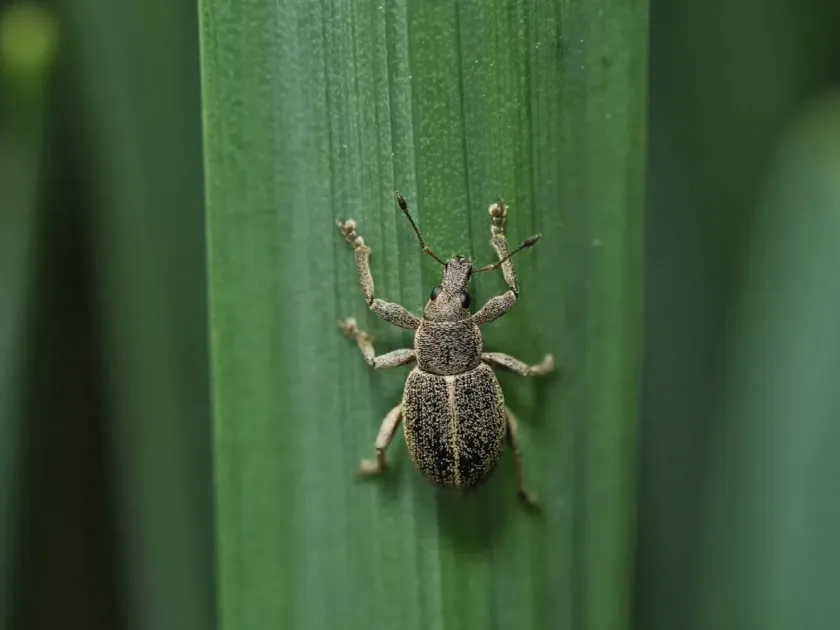
The Argentine stem weevil (Listronotus bonariensis) is a small insect pest, typically measuring 3–4 mm in length, known for causing significant damage to pasture grasses and cereal crops.
Adult weevils have a dark, brownish-black color and a characteristic snout, which is typical for the Curculionidae family. They are primarily nocturnal, hiding during the day.
The larvae are small, legless, and white with a dark head. They live inside the stems of host plants, which makes them highly protected from many external environmental factors.
The life cycle includes egg, larva, pupa, and adult stages. Pupation usually occurs in the soil, close to the root zone of the host plant.
The species has adapted to various climates, allowing it to complete multiple generations within a single growing season under favorable conditions.
What it damages
The primary hosts for this pest are perennial ryegrass, Kentucky bluegrass, and various other forage and cereal grasses.
Larval feeding is the most destructive phase. The larvae tunnel into the base of the plant stem, consuming internal tissues and interrupting the vascular supply.
This feeding behavior causes the central leaves of the grass to yellow and wither, a condition often referred to as "dead heart" or white-heading in seed crops.
In severe infestations, the entire tillers die, leading to significant thinning of the pasture or crop stand and subsequent reduction in biomass or seed yield.
Adults also feed on foliage, creating small, longitudinal scars, although this type of damage is generally considered less impactful than the larval destruction.
When it appears
Adult weevils overwinter in sheltered areas such as dense grass thatch, soil cracks, or plant debris, surviving through the winter months.
In early spring, when temperatures rise, adults emerge to feed and begin laying eggs in the leaf sheaths of host grasses.
Multiple overlapping generations occur throughout the growing season, with peak larval activity often observed during the late spring and summer months.
The intensity of the infestation is strongly correlated with moisture levels, as high humidity and adequate warmth favor rapid development.
As autumn approaches, the development cycle slows down, and the population prepares for overwintering, seeking refuge for the colder period.
Signs of infestation
The most prominent sign of an infestation is the yellowing and eventual browning of the youngest, central leaf of the grass tiller.
The affected tiller can often be easily pulled away from the base, revealing internal damage or the presence of a larva within the stem.
Feeding marks by adult weevils, appearing as small, oblong windows or notches on the leaves, indicate the presence of the population.
- Withered central leaves
- "Dead heart" symptoms in tillers
- Presence of larvae inside the base of the plant
- Visible adult feeding scars on foliage
- Patchy die-back in pasture or turf areas
In seed-producing fields, the appearance of bleached heads is a clear indicator that the larvae have severely impacted the plant's nutrient transport.
Control measures
Managing the Argentine stem weevil involves an integrated pest management (IPM) approach to minimize crop losses and chemical dependence.
Biological control, particularly the use of endophyte-infected grasses, has proven highly effective, as these grasses produce compounds that are toxic or deterrent to larvae.
Cultural practices, such as maintaining healthy, vigorous stands and proper fertilization, help plants better withstand or recover from low levels of damage.
Chemical control using systemic insecticides is most effective when applied before the larvae burrow deep into the stems, coinciding with egg-laying activity.
Monitoring using sweep nets or pheromone traps is essential to determine the timing of insecticide applications and ensure the most effective treatment window.
Taxonomy
- Latin name
- Listronotus bonariensis
- Order
- Coleoptera (beetles)
- Family
- Curculionidae
- EPPO code
- HYROBO
Discussion
No discussions yet — be the first.