
Listronotus
Listronotus
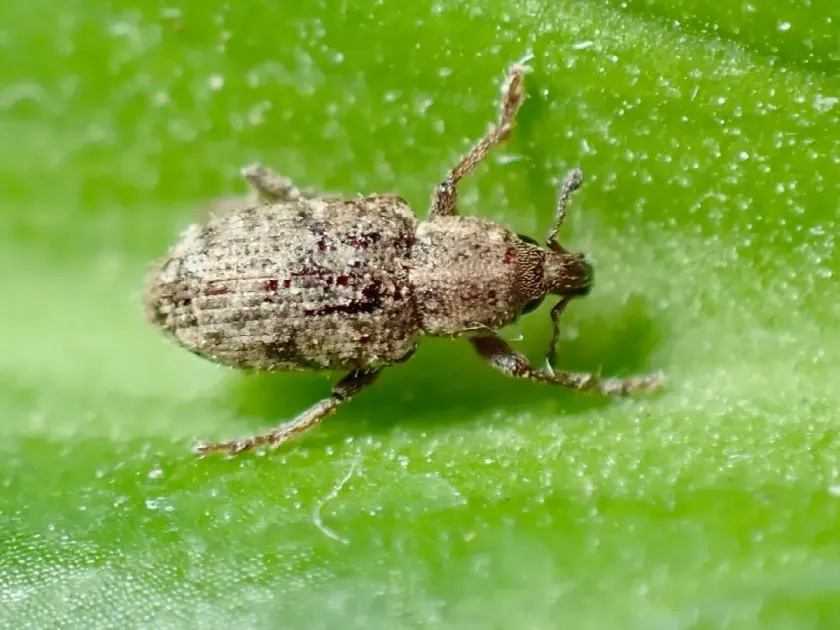
Description
How to identify
Listronotus is a genus of weevils belonging to the Curculionidae family. The most economically significant species is Listronotus oregonensis, commonly known as the carrot weevil.
Adult beetles are relatively small, typically measuring 3 to 4 millimeters in length, and possess a dark brown to black coloration that helps them blend into soil debris.
Their anatomy includes the signature elongated snout, which they use to pierce plant tissues for feeding and to create sites for oviposition.
The larvae are legless, C-shaped grubs with creamy-white bodies and distinct brown head capsules, specifically adapted for burrowing inside plant tissues.
They thrive in moist environments, making irrigated fields or low-lying agricultural areas with poor drainage particularly attractive for their colonization.
What it damages
This pest primarily targets the Apiaceae family, with carrots being the most susceptible crop, though it also causes significant damage to celery and parsley.
Adults feed on foliage, leaving small, characteristic round punctures that serve as a minor cosmetic issue but indicate the presence of an infestation.
The true damage occurs when larvae bore into the root system, creating extensive, winding tunnels filled with frass, which essentially destroys the root structure.
Root damage leads to secondary bacterial and fungal infections, causing the crop to rot and making it entirely unsuitable for fresh market sale or storage.
High population densities can result in severe yield losses, often forcing farmers to abandon fields or apply aggressive chemical interventions.
When it appears
Adults overwinter in protected areas such as field margins, hedge rows, or under dense organic debris, becoming active again in early spring.
As soil temperatures rise, the beetles emerge and move to young carrot plants to begin feeding and mating, which usually correlates with the early stages of crop development.
Oviposition typically occurs in the leaf petioles near the soil surface, providing larvae with immediate access to the root after they hatch.
The life cycle continues through the summer, with the duration of the larval stage lasting several weeks before they migrate into the soil to pupate.
Depending on local climate conditions and temperature accumulation, this pest can complete multiple generations within a single growing season.
Signs of infestation
The earliest symptom of an infestation is the appearance of small, round feeding punctures on the foliage, often concentrated near the base of the petioles.
Plants may exhibit stunted growth, yellowing foliage, or premature wilting, which indicates that larvae have already penetrated the root system.
Upon harvesting or lifting the carrots, farmers will notice dark, necrotic lesions and clear entrance holes where the larvae burrowed into the root.
Internal inspection of damaged roots reveals deep, winding galleries filled with dark fecal matter, rendering the vegetable unmarketable.
- Feeding punctures on leaves
- Yellowing of the carrot tops
- External scarring on roots
- Internal tunneling within the root
Control measures
Effective management begins with rigorous crop rotation, ensuring that carrots are not planted in the same field for at least three to four years.
Monitoring using pheromone or sticky traps is essential to determine the timing of insecticide applications to coincide with adult activity peaks.
Cultural practices such as deep autumn plowing help expose overwintering adults and pupae to predators and environmental extremes, reducing the next year's population.
Eliminating wild hosts, such as wild carrot or hemlock in surrounding ditches, helps reduce the reservoir of pests available to infest commercial crops.
Chemical control should be used selectively; systematic insecticides are often required when trap counts exceed specific economic thresholds to prevent widespread damage.
Taxonomy
- Latin name
- Listronotus
- Order
- Coleoptera (beetles)
- Family
- Curculionidae
- EPPO code
- LISRSP
Discussion
No discussions yet — be the first.