
Vegetable weevil
Listroderes costirostris
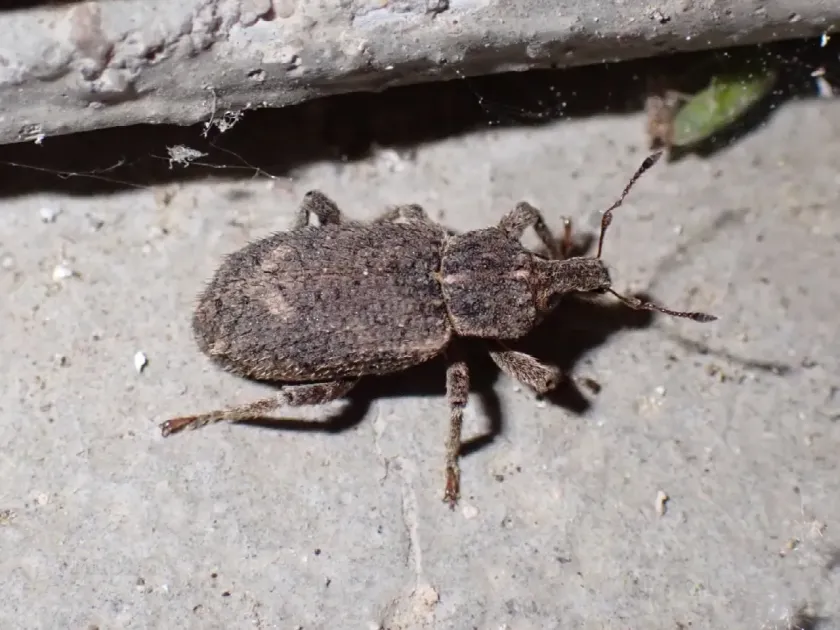
Description
How to identify
The vegetable weevil (Listroderes costirostris) is a significant agricultural pest belonging to the Curculionidae family, order Coleoptera.
Adult weevils are roughly 8–10 mm long, featuring a brownish-gray coloration that blends seamlessly into soil surfaces and organic matter.
The most distinctive feature is the elongated snout (rostrum) characteristic of the weevil family, which is used for both feeding and oviposition.
Larvae are legless, C-shaped grubs with creamy-white bodies and dark, hardened head capsules, typically found dwelling in the soil profile.
Identification is aided by observing the small, irregular tubercles on their wing covers, which provide a textured appearance to their dorsal surface.
What it damages
This species is highly polyphagous, attacking a wide range of vegetable crops including tomatoes, potatoes, carrots, cabbage, and various leafy greens.
Adult weevils primarily feed on foliage, creating jagged notches along the leaf margins, which reduces the plant's photosynthetic capacity.
Larval damage is generally considered more severe as they feed on roots and crowns, often leading to the complete collapse of young seedlings.
In commercial operations, high populations of the vegetable weevil can result in significant yield losses and stunted crop development across entire fields.
Beyond physical damage, the wounds created by this pest often facilitate the entry of soil-borne pathogens, leading to secondary bacterial or fungal infections.
When it appears
Vegetable weevil activity typically begins in the spring, triggered by rising soil temperatures that prompt the emergence of overwintering adults.
The insects are primarily nocturnal, remaining hidden under debris or soil clumps during the daytime to avoid desiccation and predation.
Oviposition occurs in the soil near the base of host plants, leading to larval development stages that feed underground throughout the growing season.
Population peaks are usually observed during moderate temperature cycles, which favor rapid reproduction and multiple developmental stages occurring simultaneously.
As winter approaches, adults migrate into deeper soil layers or sheltered areas to enter a state of dormancy, preparing for the next season.
Signs of infestation
Early warning signs include characteristic notched feeding patterns on foliage, which become obvious during periodic inspections of the crop canopy.
Unexpected wilting of plants, even when soil moisture appears adequate, is a strong indicator that the root system is being compromised by larval feeding.
Checking the soil around the base of the plant often reveals the presence of C-shaped larvae, which recoil when disturbed by manual inspection.
The appearance of stunted, chlorotic plants within a patch is often a secondary symptom of long-term root damage caused by persistent weevil pressure.
Regular night monitoring with a light source remains the most accurate way to detect the adult weevils in their active feeding phase.
Control measures
Cultural control via strict crop rotation is essential to break the pest's life cycle and prevent build-up in high-risk soil areas.
Deep cultivation or plowing after harvest helps destroy overwintering sites, exposing larvae and pupae to environmental stress and natural predators.
Chemical control using systemic or contact insecticides may be necessary during peak infestation periods, targeting either soil-dwelling larvae or nocturnal adults.
Biological control agents, such as entomopathogenic fungi or nematodes, can be applied to the soil to provide a sustainable alternative to conventional pesticides.
- Maintain weed-free environments to eliminate secondary host plants.
- Use physical barriers for seedlings in highly infested plots.
- Monitor field margins where adults often accumulate before migrating.
- Ensure adequate irrigation to support plant recovery after minor feeding incidents.
Taxonomy
- Latin name
- Listroderes costirostris
- Order
- Coleoptera (beetles)
- Family
- Curculionidae
- EPPO code
- LISTCO
Discussion
No discussions yet — be the first.