
Crowned weevil
Liparus coronatus
Description
How to identify
The crowned weevil (Liparus coronatus) is a beetle belonging to the order Coleoptera and the family Curculionidae. Adult beetles typically reach a length of 10 to 15 millimeters.
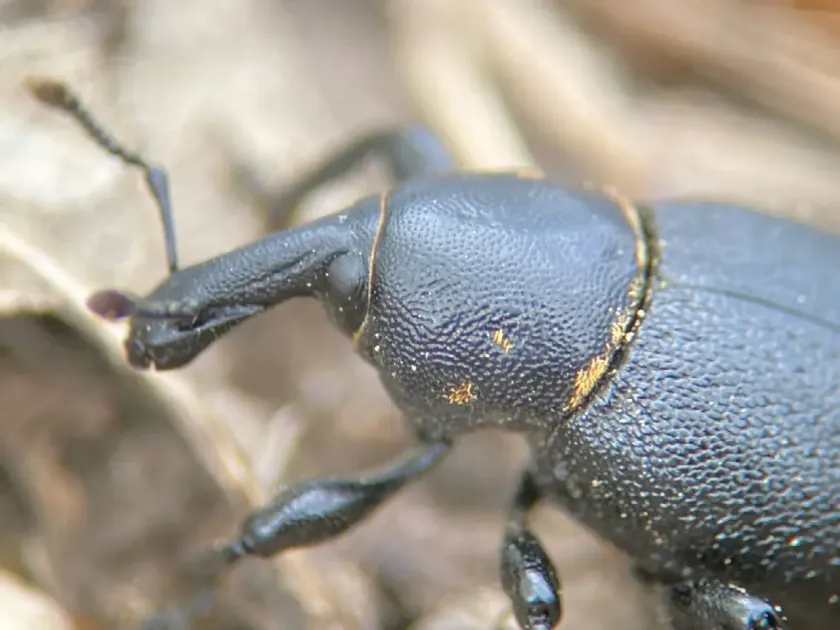
The body is primarily matte black. The most prominent feature of this species is the presence of numerous yellowish or whitish scales that form a distinct pattern on the elytra, resembling a crown.
The weevil possesses a powerful, slightly curved snout. The surface of the elytra is marked with deep pitted furrows, which serves as camouflage against soil and plant debris.
The larvae are typical of the weevil family: legless, fleshy, C-shaped, and creamy white with a brownish head. They live cryptically in the soil or within the root system of host plants.
Pupation takes place in earthen cells within the soil. Because their entire life cycle is closely linked to the root zone, the pest is difficult to detect during the early stages of infestation.
What it damages
This pest primarily attacks plants belonging to the Apiaceae (umbelliferous) family. While often found on wild plants, they can shift to cultivated crops when populations are high.
The larvae cause the most significant damage by feeding on the root tissues and the root collar, disrupting nutrient uptake and leading to the plant's decline.
Adult beetles feed on the leaves and stems. While adult feeding damage is generally less severe than root damage, it can still significantly weaken the plant's vigor.
Affected plants exhibit stunted growth and development. In cases of heavy infestation, the root system is destroyed, often leading to the death of young crops.
High infestation rates are usually correlated with monocropping of Apiaceae species, where the lack of crop rotation allows the pest population to build up over several years.
When it appears
Adult activity begins in early spring as temperatures rise, usually when they reach 10-12 degrees Celsius.
The mating and egg-laying period is extended, typically occurring throughout the late spring and early summer months.
Larvae develop in the soil throughout the summer, feeding actively on the roots. This larval stage constitutes the most prolonged phase of the beetle's life cycle.
Pupation occurs in late summer or early autumn. Newly emerged adults often spend the winter in the soil or under plant residues before becoming active the following spring.
The species generally follows a one-year life cycle, though variations in local climate can cause developmental delays or acceleration.
Signs of infestation
The primary symptom is the sudden wilting of plants during the hottest part of the day, which does not improve with irrigation.
Close inspection of the root collar may reveal chewed areas or damage to the bark, often covered by soil particles.
Foliage of adult plants may show semi-circular notches along the leaf margins, which is a common but secondary sign of weevil activity.
Severely infested plants are easily pulled from the ground because the roots have been almost entirely severed by larval feeding.
- Observation of adult weevils on foliage during the evening.
- Patchy distribution of wilted plants within the field.
- Clear evidence of larval tunnels on unearthed root systems.
Control measures
Cultural practices form the basis of control. Implementing a proper crop rotation, avoiding Apiaceae plants on the same plot for at least 3-4 years, is highly effective.
Deep autumn plowing or soil cultivation helps expose larvae and pupae to predators and adverse weather conditions, significantly reducing the population.
Rigorous weed control, particularly targeting wild Apiaceae in the vicinity of crop fields, is essential to limit the pest's alternative food sources.
Chemical control involving systemic or contact insecticides can be applied during adult emergence, but soil treatments for larvae are generally less effective.
Biological control using entomopathogenic nematodes or fungi is a promising, eco-friendly approach for managing soil-dwelling larvae.
Taxonomy
- Latin name
- Liparus coronatus
- Order
- Coleoptera (beetles)
- Family
- Curculionidae
- EPPO code
- LIPUCO
Discussion
No discussions yet — be the first.