
Plum bark beetle
Liparthrum pruni
Description
How to identify
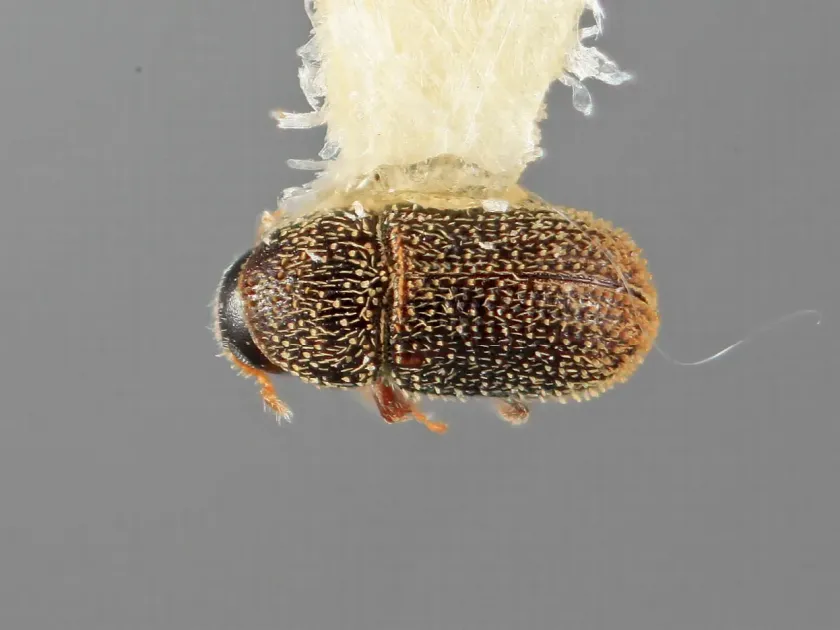
The plum bark beetle (Liparthrum pruni) is a small wood-boring insect belonging to the Curculionidae family. These beetles are typically 1.5 to 2 mm long and possess a dark brown to black cylindrical body.
Their physical appearance is characterized by fine hair-like scales covering the elytra, which helps them blend seamlessly with the bark of host trees during their active season.
The larvae are white, legless, and have a distinct brown head capsule. They spend their entire development phase beneath the bark, feeding exclusively on the phloem and cambium layers.
Adult beetles have wings and can actively fly, allowing them to detect stressed trees from a distance through chemical signals released by the weakened host plant.
Despite their small size, their ability to reproduce rapidly under the bark makes them a significant threat to orchards where tree health is compromised.
What it damages
This beetle primarily attacks stone fruit trees, including plums, sloes, and sometimes apricots or cherries. It is considered a secondary pest that thrives on weakened or injured trees.
Trees suffering from drought, poor nutrition, or recent transplant shock are the most susceptible to colonization by the plum bark beetle.
The primary damage occurs when adult beetles and their larvae create galleries beneath the bark, which disrupt the flow of water and nutrients within the tree.
As the galleries proliferate, the cambium tissue is destroyed, leading to wilting, branch dieback, and eventually the death of the entire tree if the infestation is not managed.
The cumulative effect of multiple beetle generations can quickly turn a slightly weakened tree into a dead specimen, creating a source of infestation for neighboring healthy trees.
Signs of infestation
The most common sign of an active infestation is the presence of small, circular exit or entrance holes on the bark, often accompanied by fine wood dust known as frass.
In many stone fruit trees, the plant reacts to the beetle attack by exuding sap or gum at the entry points, which serves as a defensive mechanism against the invaders.
During the growing season, a key symptom is the sudden yellowing or wilting of leaves on individual branches, which indicates that the water supply to that limb has been severed.
If you remove a piece of the outer bark, you will see a network of tunnels radiating from a central chamber, typically containing both eggs and larvae depending on the timing.
Visible woodpecker damage on the bark is another common indicator, as birds actively hunt for larvae living beneath the surface of the tree.
Control measures
The most effective long-term strategy is maintaining high tree vigor through proper fertilization, irrigation, and avoiding any unnecessary mechanical stress to the trunk or branches.
Sanitation is critical; all dead or heavily infested wood must be pruned and immediately burned to prevent the beetles from emerging and spreading to healthy trees.
For chemical control, spraying the trunks with approved contact insecticides during the emergence period of adult beetles can help reduce the population density.
Applying tree paint or whitewash to trunks can help prevent beetles from finding suitable entry points during the warmer months when the beetles are most active.
- Regular orchard inspections during the growing season.
- Removal of pruned wood from the orchard site immediately.
- Use of pheromone traps for monitoring beetle emergence patterns.
Taxonomy
- Latin name
- Liparthrum pruni
- Order
- Coleoptera (beetles)
- Family
- Curculionidae
- EPPO code
- LPRTPR
Discussion
No discussions yet — be the first.