
Liophloeus tessulatus
Liophloeus tessulatus
Description
How to identify
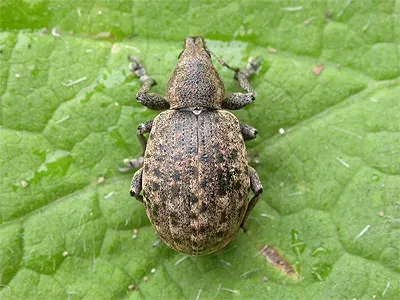
Liophloeus tessulatus belongs to the order Coleoptera and the family Curculionidae. It is a medium-to-large beetle, typically measuring between 10 and 14 mm in length.
The body of the pest is elongated and covered with tiny scales, giving it a grayish-brown or dark coloration with a characteristic mottled pattern on its elytra.
The snout (rostrum) of this species is broad and short, distinguishing it from many other members of its family. The antennae are elbowed and clubbed, allowing the beetle to navigate effectively.
The larvae of Liophloeus tessulatus exhibit a typical appearance for the family: they are legless, fleshy, white or yellowish, with a distinct brown head.
Adults are primarily nocturnal, hiding during the day in the soil, under fallen leaves, or at the base of plants, which makes them difficult to detect.
What it damages
This pest is a polyphage, but it prefers plants from the Apiaceae and Rosaceae families, often found on raspberries, blackberries, and various ornamental crops.
Adult beetles feed primarily on the aerial parts of plants, gnawing the edges of the leaves, which leads to the appearance of characteristic notched patterns.
The larvae of Liophloeus tessulatus live in the soil and cause significant damage to the root system by gnawing at roots and root necks, which can lead to plant death.
The damage caused by larvae is particularly dangerous in nurseries and young orchards, where root injury drastically reduces the vitality and productivity of the crops.
Mass reproduction of the pest can lead to stunted plant growth, loss of aesthetic value, and a significant reduction in overall yield on the site.
When it appears
The activity of adult Liophloeus tessulatus begins in the spring, once the soil warms up and the beetles emerge from their overwintering sites to feed.
The period of intensive reproduction and egg-laying occurs during May and June, at which time the insects are most visible on the leaves of host plants in the evening.
The life cycle development takes a long time, often spanning one to two years depending on the region's climatic conditions and food availability.
Overwintering occurs primarily at the larval or adult stage in the top layers of the soil, where they are protected from extreme cold.
The greatest damage from adults is observed in late spring and early summer, while larvae may damage roots throughout almost the entire growing season.
Signs of infestation
The first sign of the pest's presence is the characteristic notched feeding patterns along the edges of leaves, which resemble the work of other weevil species.
When inspecting the root system of plants that show signs of wilting without any apparent cause, one may find larvae feeding on root tissues.
The presence of adults is easily confirmed by inspecting the garden with a flashlight in the evening, as beetles emerge to feed and become visible on leaf surfaces.
Wilting of young plants caused by the disruption of the root system by larvae is often accompanied by a general slowing of the plant's development.
The presence of beetles in the topsoil layer during the day also indicates a high probability of infestation by this species.
Control measures
The mechanical control method involves the regular manual collection of beetles in the evening hours, which is effective for small private plots.
Agronomic measures include deep loosening of the soil in tree circles, which helps destroy larval tunnels and exposes them to predatory birds.
Chemical control involves the use of contact-stomach insecticides applied to the plants during the period when adults emerge from the soil.
To reduce the number of soil-dwelling larvae, the use of biological preparations based on entomopathogenic fungi or soil-applied insecticides is effective.
- Proper crop rotation practices.
- Removal of weeds that serve as alternative reservoirs for the pest.
- Encouraging natural bird populations and beneficial predatory insects.
Taxonomy
- Latin name
- Liophloeus tessulatus
- Order
- Coleoptera (beetles)
- Family
- Curculionidae
- EPPO code
- LIOPTE
Discussion
No discussions yet — be the first.