
Grain thrips
Limothrips
Description
How to identify
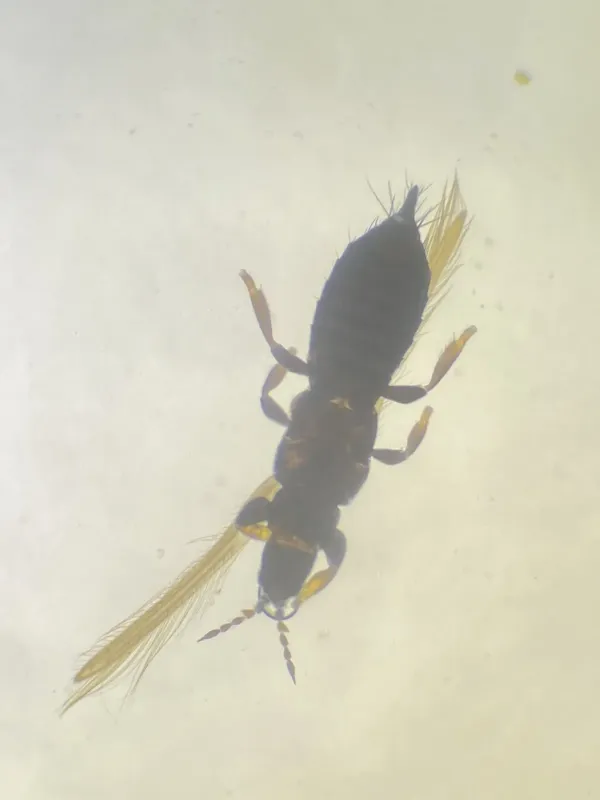
The grain thrips (Limothrips denticornis) belongs to the order Thysanoptera, family Thripidae. It is a tiny insect, measuring 1.2–1.5 mm, with an elongated dark or brown body.
Adults possess two pairs of narrow wings featuring characteristic fringes made of long hairs. Males have specific appendages on their antennae, which serves as a key diagnostic feature for the species.
Larvae are wingless and have a pale yellow or orange coloration. They are highly mobile and lead a secretive lifestyle, hiding inside leaf sheaths or glumes of cereals.
Only fertilized females overwinter, seeking shelter in plant debris, forest litter, or cereal stubble, where they enter a state of diapause.
In spring, as soil temperatures rise to +10...+12°C, the pests become active and start colonizing young crops, beginning with winter cereals and gradually moving to spring varieties.
What it damages
The primary host crops for the grain thrips are spring and winter wheat, rye, barley, and oats. In some cases, the pest may feed on wild cereal grasses.
The insect sucks cell sap from plant tissues, which disrupts vital physiological processes. The greatest damage occurs during the booting and heading stages.
Feeding by thrips in the ear area causes a condition known as "whitehead." Affected ears become shriveled, and grains develop poorly or do not form at all.
Mass outbreaks of this pest can reduce grain yields by 15–30%, depending on the intensity of the infestation and the weather conditions during the growing season.
Both adults and larvae cause damage by congregating inside the ear and sucking juices from developing ovaries, leading to deformation and premature drying.
When it appears
The emergence of overwintered females begins in late April or early May. Initially, the insects feed on winter crops, where they begin their reproductive cycle.
Throughout the growing season, the grain thrips can complete 1 to 2 generations. The development rate is directly dependent on the accumulation of effective temperatures.
The period of mass colonization of the ears coincides with the flowering stage of the cereals. This is when the most intensive feeding and egg-laying occur.
In the second half of summer, as the crops ripen and plants dry out, the thrips abandon the ears and migrate to their overwintering sites.
Hot and dry weather promotes rapid population growth, whereas prolonged rainfall can significantly reduce the number of insects.
Signs of infestation
The first sign of infestation is the discoloration of leaf tips, characterized by the appearance of silver spots or streaks on the foliage.
Upon visual inspection of the ear, one can spot the insects themselves or their larvae hiding under the glumes. Dissecting an ear often reveals excrement in the form of black dots.
Disruption of grain formation causes the ear to remain upright and pale, whereas healthy, grain-filled ears tend to bow under their own weight.
Clusters of insects can often be found under the leaf sheaths in the lower part of the stem, causing the leaves to turn yellow and curl.
A decrease in the thousand-grain weight and overall poor grain quality are the main indirect indicators that the field has been attacked by grain thrips.
Control measures
The most important agronomic control method is practicing crop rotation and maintaining spatial isolation between spring and winter crop fields.
Deep autumn plowing is effective as it helps destroy the pest's overwintering sites, thereby reducing the population size for the following season.
Eliminating weeds in fields and along field borders deprives the thrips of food sources during the off-season and early spring.
If the economic threshold of damage is exceeded (more than 10–15 insects per ear), the use of systemic insecticides is recommended.
Chemical control is most effective during the heading stage, when the pests are most exposed and vulnerable to the treatment.
Taxonomy
- Latin name
- Limothrips
- Order
- Thrips
- Family
- Thripidae
- EPPO code
- LIMTSP
Discussion
No discussions yet — be the first.