
Nettle-tree butterfly
Libythea celtis
Description
How to identify
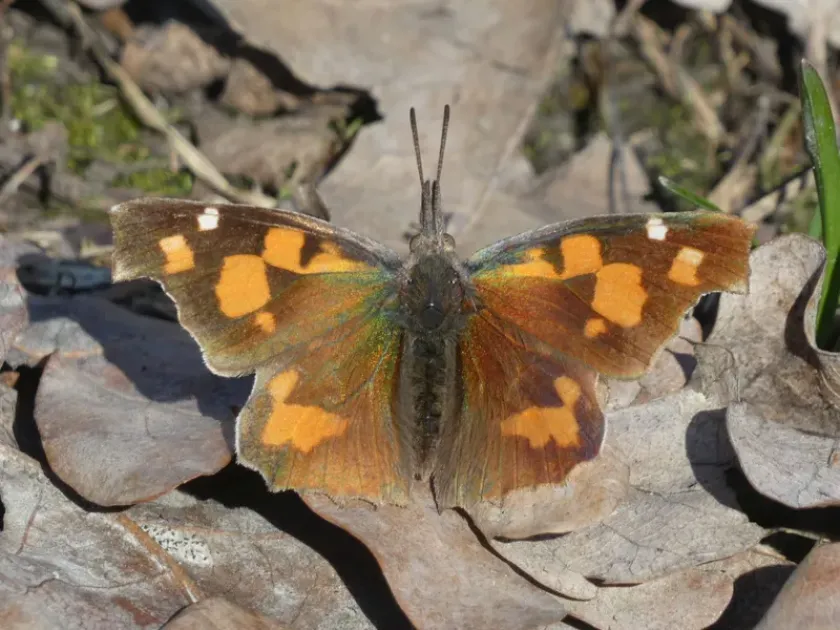
The Nettle-tree butterfly (Libythea celtis) belongs to the Nymphalidae family. It is distinct for its elongated labial palpi, which create a snout-like appearance, giving it the common name.
The wingspan of the adult butterfly is about 45–50 mm. The wings are brownish-black with orange markings, providing excellent camouflage against dry leaves, which is essential for its survival in natural habitats.
Caterpillars are vibrant green with a yellow dorsal stripe and small pale spots along the sides. They are often found on the underside of leaves, making them cryptic to casual observers.
The pupa is green with yellow accents, blending seamlessly into the foliage or twigs of the host tree. It is secured by a cremaster, often hanging vertically from a branch.
Adult butterflies are known to overwinter, seeking shelter in tree bark crevices or among debris, which allows them to survive cold winter temperatures.
What it damages
The primary host plant for this species is the Celtis australis (European hackberry). The caterpillars feed exclusively on the foliage of trees within the Celtis genus.
Young trees are most susceptible to damage, as heavy feeding by larvae can lead to significant defoliation, affecting the tree's vigor and development.
Larval feeding patterns often involve skeletonizing the leaves or consuming them entirely, leaving only the veins. This reduces the photosynthetic capacity of the plant.
While mature trees are generally resilient, outbreaks can occur in urban areas, leading to reduced aesthetic quality of street and park trees.
Repeated defoliation over several seasons can stress the tree, making it more susceptible to secondary pests and environmental stressors.
When it appears
The life cycle begins in early spring when adults emerge from hibernation to feed and mate. Females lay eggs on the young leaves of host trees.
The larval stage typically lasts for several weeks, depending on the temperature. The species may have one or two generations per year in warmer climates.
Active feeding peaks during late spring and early summer, specifically May and June, which are critical months for monitoring the health of hackberry trees.
Pupation occurs in early summer, and new adults emerge by mid-summer. These adults are the ones that will eventually enter diapause to survive the winter.
As autumn approaches, adult butterfly activity decreases as they prepare to find secure overwintering sites, completing their annual biological cycle.
Signs of infestation
Signs of infestation include irregular holes in the leaves and missing leaf margins. As caterpillars grow, the damage to the canopy becomes more noticeable.
Frass (caterpillar droppings) accumulating under the tree is a reliable indicator of active larval feeding in the upper canopy.
Silk threads used by caterpillars to secure themselves or to construct shelters near the leaf base are common structural indicators of their presence.
- Holes and jagged edges on hackberry leaves.
- Vibrant green caterpillars on the underside of foliage.
- Thinning of the crown due to high larval density.
- Pupae hanging from small twigs or leaf petioles.
Visible defoliation patterns, such as the complete loss of leaf blades, are characteristic signs of established populations of Libythea celtis.
Control measures
Biological control using Bacillus thuringiensis sprays is highly effective and safe for non-target species, targeting only the larval stage of the moth.
Systemic insecticides may be used in severe outbreak scenarios to protect high-value ornamental trees, ensuring long-term foliage protection.
Sanitation practices, including the collection and destruction of fallen leaves in autumn, can help reduce the number of overwintering pupae and larvae.
Manual removal of caterpillars is a practical approach for small-scale gardens or low-growing trees where the infestation is light.
Maintaining tree vigor through proper irrigation and balanced fertilization helps trees recover from foliage loss and improves their natural resistance to pest attacks.
Taxonomy
- Latin name
- Libythea celtis
- Order
- Lepidoptera (butterflies)
- Family
- Libytheidae
- EPPO code
- LIBYCE
Discussion
No discussions yet — be the first.