
Leuctra fusca
Leuctra fusca
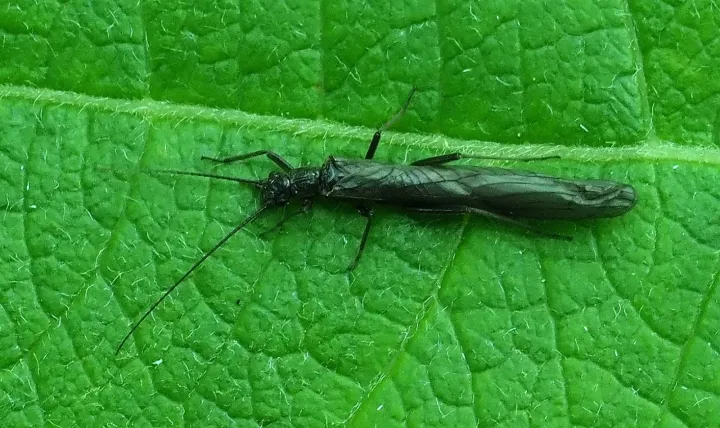
Description
How to identify
Leuctra fusca is a species of stonefly belonging to the order Plecoptera and the family Leuctridae. These are slender, small-sized insects adapted for life near running waters.
Adults exhibit a brown or dark-brown coloration, which serves as a camouflage against the bark of trees and riparian vegetation. They typically range from 7 to 12 mm in length.
The wings, when at rest, are folded tightly against the body, projecting significantly beyond the tip of the abdomen, which is a key identification feature.
The aquatic larvae are easily distinguished by their long antennae and the presence of two long cerci at the end of the abdomen, adapted for survival in high-oxygen streams.
Taxonomically, identification is confirmed by examining the wing venation patterns and the specific morphology of the terminalia in both sexes.
What it damages
The damage caused by Leuctra fusca is primarily inflicted by adults on vegetation growing in the immediate vicinity of streams and rivers.
While not a major agricultural pest, they can cause localized damage to orchard crops and coastal plants when populations reach high densities.
Feeding activity manifests as minor grazing or holes in the leaves, which, while not lethal, can diminish the plant's overall vitality.
Secondary issues arise from the mechanical injury to young shoots, potentially exposing the plant to opportunistic fungal infections.
Assessment of damage involves inspecting the leaves for irregular grazing patterns and monitoring the presence of adult stoneflies on the foliage.
When it appears
The life cycle of Leuctra fusca is strictly tied to the environmental conditions of the water bodies where the larval stages reside.
The emergence of adults typically occurs in late summer and autumn, which constitutes the peak period for potential activity on land.
Larvae remain in the water for an extended period, developing slowly as they feed on detritus and aquatic vegetation on the riverbed.
The adult phase is relatively short, focusing primarily on reproduction and egg-laying in suitable stream habitats before the onset of winter.
Agricultural monitoring should be increased during the late autumn transition when adult activity is at its zenith near riparian fields.
Signs of infestation
The primary sign of infestation is the direct observation of adult insects resting on plant stems or leaves during the twilight or night hours.
Visible feeding damage in the form of irregular notches on leaf margins or small holes in the lamina indicates their current activity.
The accumulation of stoneflies on surfaces near streams is a clear indication that the population is currently in the adult emergence phase.
Stunted growth or deformation of young, tender shoots can occur if the insect population remains active on the crop for a sustained period.
Regular visual inspections of riparian zones provide the most reliable way to detect the presence of this insect before significant damage occurs.
Control measures
Controlling Leuctra fusca requires a cautious approach, as chemical interventions can easily disrupt the delicate balance of the associated aquatic ecosystems.
Integrated Pest Management (IPM) strategies should prioritize non-chemical measures that do not contaminate the water source.
- Physical removal of adults from susceptible plants during peak activity.
- Establishment of buffer zones with non-host vegetation near stream banks.
- Promotion of natural predatory habitats to regulate insect numbers.
- Localized, minimal-impact control measures when economic thresholds are reached.
Maintaining clean and healthy stream channels helps prevent excessive population growth by managing the organic food sources required by the larvae.
Taxonomy
- Latin name
- Leuctra fusca
- Family
- Leuctridae
- EPPO code
- LUCTFU
Discussion
No discussions yet — be the first.