
Stonefly
Leuctra
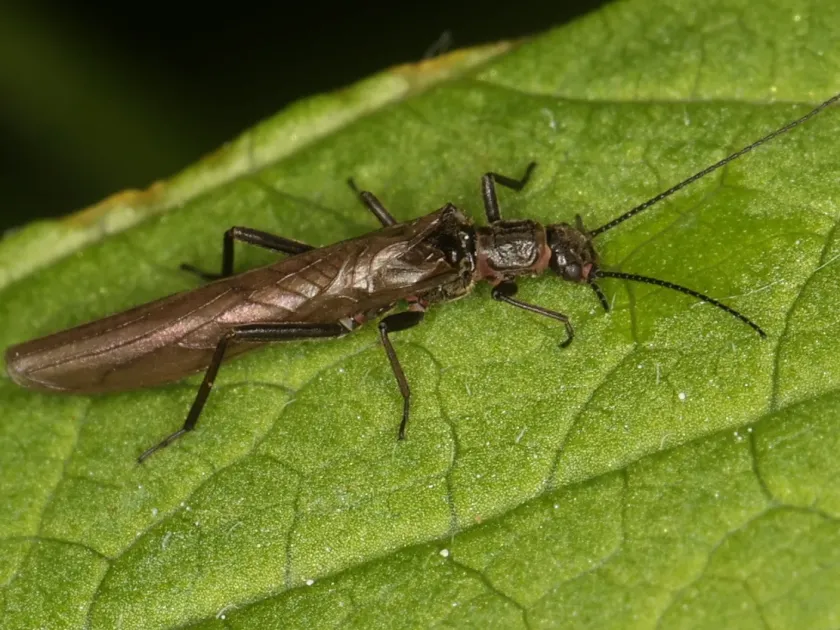
Description
How to identify
Stoneflies (order Plecoptera, family Leuctridae) are insects that undergo hemimetabolous development. They are characterized by a slender body, two pairs of membranous wings, and long, thread-like antennae.
The immature stages, known as nymphs, are strictly aquatic. They require cool, clean, and oxygenated water to survive and complete their life cycle, which makes them excellent biological indicators.
Species within the genus Leuctra are small to medium-sized. They are easily recognized by their resting wing position, where the wings are folded flat against their elongated abdomen.
Adult stoneflies are relatively poor fliers and are typically found clinging to vegetation near the water bodies where they emerged as nymphs.
While they share some morphological similarities with other aquatic insects, the specific wing venation patterns of Leuctra are key to their identification by entomologists.
What it damages
In terms of agriculture, Leuctra stoneflies do not cause any significant damage. They are not pests of any major field, fruit, or vegetable crops.
Adults often have vestigial or reduced mouthparts and feed very little, if at all, during their short adult life stage. They certainly do not consume crop leaves, stems, or fruits.
Their presence on or near agricultural land is a sign of local ecological health, particularly the quality of adjacent freshwater streams or rivers, rather than a pest infestation.
There are no recorded instances where Leuctra species have required pest management interventions or have caused any form of economic loss to farmers.
Misidentifying these insects as harmful pests can lead to unnecessary and potentially harmful use of insecticides, which should always be avoided.
When it appears
As the common name implies, stoneflies are most active during the early spring months. Emergence usually begins as temperatures rise following the winter thaw.
The life cycle of Leuctra is synchronized with seasonal water temperature changes. Nymphs grow slowly in the water for several months or even years before emerging as adults.
The adult phase of the life cycle is brief, usually lasting only a few weeks, which is solely dedicated to mating and egg-laying in suitable aquatic habitats.
Weather conditions in early spring, particularly the rate of warming, dictate the timing and intensity of the stonefly emergence in a specific region.
Monitoring for adult stoneflies is most effective during the spring season when they are found in vegetation near riparian corridors or drainage systems.
Signs of infestation
The most common sign of stonefly presence is the visual observation of adults on the stems of plants near water sources. They are often passive and easily disturbed.
Exuviae, or cast-off nymphal skins, can often be found on rocks, bridge pylons, or riparian vegetation, providing clear evidence of recent emergence.
Because stoneflies do not feed on crops, there are no specific signs of damage such as defoliation, boring holes, or stunted growth associated with this group of insects.
Farmers or scouts might notice their presence during spring operations, but this should be recorded as a neutral ecological observation rather than an infestation sign.
A lack of plant damage is the strongest diagnostic indicator that the insects observed on the field are not the cause of any agricultural issue.
Control measures
No control measures are necessary for stoneflies of the genus Leuctra. They are not considered harmful to crops and therefore do not require any pesticide applications.
The use of insecticides in areas where stoneflies are present would be counterproductive, as it could negatively affect water quality and biodiversity without any agricultural benefit.
Integrated Pest Management (IPM) guidelines do not include stoneflies as a target species, emphasizing that only genuine pests should be subject to suppression efforts.
Managing the health of nearby water bodies and surrounding vegetation is sufficient to maintain a balanced ecosystem without the need for insect control targeting this group.
The best practice is to simply monitor the field for actual pests and disregard the presence of stoneflies, recognizing them as a non-pest component of the local environment.
Taxonomy
- Latin name
- Leuctra
- Family
- Leuctridae
- EPPO code
- LUCTSP
Discussion
No discussions yet — be the first.