
Leucosolenia complicata
Leucosolenia complicata
Description
How to identify
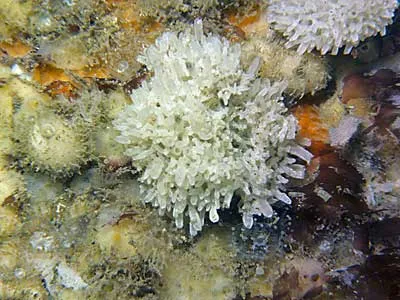
Leucosolenia complicata is a species of calcareous sponge belonging to the family Leucosoleniidae. It is exclusively a marine organism and serves as a classic model in marine biology studies.
The sponge features a highly branched, tubular morphology, creating intricate colonies. Its structure is supported by a skeleton of calcareous spicules, which gives it a distinct but soft tactile profile when underwater.
Systematically, this organism is categorized under the phylum Porifera, class Calcarea. Its biological role is restricted to benthic marine environments, where it feeds on organic micro-particles through a primitive filtration system.
The life cycle involves a dispersal larval stage followed by settlement on hard surfaces. As a sessile filter feeder, it remains stationary throughout its mature life, posing no threat to terrestrial vegetation.
There is no evidence in agricultural literature or entomological databases suggesting that this organism interacts with field crops, greenhouses, or garden plants in any harmful capacity.
What it damages
Leucosolenia complicata is not a plant pest. It lacks the specialized physiological mechanisms, such as mandibles or enzymes, required to penetrate or digest the tissues of vascular plants.
In the context of agriculture, the interaction with this organism is non-existent. It does not act as a vector for viruses, bacteria, or fungi that affect traditional agricultural produce.
Potential conflicts may arise only in marine aquaculture systems, where these sponges may colonize equipment and restrict water flow. This is a technical issue rather than an agronomic pest problem.
Since the species is stenohaline, it cannot survive in agricultural irrigation systems that use fresh water. Consequently, there is zero risk to greenhouse operations or industrial farming equipment.
The organism does not deplete soil nutrients or affect plant health in any way, making it irrelevant to the standard practices of crop protection and Integrated Pest Management (IPM).
Control measures
No agricultural control measures, such as insecticides or fungicides, are necessary or appropriate for this species. It does not pose a threat, so it does not require an eradication strategy.
In aquaculture environments where these sponges may become a nuisance, mechanical removal is the primary solution. Scrubbing or power-washing the surfaces of cages and nets is highly effective.
Exposure to fresh water serves as an excellent natural control mechanism. Because calcareous sponges are adapted to marine salinity, immersion in fresh water causes rapid cellular collapse and death.
Operators should focus on maintaining water filtration systems to prevent the accidental intake of marine biological materials into processing lines, which is a standard engineering procedure.
- Mechanical removal using brushes or scrapers.
- Flushing systems with fresh water.
- Drying out equipment to ensure dehydration.
- Maintaining filter systems for intake water.
Taxonomy
- Latin name
- Leucosolenia complicata
- Family
- Leucosoleniidae
- EPPO code
- LSOLCO
Discussion
No discussions yet — be the first.