
Willow weevil
Lepyrus palustris
Description
How to identify
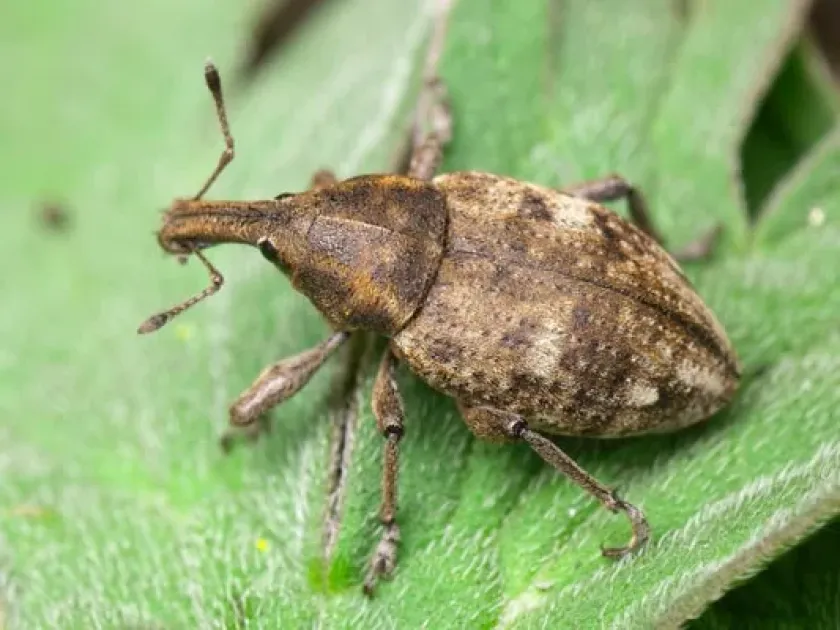
The willow weevil (Lepyrus palustris) belongs to the Curculionidae family. It is a robust beetle, approximately 10–14 mm long, with a body covered in fine greyish-brown scales that provide excellent camouflage against tree bark.
The head is extended into a characteristic snout (rostrum) of medium length. The antennae are elbowed and club-ended, which is a key diagnostic feature for this family. Their color often matches the substrate, making them difficult to spot during daylight.
The larvae are typical of weevils: legless, white-bodied, and curved, with a dark, sclerotized head. They live a cryptic lifestyle, developing either within the soil or in the lower tissues of the host plant, remaining hidden from casual observation.
Adults are predominantly nocturnal. During the day, they hide in bark crevices, leaf litter, or the upper soil layer, emerging at dusk to feed on leaves and young shoots of their host plants.
Reproduction follows a typical pattern: females carve small notches in the bark or near the root collar to lay their eggs. This ensures that the newly hatched larvae have immediate access to nutrients required for their development.
What it damages
The primary host plants for Lepyrus palustris are species of the willow genus (Salix). In some environments, the weevil may occasionally infest related woody species if its preferred food source is scarce.
Adult beetles are responsible for the most visible damage, as they feed on leaves and buds, often skeletonizing leaf margins or causing extensive irregular holes, which significantly reduces the tree's photosynthetic capacity.
Larvae cause more insidious damage by feeding on roots or the cambial layer of the lower trunk. This feeding activity disrupts the flow of water and nutrients, which can lead to the wilting and eventual death of branches or young trees.
In nurseries, the presence of the willow weevil is highly problematic as it reduces the quality of saplings, making them less marketable and more susceptible to secondary infections like fungal pathogens.
Severe infestations are most common in areas with high soil moisture, such as wetlands or riparian zones, where willow growth is abundant and provides an ideal environment for the weevil's lifecycle.
When it appears
Adult willow weevils emerge from their overwintering sites in April or May, once ambient temperatures consistently rise above 10–12 degrees Celsius. This marks the beginning of their spring feeding period.
Mating and oviposition occur throughout late spring. This period is critical for management, as the adult population is active and exposed on the foliage during twilight hours, making them susceptible to control measures.
Larval development proceeds throughout the summer months. The larvae grow through several instars, continuously feeding on the plant's tissues, which is when most of the hidden damage to the root system occurs.
New adults of the next generation emerge in late summer and early autumn. These beetles feed intensively to build up energy reserves before seeking secure locations to enter diapause for the winter.
Overwintering occurs in sheltered areas such as dense leaf litter, loose soil at the base of trees, or deep within bark cracks, where they can survive cold winter temperatures until the following spring.
Signs of infestation
The most common sign of infestation is the appearance of characteristic notched or scalloped edges on the leaves, which is the signature feeding pattern of adult weevils.
Careful inspection of young shoots may reveal small puncture marks or holes in the bark, indicating where females have laid their eggs. Occasionally, sap or gum exudation may be visible at these sites.
Sudden wilting or chlorosis of leaves without any apparent surface foliage damage often indicates larval feeding at the root collar or cambium, requiring an immediate check of the base of the plant.
At night, using a flashlight to inspect the trunks and foliage will often reveal the adult beetles. If disturbed, they are known to exhibit "thanatosis," dropping to the ground and playing dead.
Accumulations of dark, granular frass (excrement) on the leaves or the ground beneath the canopy are clear indicators of significant pest activity and the need for intervention.
Control measures
Manual control involves shaking beetles off small trees onto a cloth early in the morning or late at night, as they are sluggish and easy to catch when the temperatures are cooler.
Cultural management is essential, including maintaining clean nursery practices, removing dead or dying branches, and keeping the area around the base of trees free of excessive debris where beetles might hide.
Chemical control focuses on applying systemic or contact insecticides during the period of peak adult activity in the spring. Rotation of chemical classes is recommended to prevent the development of pest resistance.
Biological control methods include encouraging natural predators, such as insectivorous birds and parasitic wasps, which can help keep weevil populations at manageable levels without chemical intervention.
Regular monitoring using visual inspections or pitfall traps helps to identify the onset of an infestation early, allowing for localized spot treatments that prevent the spread of the pest across the entire site.
Taxonomy
- Latin name
- Lepyrus palustris
- Order
- Coleoptera (beetles)
- Family
- Curculionidae
- EPPO code
- LPYRPA
Discussion
No discussions yet — be the first.