
Leptoxyleborus sordicauda
Leptoxyleborus sordicauda
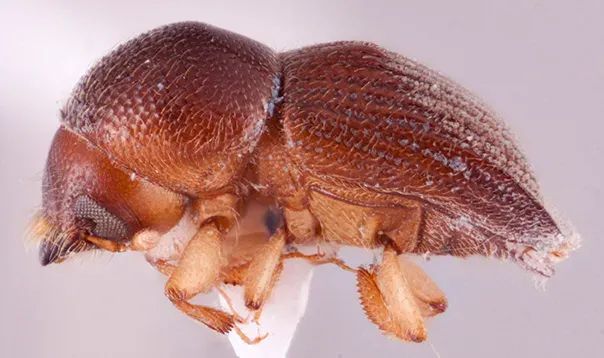
Description
How to identify
Leptoxyleborus sordicauda is a species of bark and ambrosia beetle belonging to the family Curculionidae and subfamily Scolytinae. These insects are notorious for their concealed lifestyle within the woody tissues of trees.
The adult beetles typically exhibit a cylindrical body shape, which is highly adapted for moving through galleries inside wood. Their coloration is generally dark brown to black, aiding in their camouflage against the bark.
As part of the tribe Xyleborini, these beetles maintain a symbiotic relationship with specific ambrosia fungi. They possess specialized structures called mycangia used to transport fungal spores to new host trees.
The biology of the species revolves around the fungus, which serves as the primary nutrient source for the larvae. The beetles do not feed on wood directly but instead "farm" the fungi within the galleries they excavate.
Lifecycle stages include eggs, larvae, pupae, and adults. Due to the rapid development cycle in tropical environments, multiple generations can occur throughout the year under favorable conditions.
What it damages
This beetle primarily attacks deciduous tree species in tropical and subtropical regions. It often targets weakened or stressed trees, though some infestations can occur in apparently healthy specimens.
The damage is caused by the construction of extensive gallery systems within the xylem. This physical disruption blocks the tree's vascular system, preventing the transport of water and nutrients.
Economic damage is significant in the timber industry. The galleries create unsightly dark tunnels in the wood, known as "pinholes," which degrade the quality and market value of the lumber.
Furthermore, the introduction of pathogenic fungi by the beetles can accelerate the death of the tree, making it vulnerable to other secondary pests and wood-decay organisms.
In forest management, Leptoxyleborus sordicauda is considered a pest that requires strict quarantine monitoring to prevent its spread through the international trade of logs.
Signs of infestation
The most diagnostic sign of an infestation is the presence of fine, powdery frass (boring dust) pushed out from the entrance holes by the beetles.
Entrance holes are typically small, circular, and uniform in size, measuring about 1 to 2 millimeters in diameter, often difficult to spot without careful inspection of the trunk.
Dark stains on the bark surface surrounding the entry points often indicate the development of ambrosia fungus, which can be visible as the beetle continues its activity.
Dieback, yellowing leaves, or premature leaf drop are common symptoms in the tree canopy, resulting from the vascular disruption caused by the galleries deeper inside the stem.
Upon removing the outer bark, one can observe the characteristic intricate branching galleries filled with fungal growth, which is a hallmark of ambrosia beetle colonization.
Control measures
Effective management begins with strict forest hygiene, including the prompt removal and destruction of infested logs to prevent the emergence of new adult beetles.
Pheromone-based trapping systems are used to monitor beetle activity and population levels, providing crucial data for determining the timing of localized interventions.
Protective measures for valuable timber involve keeping logs dry, applying preventative insecticide treatments, and using mechanical barriers where feasible to discourage colonization.
Maintaining high tree health and vigor through appropriate silvicultural practices helps prevent the stress that makes trees attractive to wood-boring insects.
- Regular forest surveys to detect early signs of "boring dust."
- Destruction of heavily infested material via incineration.
- Use of trap logs to attract and collect beetle populations.
Taxonomy
- Latin name
- Leptoxyleborus sordicauda
- Order
- Coleoptera (beetles)
- Family
- Curculionidae
- EPPO code
- LETXSO
Discussion
No discussions yet — be the first.