
Leptopius
Leptopius
Description
How to identify
Leptopius is a genus of weevils (family Curculionidae) known for their robust build and significant impact on woody plants. These beetles are predominantly native to Australia and are well-adapted to diverse forest ecosystems.
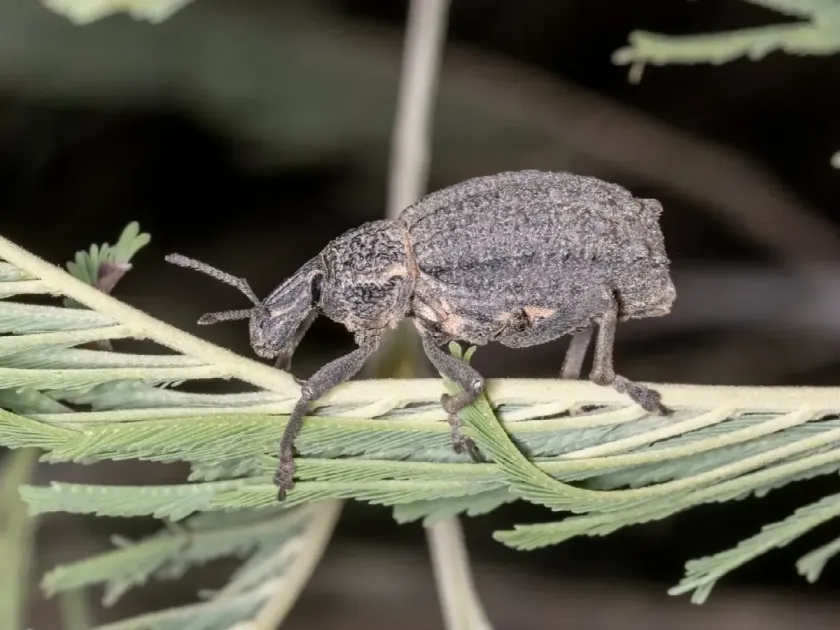
Adult weevils possess a hard, chitinous exoskeleton and a characteristic snout. Their coloration is usually mottled, providing effective camouflage against tree bark, which makes visual detection difficult.
The life cycle is complex, involving stages from egg to larva, pupa, and adult. Females lay eggs in soil cracks or beneath tree bark, ensuring the larvae have immediate access to food sources upon hatching.
Larvae are white, legless, and have powerful mandibles. They spend their entire developmental period in the soil, feeding on roots, which makes them essentially invisible until significant damage is already done.
The adult lifespan can be quite long, and they may be found in both urban landscapes and natural forests depending on the availability of host species.
What it damages
Leptopius primarily targets members of the Fabaceae and Myrtaceae families. In agricultural contexts, they pose a threat to fruit orchards and ornamental tree nurseries.
The damage caused by larvae is often critical, as they prune or destroy major roots, leading to the sudden decline of mature trees and the death of younger ones.
Adult beetles feed on leaves, creating distinct semi-circular notches. While this does not usually kill the tree, it significantly reduces the photosynthetic efficiency of the plant.
Severe infestations can lead to total growth stagnation, making trees more susceptible to drought, wind, and secondary pathogens like fungal rots.
- Root system destruction by subterranean larvae.
- Foliage notch damage by adult weevils.
- Growth retardation in nursery saplings.
- Increased tree vulnerability to environmental stress.
When it appears
Adult activity is highly seasonal and typically coincides with the arrival of warmer weather in spring and early summer when sap flow in trees is at its peak.
Egg-laying periods are concentrated during the warmer months, ensuring that larvae can develop in soil that remains adequately warm and moist.
Pupation occurs in soil chambers constructed by mature larvae, usually reaching completion just before the onset of the next adult emergence cycle.
Environmental factors such as soil temperature and moisture levels are the primary drivers of the development rate, often leading to uneven emergence of adults.
In regions with mild winters, the biological clock of these insects can be less synchronized, leading to overlapping generations and a prolonged period of potential damage.
Signs of infestation
Visible signs of infestation include the characteristic notched edges of leaves, which serve as a primary indicator of adult weevil presence.
Subterranean activity is harder to detect, but a sudden yellowing or wilting of the canopy without obvious drought symptoms is a major red flag for root damage.
Check the base of the trunk for small exit holes or damaged bark, which can indicate where the beetle emerged from or entered the soil.
Manual inspection using a flashlight at night can reveal adults feeding on leaves or crawling on the bark surface.
Soil disturbance around the root zone may occasionally reveal larvae, especially if the infestation is heavy and localized near the root collar.
Control measures
Effective management requires a multi-pronged approach, focusing on both soil-borne larvae and aerial adult populations to prevent population growth.
Soil drenches using entomopathogenic nematodes are a highly recommended biological control method, as they actively seek out and infect the larvae in their underground environment.
For adult beetles, targeted applications of systemic or contact insecticides during the evening hours provide the best protection against foliage damage.
Good sanitation, including the removal of severely infested plants and debris, helps to break the life cycle and reduce the number of potential breeding sites.
Regular monitoring of root health in nursery stock is essential, as preventative measures are always more effective than attempting to restore a compromised root system.
Taxonomy
- Latin name
- Leptopius
- Order
- Coleoptera (beetles)
- Family
- Curculionidae
- EPPO code
- LPTISP
Discussion
No discussions yet — be the first.