
California ash borer
Leperisinus californicus
Description
How to identify
The California ash borer (scientific name Leperisinus californicus) belongs to the order Coleoptera and the family Curculionidae, specifically the subfamily Scolytinae. These beetles are specialized wood-boring insects known for their ability to colonize various woody species.
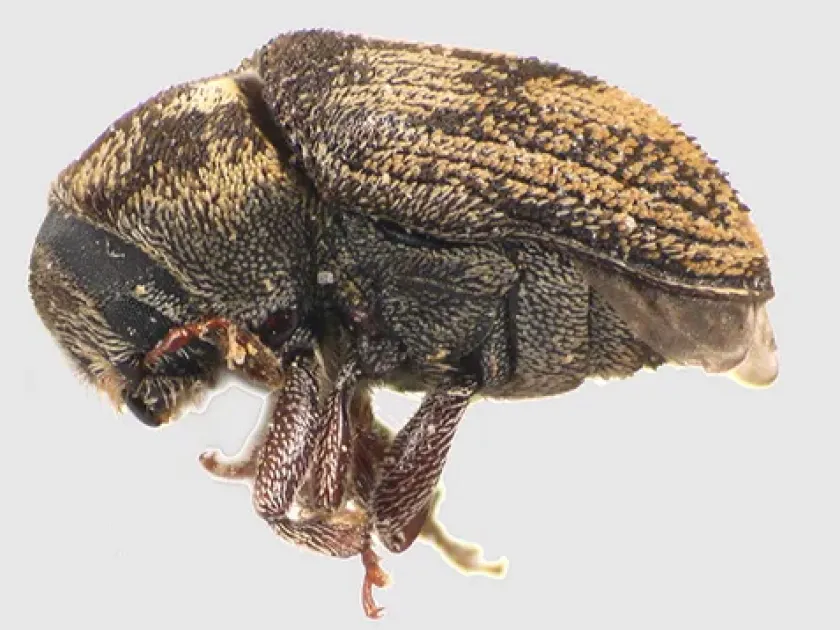
The adult beetle is small and cylindrical, typically brown to black in color. Their morphology is adapted for life under bark, with a head often concealed by the pronotum, which is a classic feature of bark beetle species.
Larvae are legless, C-shaped, and creamy-white in appearance. They are the stage responsible for the primary internal damage, as they feed on the nutritious phloem and cambium layers of the host plant.
This species is recognized for its preference for certain types of host trees, particularly those that are already stressed or compromised by environmental factors. Understanding this preference is key to monitoring and identifying local outbreaks.
The taxonomy of this species is well-documented within entomological studies, emphasizing its role as a pest in both forested areas and managed landscapes where its host trees are present.
What it damages
The primary hosts of this insect are various species of trees and shrubs. The feeding activity of both adults and larvae compromises the tree's vascular system, hindering the transport of water and nutrients.
Adult beetles create entrance holes, followed by complex galleries where females lay eggs. As larvae hatch and grow, they tunnel extensively through the bark, disrupting the cambium layer that is essential for tree growth and longevity.
By damaging the phloem, the infestation eventually causes the foliage to wilt and branches to die back. In severe cases, the entire tree can succumb to the infestation, especially if it was already in a weakened state.
Moreover, the damage acts as an entry point for secondary pathogens, such as wood-decaying fungi and bacteria, which can accelerate the decline of the tree and make recovery nearly impossible once the infestation becomes widespread.
Economic damage is significant in both silviculture and landscaping, where the loss of trees leads to decreased timber value or the loss of ornamental shade and aesthetic appeal in parks and private gardens.
When it appears
The life cycle of the California ash borer is highly dependent on environmental temperatures. Springtime, once temperatures rise consistently, marks the emergence of overwintering adults and the beginning of the flight period.
During the summer months, the beetle is at its most active, engaging in mating and searching for new host trees. This is the period when the population grows most rapidly and spreads to neighboring trees.
Multiple generations can occur within a single growing season if climatic conditions remain favorable, particularly in regions with long, warm summers. This leads to cumulative damage that can build up throughout the season.
As autumn approaches and temperatures drop, the insect enters its overwintering phase. Adults typically seek shelter within the bark of a host tree or migrate to the leaf litter at the base to endure the winter months.
Monitoring for the timing of adult flight is vital for effective management. Knowing when the insects are active allows for the application of protective measures before colonization takes hold.
Signs of infestation
The most telltale sign of infestation is the presence of "frass"—a mixture of wood dust and beetle excrement that is pushed out of entrance holes and accumulates on the bark or at the base of the tree trunk.
Visible inspection of the bark reveals numerous tiny circular holes, often referred to as "shot holes," which indicate where the beetles have successfully penetrated the surface.
Stressed trees may show signs of yellowing leaves, thinning canopy, and dieback in the crown. These symptoms often progress from individual limbs to the entire tree as the infestation continues.
Under the bark, one can find the signature galleries of the beetle. The pattern and complexity of these tunnels vary depending on the beetle density and the time elapsed since the initial colonization.
- Accumulated wood dust (frass) at the base of the tree
- Numerous small entrance holes in the bark
- Wilting or premature yellowing of leaves
- Dieback of twigs and branches
- Complex tunnel galleries visible under the bark
Control measures
Preventative care is the most effective defense. Maintaining tree health through proper watering, mulching, and fertilization increases the tree's natural resistance and its ability to withstand minor pest attacks.
Sanitation is crucial; all infested limbs or dead trees must be pruned, removed, and destroyed promptly. This prevents the emergence of the next generation of beetles and limits the spread to healthy trees nearby.
During the peak flight season, protective trunk sprays using contact insecticides can be used to prevent beetles from boring into the bark. These treatments must be applied thoroughly to be effective.
Trapping techniques, including the use of pheromone or color-attractant traps, can help reduce the local beetle population. While these are often used for monitoring, they also serve as a non-chemical method of control.
In cases of severe infestation, professional tree care services may be needed to apply systemic insecticides. These treatments are absorbed by the tree and help control the internal populations of larvae effectively.
Taxonomy
- Latin name
- Leperisinus californicus
- Order
- Coleoptera (beetles)
- Family
- Curculionidae
- EPPO code
- LEPECA
Discussion
No discussions yet — be the first.