
Ash bark beetle
Leperisinus
Description
How to identify
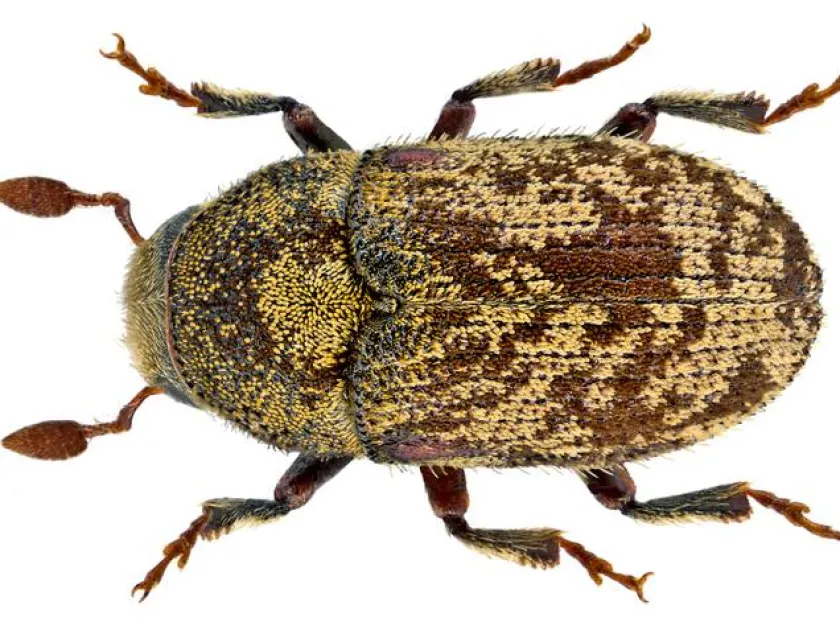
The ash bark beetle (lat. Leperisinus varius) belongs to the Curculionidae family, subfamily Scolytinae. It is a small beetle, typically measuring only 3–4 mm in length.
The body of the adult is oval-shaped, with a color ranging from dark brown to almost black, featuring a characteristic pattern of light-colored scales on the elytra.
The larva is a white, legless grub with a brown head, typical of bark beetles, and lives hidden under the tree bark.
The insects overwinter primarily as adults in specialized maternal galleries or within the bark of young trees, where they feed before emergence.
The life cycle involves complete metamorphosis: egg, larva, pupa, and adult, with the development of one generation usually taking one calendar year.
What it damages
The primary host is the European ash (Fraxinus excelsior), though the pest may occasionally affect other ash species and sometimes olive trees.
Adults cause damage to young shoots by boring short feeding galleries, which leads to reduced growth and the withering of branches.
Larvae create branched galleries in the phloem and cambium, disrupting nutrient flow, which often leads to the death of the entire tree during mass infestations.
Trees stressed by drought, disease, or poor growing conditions are the most susceptible to attacks.
Mass outbreaks of this pest can lead to the widespread dieback of ash forests, posing a severe threat to both forestry and urban landscaping.
When it appears
The emergence of overwintered adults usually begins in spring, when bark temperatures reach optimal levels, typically occurring in May.
Mating and oviposition take place throughout June, as females bore maternal galleries under the bark of weakened trees.
Larval development continues throughout the summer, followed by pupation in August and September, leading to the emergence of the new generation.
After a period of supplemental feeding on shoots, young adults prepare for overwintering, seeking shelter in bark crevices or niches within the wood.
Agronomic monitoring of plantation health is most critical during the spring flight period, as this is when insecticide applications are most effective.
Signs of infestation
One of the first signs of infestation is the appearance of small, round entry holes on the bark, accompanied by fine wood dust known as boring dust.
Upon careful inspection of the canopy, one may notice premature yellowing and wilting of individual shoots that snap off easily.
When a portion of the bark is peeled back on an infected tree, characteristic "star-shaped" or transverse maternal galleries are revealed, with larval tunnels branching off.
Overall tree weakness, manifested by sparse foliage and crown dieback, also indirectly indicates hidden infestation by wood-boring pests.
- Bark fragments falling off in areas of active feeding.
- Presence of resin or sap flows on the trunk.
- Distinctive gnaw marks on the bark of young branches.
Control measures
The primary control measure is the timely sanitary felling and removal of infested trees before the pest spreads to neighboring healthy plants.
Systemic insecticides are effective during the adult flight period and the subsequent supplemental feeding on young shoots.
Maintaining high standards of silviculture, including optimal watering and fertilization, is crucial as healthy trees possess greater resistance to the beetle.
The use of pheromone traps allows for the monitoring of population density and the precise timing of protective treatments.
Biological control methods include utilizing natural enemies of bark beetles, such as predatory insects and entomopathogenic fungi, which is vital for forest ecosystems.
Taxonomy
- Latin name
- Leperisinus
- Order
- Coleoptera (beetles)
- Family
- Curculionidae
- EPPO code
- LEPESP
Discussion
No discussions yet — be the first.