
Siberian brown lemming
Lemmus sibiricus
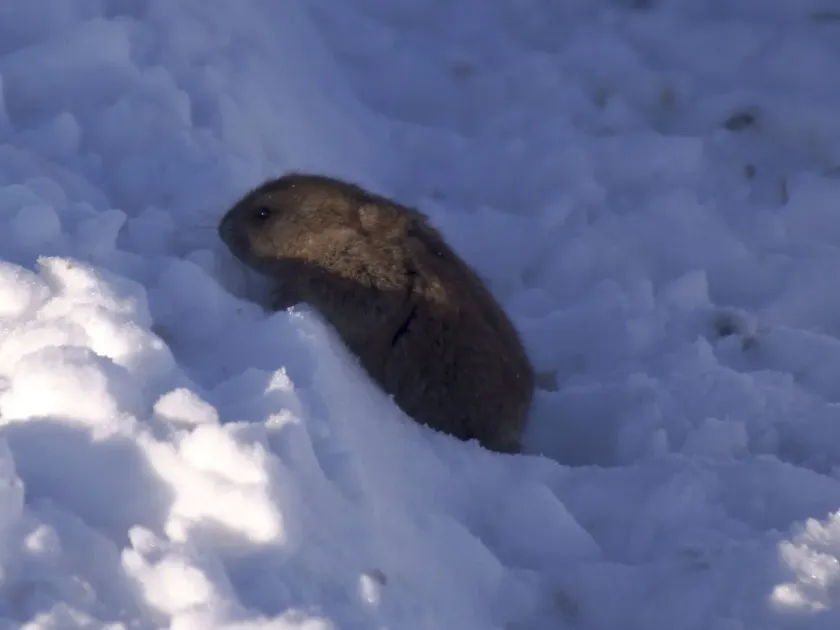
Description
How to identify
The Siberian brown lemming Lemmus sibiricus belongs to the order Rodentia and the family Cricetidae. It is a small, compact rodent with a short tail and dense fur adapted for harsh arctic environments.
Adult individuals typically weigh up to 130 grams and reach a body length of about 13–15 centimeters. Their front paws are equipped with robust claws, facilitating burrowing and movement through dense soil or deep snow.
Systematically, this species is intrinsic to the tundra and sub-arctic ecosystems. However, during periods of peak population density, they frequently migrate into areas utilized for agriculture.
These rodents exhibit a high reproductive rate, which is a fundamental biological trait. Under favorable conditions, their populations expand rapidly, leading to cyclic outbreaks of activity.
Young lemmings reach sexual maturity at a very early age, often as early as three weeks, which allows for the explosive population growth typical of the species.
What it damages
The primary agricultural damage caused by the Siberian lemming occurs in northern latitudes, where they consume forage grasses, drastically reducing the quality of pastures and hayfields.
When lemmings invade grain fields, they cut down wheat or barley stems, particularly during the milky ripening stage, which directly leads to significant crop yield loss.
Vegetable crops, especially root vegetables and leafy greens, are highly susceptible to damage. Lemmings often gnaw the stems at the base or consume the storage roots, causing plant death.
In winter, when food sources are scarce, lemmings may gnaw the bark of young trees and ornamental shrubs, which can result in long-term damage or the death of the plantings.
Beyond feeding, the rodents cause structural damage to fields by creating extensive tunnel systems and trails, which disturbs the soil structure and interferes with mechanized harvesting operations.
When it appears
Siberian lemmings remain active throughout the year as they do not hibernate. The subnivean period (under the snow) is critical for their survival and feeding activities.
Spring thaw events force lemmings to abandon flooded burrows, often causing them to move toward higher, cultivated areas where they pose an immediate threat to emerging seedlings.
Summer corresponds to the peak nutritional intake period. As agricultural crops grow, lemmings focus on consuming the abundant, nutritious green biomass available on farms.
During the autumn, lemmings increase their foraging intensity to build up energy reserves, making this season a high-risk period for crop infestation before the ground freezes.
Population cycles are highly predictable, with outbreaks usually occurring every few years. Monitoring these cycles allows farmers to prepare defensive strategies in advance.
Signs of infestation
The most reliable indicator of lemming activity is the presence of complex burrow networks with characteristic soil mounds at the entrances across the field surface.
Plants cut at an angle are a tell-tale sign of lemming presence. Rodents typically snip stalks cleanly with their incisors while foraging in grain or grass fields.
Distinct trails and tracks visible through the vegetation indicate movement patterns between burrows and food sources. These paths are often kept clear by the rodents.
The presence of droppings near foraging sites is another diagnostic feature. These are small, dark, cylindrical pellets that confirm the area is being utilized as a feeding zone.
Winter damage is often identified in spring as bare patches of soil where vegetation has been completely grazed away beneath the protective cover of the snow.
Control measures
Effective management includes deep autumn plowing, which destroys the burrow systems and disrupts the rodents' winter habitats, leading to a localized reduction in the population.
The use of rodenticides can be implemented in specific areas, provided that environmental safety guidelines are followed to protect birds of prey and other non-target species.
Physical exclusion methods, such as installing fine-mesh fencing buried at least 20–30 centimeters into the ground, can be highly successful for protecting high-value crops and nurseries.
Maintaining a weed-free buffer zone around cultivated fields reduces the attractiveness of the area to lemmings, as it eliminates necessary cover and nesting materials.
Ultrasonic repellers can be utilized on smaller plots to create an acoustic environment that is uncomfortable for rodents, prompting them to relocate away from the crop site.
Taxonomy
- Latin name
- Lemmus sibiricus
- Order
- Rodents
- Family
- Muridae
- EPPO code
- LEMMOB
Discussion
No discussions yet — be the first.