
Amur lemming
Lemmus amurensis
Description
How to identify
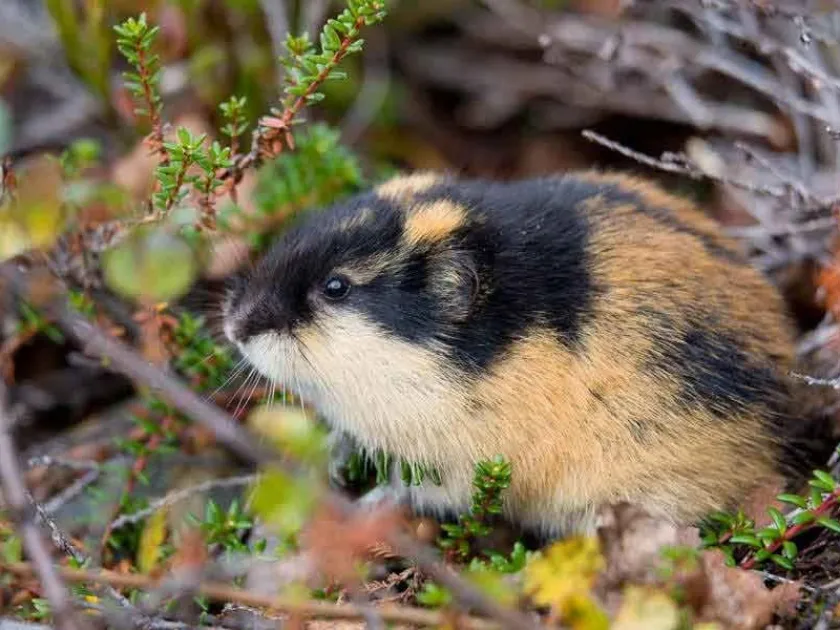
The Amur lemming (Lemmus amurensis) belongs to the order Rodentia and the family Cricetidae. It is a small, stout-bodied rodent with a short tail and dense fur that changes color depending on the season.
The species is characterized by relatively short ears, which are almost completely hidden in its winter coat. The body length of an adult specimen ranges from 10 to 13 centimeters, making it a typical small mammal of the tundra and forest-tundra zones.
Particular attention during identification should be paid to the claws on the forelimbs: they are powerful and adapted for digging through dense soil and constructing sub-nivean (under-snow) tunnels.
The dorsal coloration varies from grayish-brown to reddish, which provides camouflage in its natural habitat. This coloring is essential for avoiding predators in open northern landscapes.
The biology of the species is closely linked to extreme northern conditions. Lemmings are highly prolific, leading to sudden population explosions that can turn them from neutral residents into significant agricultural pests.
What it damages
The main damage caused by the Amur lemming occurs in areas where northern land development brings natural pastures and fodder crop fields into proximity with the rodent's natural habitats.
The pest damages the above-ground parts of herbaceous plants, consuming juicy stems and leaves of grain and legume crops. During the autumn and winter months, lemmings may damage the bark of trees and shrubs, as well as young shoots, weakening saplings.
Their mass migrations pose a specific threat, as dense colonies can consume a significant portion of green biomass in pastures, drastically reducing the productivity of hayfields.
During warm winters or prolonged autumns, lemmings may switch to consuming agricultural root crops stored in poorly protected piles or left in the soil, causing substantial economic losses to farmers.
Intensive burrowing and tunneling beneath the turf disrupt soil structure, negatively affecting the root systems of young plantings and complicating subsequent mechanized field operations.
Signs of infestation
The primary sign of Amur lemming presence in a field is the appearance of numerous burrows and deep furrows in the soil, which become visible after snowmelt or during active colonization.
The presence of specific "grazing patches," where vegetation has been eaten down to the base, indicates a high concentration of rodents in a specific area of a pasture or field.
Excrement and remnants of uneaten plant parts, often found in small piles on the soil surface, are clear markers of lemming activity in the immediate vicinity.
When sapling bark is damaged, characteristic incisor marks can be seen on the lower trunk or primary branches; circular damage often leads to the death of the young plant.
In winter, the presence of lemmings is indicated by a network of branched tunnels under the snow, which expose trampled and damaged sections of crops once the snow melts, contrasting sharply with healthy vegetation.
Control measures
The primary method for controlling the Amur lemming population is an integrated agronomic approach aimed at creating conditions unfavorable for the reproduction and movement of rodents across agricultural lands.
Regular deep plowing of fields after harvest destroys burrow systems and nesting chambers, forcing the population to abandon the treated area or physically eliminating part of the colony.
An effective protection method is the maintenance of quarantine zones around feed storage facilities and the use of fine-mesh metal fencing to protect nurseries and young plantings from rodent intrusion.
During periods of critical population growth, rodenticides may be used; however, the use of chemical agents must be strictly regulated to prevent secondary poisoning of local birds of prey and fur-bearing predators.
- Preventive destruction of weeds along field margins.
- Encouraging natural predators such as owls, foxes, and stoats.
- Timely harvesting and removal of root crop yields.
- Monitoring population density at the beginning of the spring season.
Taxonomy
- Latin name
- Lemmus amurensis
- Order
- Rodents
- Family
- Muridae
- EPPO code
- LEMMAM
Discussion
No discussions yet — be the first.