
Harvestman
Leiobunum rotundum
Description
How to identify
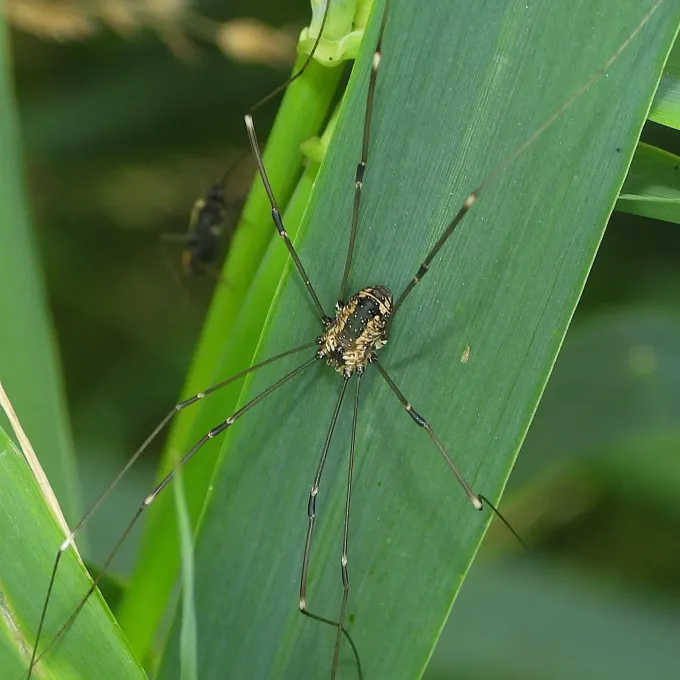
The harvestman, Leiobunum rotundum, is a fascinating arachnid characterized by its exceptionally long, fragile legs and a compact, rounded body.
Unlike true spiders, they lack a pedicel or "waist" connecting their body segments, making them appear as a singular, unified oval structure.
Their coloration is generally brownish or orange-tan, frequently featuring a dark, saddle-shaped marking on the dorsal side of the body.
They possess a prominent ocular tubercle in the center of their body, housing their eyes, which is a key diagnostic feature for identification.
They are capable of autotomy, voluntarily shedding a limb if grabbed by a predator, which allows them to escape while the leg continues to twitch.
What it damages
While often acting as beneficial predators of aphids and small insects, Leiobunum rotundum can occasionally cause harm to delicate crops.
During population spikes, they may feed on young seedling tissues or succulent stems, causing wilting or stunted growth in sensitive plant varieties.
They have been observed damaging soft fruits, such as strawberries, by piercing the skin, which then facilitates secondary rot infections.
In greenhouses, their habit of congregating on plant foliage can result in physical contamination, affecting the marketability of vegetables and flowers.
However, under normal field conditions, they are rarely classified as primary pests and usually coexist with crops without causing economic loss.
When it appears
The life cycle begins in late spring, as temperatures rise, allowing juveniles to emerge from their overwintering sites in the soil or leaf litter.
Their peak activity occurs throughout the summer months, aligning with the period of rapid crop development and high humidity in dense vegetation.
As autumn approaches, the adult population prepares for the reproductive phase and eventual egg-laying in protected, moist environments.
They follow a univoltine cycle, meaning there is only one generation per year, which simplifies the timing of management interventions.
Environmental conditions such as excessive moisture and dense weed cover significantly favor the expansion of their population during the season.
Signs of infestation
Identification of their presence usually involves locating clusters of individuals hidden under leaves or in shaded, damp corners of the field or greenhouse.
Damage to crops often manifests as shallow, irregular epidermal marks, distinct from the clean-cut edges caused by chewing insects like caterpillars.
An abundance of detached legs scattered on the ground indicates that the local population is active and potentially interacting with other insects.
Nighttime monitoring with a light source reveals their activity as they move across plant stems using their characteristic stilt-like walk.
The presence of small, dark excretory spots on fruit surfaces is a reliable indicator that harvestmen have been feeding or congregating on the crop.
Control measures
The most effective management strategy involves keeping fields free of weeds and dense debris to reduce their preferred humid microhabitats.
Regular cultivation of the soil between crop rows can disturb their breeding sites and reduce the number of individuals reaching maturity.
Managing irrigation systems to prevent standing water or overly damp conditions helps make the environment less suitable for the harvestmen.
Promoting a healthy ecosystem for birds and other natural insectivores naturally keeps the population in check without requiring chemical inputs.
Chemical control is rarely necessary; however, if populations reach economic thresholds, targeted applications of contact insecticides may be applied.
Taxonomy
- Latin name
- Leiobunum rotundum
- Family
- Sclerosomatidae
- EPPO code
- LEIBRO
Discussion
No discussions yet — be the first.