
Harvestman
Leiobunum
Description
How to identify
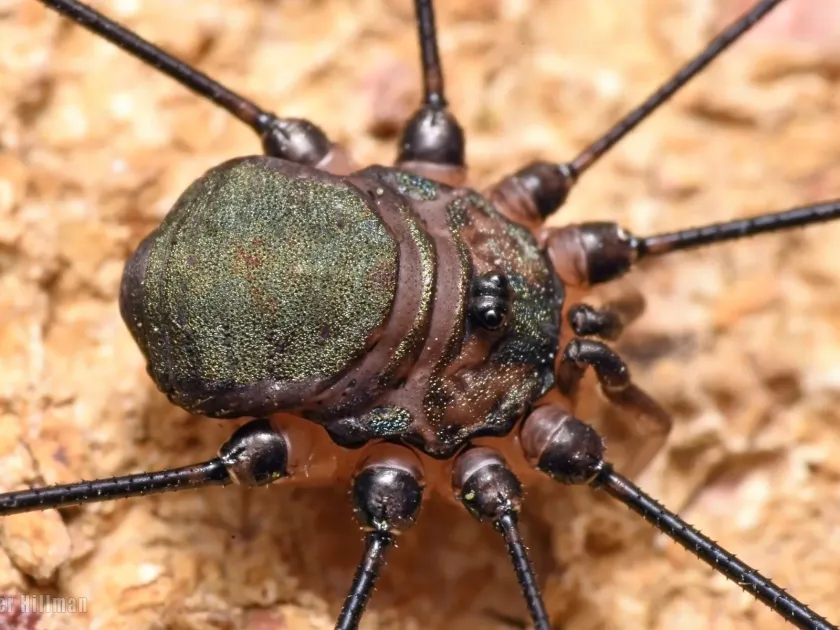
Harvestmen of the genus Leiobunum are arachnids belonging to the order Opiliones. They are easily distinguished from spiders by their compact, single-segment body and exceptionally long, thin legs.
Unlike true spiders, harvestmen do not possess venom glands, nor do they spin webs. Their body appearance is essentially a single oval shield, which is a diagnostic feature of this order.
These organisms move across vegetation on their elongated legs, which function like stilts. Their coloration is typically cryptic, ranging from brown to greyish hues, providing camouflage against bark, soil, or leaves.
Harvestmen have a single pair of eyes located on a small, central tubercle. They are highly sensitive to chemical and tactile signals in their environment, which helps them navigate and detect potential food sources.
Because they do not have the complex anatomy of orb-weaving spiders, harvestmen rely on their agility and generalist feeding habits to survive in various agricultural and forest habitats.
What it damages
It is crucial to state that Leiobunum species are not agricultural pests. They do not feed on plant tissues, do not bore into crops, and do not cause any physiological damage to fruits, leaves, or roots.
They are generalist predators and scavengers. Their diet includes small insects, such as aphids, mites, and various insect larvae, as well as decaying organic matter found on the soil surface.
By consuming smaller invertebrates, harvestmen act as beneficial biological control agents. They contribute to the natural suppression of pest populations within the agroecosystem.
The misconception that harvestmen are pests often stems from their appearance when found in large clusters. However, this clustering behavior is simply a survival strategy for thermoregulation and hydration.
Farmers should view the presence of harvestmen as a positive indicator of ecological health. They do not pose any economic threat to crops, and their removal is never recommended.
When it appears
The lifecycle of Leiobunum harvestmen is seasonal, typically spanning from spring through late autumn. Adults are most conspicuous during the warmer months of mid-to-late summer.
The winter period is usually spent in the egg stage. Eggs are laid in protected crevices within the soil or beneath decaying leaf litter, where they remain dormant until spring temperatures rise.
After hatching, the nymphs undergo several molts as they grow into adults. Throughout this period, they are actively foraging for food, gradually increasing their range and impact as beneficial predators.
As the season progresses toward autumn, harvestmen exhibit social aggregation. Gathering in large groups is a classic autumnal behavior that helps them survive fluctuating temperatures and moisture loss.
By the onset of hard frost, most adults expire. The cycle is maintained exclusively through the eggs protected in the soil, ensuring the emergence of the next generation in the following season.
Control measures
There are no control measures for harvestmen, as they are non-pest organisms. Implementing any form of extermination would be counter-productive to the principles of integrated pest management.
Excessive use of broad-spectrum pesticides is the primary threat to harvestmen populations. By killing these beneficial predators, farmers inadvertently remove a natural defense against more destructive pests.
Maintaining field margins and avoiding unnecessary soil disturbance can help protect the micro-habitats where harvestmen deposit their eggs and find shelter during the winter months.
If harvestmen are found in storage facilities, simple sanitation and improved ventilation are sufficient to encourage them to move elsewhere, as they prefer humid, sheltered natural environments.
Promoting a balanced agroecosystem involves respecting the roles of various organisms, including harvestmen. We strongly advocate for their conservation as part of sustainable farming practices.
Taxonomy
- Latin name
- Leiobunum
- Family
- Sclerosomatidae
- EPPO code
- LEIBSP
Discussion
No discussions yet — be the first.