
Lecanodiaspis scale
Lecanodiaspis
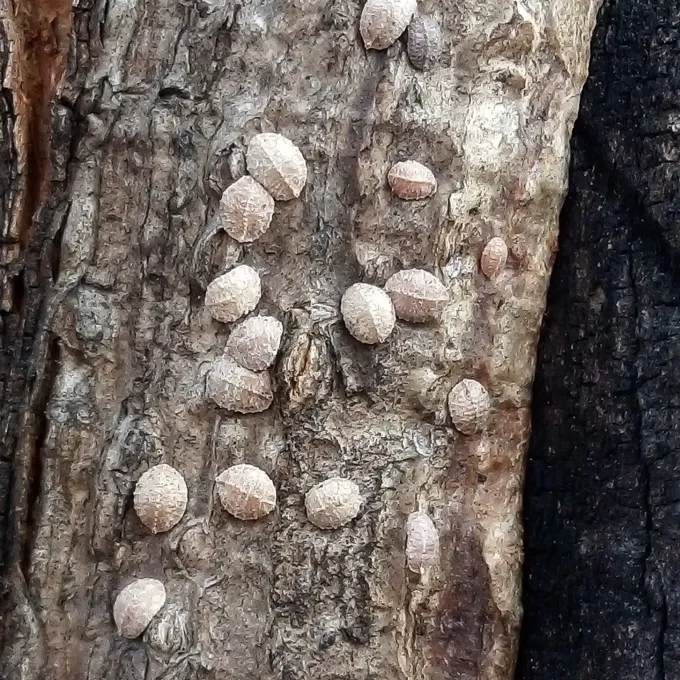
Description
How to identify
The genus Lecanodiaspis belongs to the family Lecanodiaspididae. These are specialized scale insects where the female is protected by a test (scale) composed of wax and other secretions.
Adult females are sedentary, living permanently attached to the bark of the host plant. Their scales are often cryptic, mimicking the texture and color of the bark to avoid detection by predators and observers.
The first-instar nymphs, known as crawlers, are the only mobile stage. They are minute and possess legs, allowing them to disperse to new feeding sites on the host plant or to be carried by wind to nearby plants.
Males are structurally different, undergoing metamorphosis that includes a pupal-like stage. They possess wings and are ephemeral, living only long enough to locate and mate with the females.
Identification often requires careful examination of the insect's microscopic morphology, including the arrangement of pores and the structure of the pygidial margin.
What it damages
These pests primarily target woody plants, including various deciduous trees and shrubs found in urban landscapes, forests, and ornamental gardens.
By inserting their piercing-sucking mouthparts into the plant tissues, they extract sap, which deprives the tree of essential nutrients and weakens its vascular system.
Chronic infestation leads to a decline in tree vigor, characterized by stunted growth, branch dieback, and increased susceptibility to secondary infections and environmental stress.
The damage caused by Lecanodiaspis scale can be particularly severe in nursery settings, where the cosmetic quality of the plants is critical for market value.
If left unmanaged, heavy infestations can result in the death of smaller plants or severely disfigured crown structures in older trees.
When it appears
The life cycle of the scale is synchronized with the seasonal growth of the host plant. Activity typically increases as spring temperatures rise, promoting the feeding cycle.
Crawlers usually emerge during late spring or early summer. This window is the most critical time for monitoring and intervention, as the nymphs are most vulnerable before forming their protective covers.
As summer progresses, the scales develop and mature, with females hardening their protective wax shields to survive the changing environmental conditions.
Winter survival is achieved by the insect entering a period of diapause, often remaining fixed on the bark, capable of enduring sub-zero temperatures.
Depending on the species and regional climate, there may be one or more generations per year, with the number of cycles determining the potential for rapid population growth.
Signs of infestation
The most prominent sign is the presence of small, raised bumps on the bark that feel firm or leathery to the touch and cannot be easily removed.
Infested trees often show signs of sooty mold, a dark, powdery fungal growth that thrives on the honeydew secreted by the feeding scales.
Leaf yellowing and premature leaf drop are common symptoms, reflecting the internal stress placed on the tree's physiological processes by the scale population.
Stunted twig growth and dieback of outer branches are reliable indicators that the scale population has reached a damaging level over several seasons.
- Raised, bump-like structures on stems.
- Sticky residue (honeydew) on foliage.
- Development of sooty mold.
- Reduced annual shoot growth.
- Branch dieback and wilting.
Control measures
Integrated Pest Management (IPM) is essential for controlling Lecanodiaspis. This begins with good cultural practices, such as pruning away heavily infested branches to reduce the overall population.
Dormant oil sprays applied in early spring can effectively smother the overwintering females by blocking their respiratory pores before growth begins.
Systemic insecticides are most effective when applied during the crawler emergence phase, as the young nymphs ingest the chemical while feeding on the plant sap.
Encouraging natural predators, such as lady beetles, lacewings, and parasitic wasps, can provide a significant level of biological control in balanced ecosystems.
Regular inspection of plant materials before installation and throughout the growing season helps catch infestations early, preventing the spread of the pest to healthy vegetation.
Taxonomy
- Latin name
- Lecanodiaspis
- Order
- Hemiptera (bugs, aphids, leafhoppers)
- Family
- Lecanodiaspididae
- EPPO code
- LCADSP
Discussion
No discussions yet — be the first.