
Artichoke weevil
Larinus scolymi
Description
How to identify
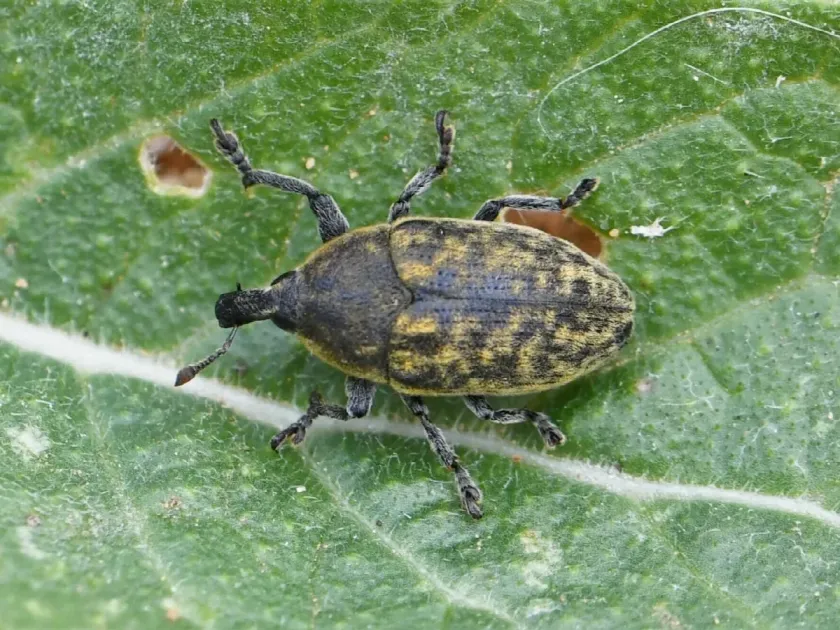
The artichoke weevil (Larinus scolymi) is a member of the Curculionidae family. Adult beetles are recognizable by their elongated snout, which is specifically adapted to bore into plant tissue for feeding and egg-laying.
The beetle's body is typically covered in dense, hair-like scales, giving it a mottled grey or brown appearance. This coloration provides excellent camouflage against the textured surface of artichoke buds.
Larvae are legless and creamy-white, with a curved body shape. They live and develop exclusively inside the flower heads, making them hidden from view during most of their life cycle.
Pupation takes place within the damaged flower head. The larva constructs a sturdy cocoon, known as a pupal chamber, made from chewed plant fibers and fecal matter to protect itself during transformation.
Adults are highly mobile and active during the budding and flowering phases of host plants. They disperse across fields to locate suitable sites, making them a persistent pest in regions where artichokes are grown.
What it damages
This weevil primarily targets the globe artichoke, but it also infests various species of thistle (Carduus) and other members of the Asteraceae family, which serve as alternative hosts.
Damage is caused both by adults feeding on the exterior of the buds and by larvae boring into the fleshy receptacle. The larvae consume the heart of the artichoke, effectively destroying the edible portion of the crop.
Infested flower heads show poor development, deformation, and reduced marketability. In severe cases, the damage is so extensive that the entire crop or significant portions of it are rendered unsuitable for commercial sale.
The feeding holes and galleries created by the larvae provide easy entry points for various pathogens, leading to secondary bacterial and fungal infections that cause the buds to rot prematurely.
Economic impact is high in areas with established populations. When the weevil population density is not managed, yield losses can escalate significantly, threatening the profitability of the artichoke enterprise.
When it appears
The life cycle of Larinus scolymi is strictly synchronized with the phenology of its host plants. Adults emerge from overwintering sites in the soil as temperatures rise in the spring.
Mating and oviposition coincide with the formation of artichoke buds. Females bore into the young buds to deposit eggs, ensuring that newly hatched larvae have an immediate food source within the flower head.
Larval development occurs during the summer months. The larvae feed continuously, growing inside the receptacle while the plant continues to develop, leading to progressive internal damage.
New adults emerge in late summer or early autumn. They undergo a period of feeding on remaining plant tissue before seeking suitable overwintering sites to enter diapause for the colder months.
Overwintering occurs in the top layer of soil or under plant debris, where the beetles remain protected from extreme cold, allowing them to resume activity as soon as conditions become favorable in the next cycle.
Signs of infestation
The first indicator of an infestation is the presence of small, circular feeding or egg-laying punctures on the outer bracts of the artichoke bud, sometimes accompanied by sap exudation.
Deformed or stunted buds often signal that larvae are actively feeding inside. Such heads will appear sickly or show signs of premature wilting despite adequate watering and fertilization.
Cutting open an infested bud usually reveals internal galleries and frass (larval excrement). This contamination makes the artichoke completely unusable and confirms the presence of the pest.
Finding pupal chambers within the heart of the bud is a definitive sign of an advanced infestation, suggesting that the pest has successfully completed its generation cycle.
A general reduction in yield quality, such as yellowing or browning of the internal tissues, is a common observation in fields affected by Larinus scolymi throughout the growing season.
Control measures
Integrated pest management is essential for controlling this weevil. Cultural practices, such as removing and destroying crop residues immediately after harvest, are critical to breaking the life cycle.
Deep soil cultivation in the off-season can effectively kill overwintering beetles, reducing the overwintering population density and limiting the potential for a massive outbreak the following year.
Strategic timing of chemical applications is required, focusing on the period before larvae burrow deep into the bud, where they become protected from contact insecticides.
Monitoring the field with pheromone or sticky traps helps determine the timing of interventions, ensuring that control measures are implemented precisely when adult beetles are active.
- Cultivate early-maturing varieties to harvest before peak beetle populations emerge.
- Manual removal of initial infested buds to reduce the local population of larvae.
- Clear surrounding areas of wild thistle to eliminate alternative host reservoirs.
Taxonomy
- Latin name
- Larinus scolymi
- Order
- Coleoptera (beetles)
- Family
- Curculionidae
- EPPO code
- LARISC
Discussion
No discussions yet — be the first.