
Larinus planus
Larinus planus
Description
How to identify
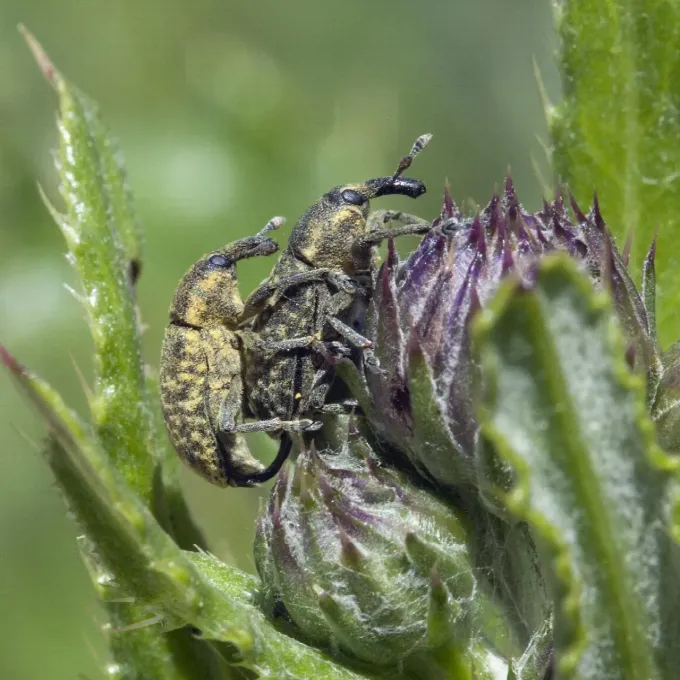
Larinus planus, commonly known as the thistle bud weevil, is a member of the Curculionidae family within the order Coleoptera. Adult weevils are typically 5–9 mm long, with a robust, elongated body and a dense, dark-colored pubescence.
A prominent feature of this species is its long, curved rostrum (snout), which is specialized for feeding on and ovipositing into the floral tissues of various Asteraceae species.
The larvae are typically C-shaped, legless, and white, designed to reside and feed within the restricted space of a thistle flower head without causing its immediate collapse.
Pupation occurs within a specially constructed chamber inside the flower head. This chamber is built by the mature larva using a mixture of plant debris, excrement, and secretions to ensure a secure environment for metamorphosis.
The species demonstrates high environmental adaptation, as the adult stage is well-protected by hard chitinous elytra, allowing it to survive varying weather conditions during the dispersal phase.
What it damages
The primary hosts of Larinus planus are plants from the Asteraceae family, most notably the Canada thistle (Cirsium arvense) and various Carduus thistle species.
Adult weevils consume the foliage and developing buds of these weeds, resulting in aesthetic damage and minor physiological stress to the plant.
The most significant impact occurs during the larval stage, as they feed extensively on the developing seeds and receptacle tissue within the flower head.
This feeding behavior effectively sterilizes the flower head, preventing the production of viable seeds and thereby reducing the long-term spread of the weed population.
Because of this destructive behavior towards invasive thistles, Larinus planus is frequently recognized as a beneficial agent in classical biological control programs.
When it appears
Adults emerge from their overwintering sites in the soil or under leaf litter during the early spring as temperatures begin to rise, following the growth of host plants.
The peak feeding and mating period occurs in late spring, which aligns with the phenological stage of host plants as they begin to bolt and develop floral buds.
Egg-laying (oviposition) takes place during the budding phase, ensuring that neonate larvae have immediate access to high-quality floral nutrients.
Larval development takes place throughout the summer months, with the insects progressing through several instars before successfully pupating inside the thistle head.
The new generation of adults emerges in late summer or early autumn, feeds briefly on host foliage, and then seeks sheltered locations to survive the winter.
Signs of infestation
Early indicators of Larinus planus activity include small, circular feeding holes on the leaves and bracts of thistle plants caused by adult feeding.
Flower heads that appear shriveled, deformed, or fail to open fully are clear signs of internal larval infestation and subsequent destruction of the floral structures.
Opening an infested flower head usually reveals the presence of larvae, pupae, or distinct, coarse frass resulting from larval feeding activities.
The absence of mature seeds at the end of the season in traditionally seeding thistle patches is a primary indicator of successful biological control by the weevil.
- Deformed or stunted flower heads
- Exit holes on the exterior of the flower head
- Missing or damaged seeds inside the receptacle
- Reduced weed density in the subsequent season
Control measures
In most agricultural settings, Larinus planus is not considered a pest requiring control; instead, it is encouraged as a natural biological control agent.
However, if intervention becomes necessary, broad-spectrum insecticides can reduce populations, though they are rarely recommended due to the weevil's positive role.
Mechanical management, such as deep autumn tilling, can disturb overwintering adults and larvae, significantly lowering the population size for the next season.
To discourage the weevil when it becomes a nuisance, host plants should be mown or removed before the budding phase to prevent the establishment of the life cycle.
Integrated pest management strategies prioritize maintaining natural enemies and environmental conditions that support the limited local activity of the species.
Taxonomy
- Latin name
- Larinus planus
- Order
- Coleoptera (beetles)
- Family
- Curculionidae
- EPPO code
- LARIPL
Discussion
No discussions yet — be the first.