
Thistle bud weevil
Larinus meleagris
Description
How to identify
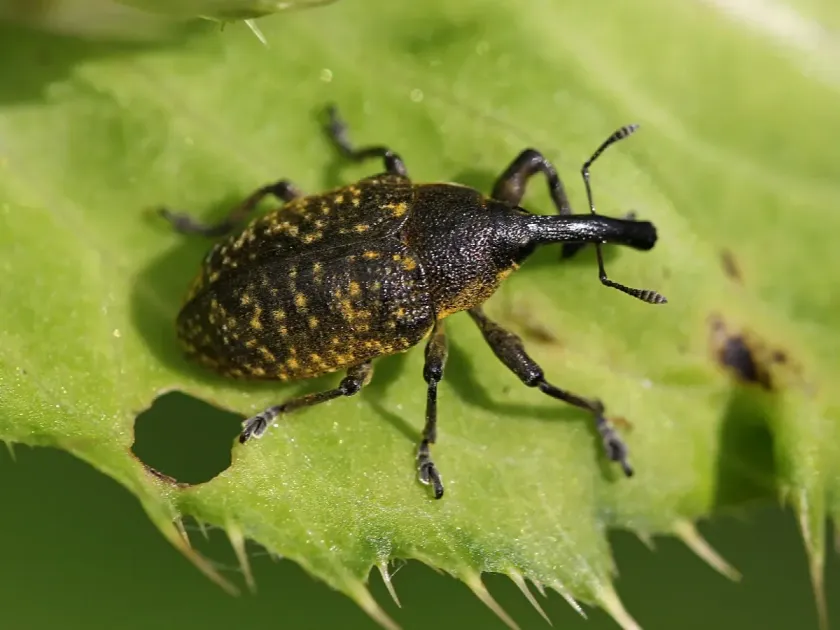
The thistle bud weevil (Larinus meleagris) is a beetle belonging to the Curculionidae family. It is a medium-sized weevil, typically measuring between 8 and 12 mm, with a robust body covered in fine greyish or brownish scales that provide effective camouflage.
Its most distinct feature is a long, prominent rostrum, which the adult uses both for feeding on plant tissues and for boring holes in flower buds to deposit its eggs. The overall coloration is dark, helping it blend into the stems of its host plants.
Larvae are typical of the weevil family: legless, C-shaped, and creamy-white in color with a darker, hardened head capsule. They are exclusively adapted to develop inside the flower heads of their host plants, where they are protected from environmental extremes.
Taxonomically, Larinus meleagris is a member of the order Coleoptera. It is a specialist feeder primarily targeting species within the Asteraceae family, which makes it a significant concern for both flower seed production and certain medicinal herb crops.
Identification in the field is usually based on the plant species infested and the specific damage pattern observed. While adults are visible on the plant surface, the larvae remain hidden inside the bud throughout their entire growth stage.
What it damages
The primary hosts of this pest include various types of thistles and knapweeds. The damage is twofold, caused by both adults feeding on foliage and larvae consuming the reproductive organs of the plant.
Adult beetles feed on leaves and young stems by chewing small, regular holes. While this does not usually kill the plant, it causes physiological stress and reduces the plant's overall vigor and capacity to produce healthy blooms.
The most destructive phase is the larval stage. Larvae bore into the flower head and consume the developing seeds and flower tissues. This leads to the total loss of the seed crop, which is particularly devastating for commercial seed farmers.
In high infestation scenarios, the flower heads become stunted, deformed, or fail to open completely. This results in significant loss of market value for ornamental plants and catastrophic failure in seed production fields.
Furthermore, the physical damage created by larvae serves as an entry point for various secondary pathogens, including fungi and bacteria. These infections cause the flower heads to rot, further reducing the overall crop yield.
When it appears
Adults overwinter in soil or leaf litter, emerging in early spring when temperatures become favorable. They immediately start feeding on the young growth of available Asteraceae plants to gain energy for reproduction.
The mating and oviposition process usually begins with the development of the first flower buds. Females carefully select suitable buds to lay eggs, ensuring their larvae have an immediate and continuous food source as they hatch.
The larval development period coincides with the host plant's blooming season. Throughout this time, the larvae grow inside the flower head, passing through several larval stages and progressively consuming the inner tissues of the bud.
Pupation occurs within a cavity constructed by the larva inside the infested flower head. The adult beetles typically emerge in mid-summer, spending the rest of the season feeding on plant tissues before seeking overwintering sites.
The species is univoltine, completing only one life cycle per year. This predictable seasonal activity is critical for agricultural planning, allowing growers to target the timing of their control measures effectively.
Signs of infestation
The initial signs of infestation are circular, neat holes on the leaves and stems. Observant farmers can often spot the beetles resting on top of the stems or tucked into the leaf axils during the early hours of the day.
Deformed or drooping flower heads are the most reliable indicator of larval presence. If a bud appears crooked or is failing to open properly, it is highly likely that a larva is consuming its internal structure.
Small, sealed holes on the buds, often capped with a mixture of frass and debris, indicate where a female has laid eggs. These entry points can sometimes show early signs of necrosis, highlighting the site of the attack.
When an infested flower head is opened, the interior is often completely hollowed out. A large white larva and a significant amount of larval frass are usually present, leaving little to no viable seed inside the bud.
Infestation typically occurs in localized patches within a field, rather than being uniformly distributed. Identifying these initial hot spots allows for early intervention before the pest can spread to the rest of the crop.
Control measures
Cultural control is the most effective starting point. Removing wild thistles and knapweeds from the perimeter of the fields is crucial, as these weeds act as a primary reservoir for the pest population throughout the spring.
Deep autumn plowing or soil cultivation is recommended after harvest to disrupt the overwintering sites of the adults. By burying or disturbing the soil, many beetles are destroyed or rendered unable to emerge effectively in the following spring.
Chemical control using systemic insecticides is necessary during high-pressure years. Applications should be timed precisely during the bud development stage, ensuring the product reaches the plant before the larvae migrate deep into the flower head.
It is important to manage insecticide application to protect pollinators. Avoid spraying during full bloom and prefer chemicals with lower toxicity to beneficial insects, focusing treatments only on the affected areas of the field.
Regular scouting using sweep nets or pheromone-based monitoring (if available) can help determine the exact moment of beetle arrival. This approach minimizes the need for blanket spraying and promotes a more sustainable integrated pest management strategy.
Taxonomy
- Latin name
- Larinus meleagris
- Order
- Coleoptera (beetles)
- Family
- Curculionidae
- EPPO code
- LARIME
Discussion
No discussions yet — be the first.