
Thistle weevil
Larinus griseoplus
Description
How to identify
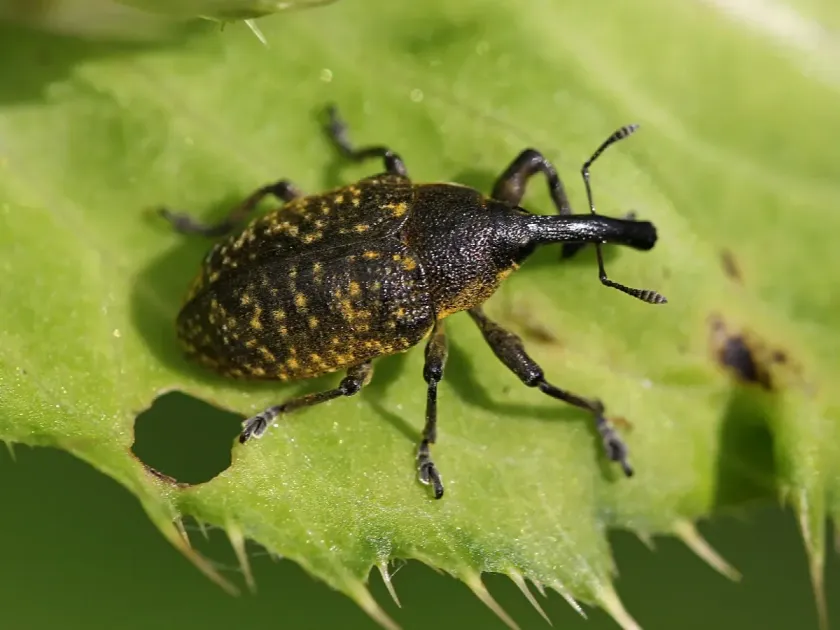
The thistle weevil (Larinus griseoplus) belongs to the Curculionidae family of the Coleoptera order. Adult beetles are characterized by their elongated rostrum and dense greyish pubescence, which serves as effective camouflage on host plants.
The beetle has an oval-shaped, robust body with a greyish-brown color. The larvae, which reside inside flower heads, are legless and possess a cream-white body with a distinct dark head capsule.
The lifecycle of this pest is intrinsically linked to plants of the Asteraceae family. Adult beetles are primarily diurnal and exhibit defensive behavior by feigning death when threatened.
Pupation takes place within the flower heads where the larvae have been feeding. The pupa is free and protected by the remnants of plant tissues, creating a safe micro-environment for metamorphosis.
The species overwinters mainly in the adult stage, hiding in the top layer of soil or under plant debris, which ensures survival during the winter season until spring activity resumes.
What it damages
The primary damage is caused by larvae, which feed on the internal tissues of the flower heads, destroying the receptacle and seeds. This leads to a significant decrease in the reproductive potential of weeds and can impact cultivated crops.
In agricultural settings, the beetle may migrate to related crops, such as sunflowers, especially if these fields are located in close proximity to dense populations of wild thistle.
Adult beetles also feed on foliage and young shoots; however, this damage is generally secondary to the larval impact on flower development, which prevents seed production.
High infestation rates can lead to severe crop loss, as the larvae render flower heads sterile, making them unsuitable for harvest or seed collection in agricultural systems.
The pest's impact is often underestimated because the larvae develop internally, concealed from view, which masks the extent of the damage until the flower heads are opened or inspected.
When it appears
Adults emerge from hibernation in the spring when average daily temperatures consistently reach 10-12 degrees Celsius. This emergence timing is synchronized with the vegetative growth of host plants.
Mating and oviposition occur during the budding and early flowering phases. Females bore holes into the buds and deposit eggs, ensuring that the larvae have immediate access to food upon hatching.
The peak feeding stage for larvae occurs during the summer months, matching the period of seed formation in host plants, leading to high metabolic activity and rapid pest growth.
New generation adults appear in late summer or early autumn. They feed actively to accumulate reserves for the winter before entering diapause by October.
The species typically completes one generation per year, making its population dynamics highly dependent on spring weather conditions and the availability of suitable floral hosts.
Signs of infestation
Signs of infestation are visible as small entry holes on the buds, which indicate where the female has deposited eggs. This is a primary diagnostic indicator for field scouting.
The presence of larval frass and excavated tunnels inside the flower head confirms the damage. Affected heads often show empty seed chambers, signaling total seed destruction.
Premature wilting or deformation of the flower buds is a clear sign that larvae are consuming the inner tissues that support normal flower development.
During the early morning, beetles can be seen sitting on top of the stems or buds. If disturbed, they will typically drop to the ground and remain motionless to avoid detection.
The presence of dry, stunted, or partially hollowed-out flower heads during the peak flowering season is a definitive indicator of an established thistle weevil population.
Control measures
Cultural control methods involve the regular removal of host weeds from the Asteraceae family, particularly in field margins and fallow areas that serve as breeding grounds.
Deep autumn plowing is an effective mechanical method that disrupts the overwintering sites of the beetles, significantly reducing the survival rate of the next generation.
Insecticide applications may be required in high-pressure scenarios, but must be timed carefully to avoid affecting beneficial pollinators that visit the blooming flowers.
Biological control, utilizing natural enemies or parasitoids that target the larval stage within the flower heads, can help keep population levels below the economic injury threshold.
Maintaining crop rotation and providing adequate spatial isolation between sensitive crops and wild weed populations are the most effective preventive measures against the thistle weevil.
Taxonomy
- Latin name
- Larinus griseoplus
- Order
- Coleoptera (beetles)
- Family
- Curculionidae
- EPPO code
- LARIGR
Discussion
No discussions yet — be the first.