
Pinfish
Lagodon rhomboides
Description
How to identify
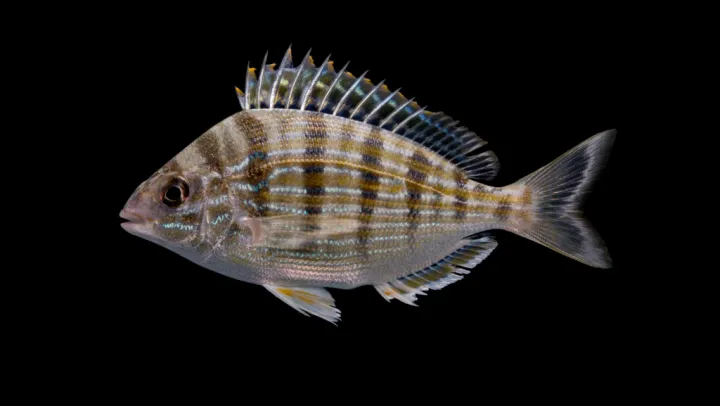
The Pinfish (Lagodon rhomboides) is a member of the Sparidae family, characterized by its deep, compressed, rhomboid-shaped body structure.
It typically exhibits a silver color with prominent yellow and blue horizontal stripes running along its flanks, and a distinctive dark spot behind the gill cover.
The mouth is small but equipped with specialized incisor-like teeth designed to clip, cut, and browse on aquatic vegetation and small invertebrates.
These fish grow up to 25 centimeters in length and are predominantly found in shallow estuarine and coastal waters across the Western Atlantic.
They are known for their schooling behavior, which allows them to overwhelm and rapidly consume vegetation in specific areas of the marine ecosystem.
What it damages
Pinfish cause significant damage by overgrazing seagrass meadows and cultivated algae, which are critical for coastal health and commercial marine farming.
They browse on the shoots and blades of seagrass, such as Zostera marina, effectively reducing the overall canopy density of the underwater environment.
Their feeding activity leads to habitat fragmentation, which can negatively impact nursery grounds for various commercially important marine species.
In high-density populations, Pinfish can strip entire sections of a seaweed farm, causing severe economic losses for aquacultural operations.
Beyond direct grazing, the physical action of schooling and foraging disturbs the sediment, which can cause indirect damage to the roots of established plants.
When it appears
Pinfish activity follows seasonal temperature fluctuations, with the highest levels of feeding occurring during the warmer spring and summer months.
During the spring, juvenile Pinfish migrate into shallow estuarine waters, where they remain to feed and grow, placing pressure on local aquatic flora.
As water temperatures drop during autumn, the populations move toward deeper offshore waters, significantly reducing the grazing pressure on coastal sites.
However, in some subtropical regions, Pinfish can remain active throughout the winter, requiring year-round monitoring of sensitive aquaculture plots.
Timing the planting of sensitive seaweed species to avoid peak migration periods is a key strategic approach for minimizing potential damage.
Signs of infestation
The presence of Pinfish is often indicated by patches of reduced seagrass density where vegetation has been heavily clipped or entirely removed.
Close inspection of the blades reveals clean, diagonal, or blunt cuts, which are characteristic of the species' incisor teeth used for grazing.
Increased turbidity around the planting site often points to active feeding, as the fish disturb bottom sediments while browsing on plant material.
Visible schooling behavior in the vicinity of seagrass or algae farms is a strong precursor to localized overgrazing and plant loss.
- Patchy seagrass distribution
- Cleanly clipped vegetation blades
- Increased local water turbidity
- Observed schools of Pinfish
Control measures
Physical exclusion remains the most reliable method, utilizing fine-mesh nets or cages to prevent Pinfish from accessing vulnerable seaweed plots.
Innovative aquaculture management uses bio-deterrents or acoustic devices that simulate the presence of predators to discourage foraging in protected zones.
Crop rotation and selecting less palatable seaweed varieties can help reduce the attractiveness of a farm to Pinfish during high-activity seasons.
Integrated management plans involve monitoring fish population density to determine when temporary barriers or other mitigation strategies are most needed.
Maintaining healthy, dense seagrass beds can sometimes increase the resilience of the ecosystem, though Pinfish pressure can still be significant in managed areas.
Taxonomy
- Latin name
- Lagodon rhomboides
- Family
- Sparidae
- EPPO code
- LAGDRH
Discussion
No discussions yet — be the first.