
Shore earwig
Labidura riparia
Description
How to identify
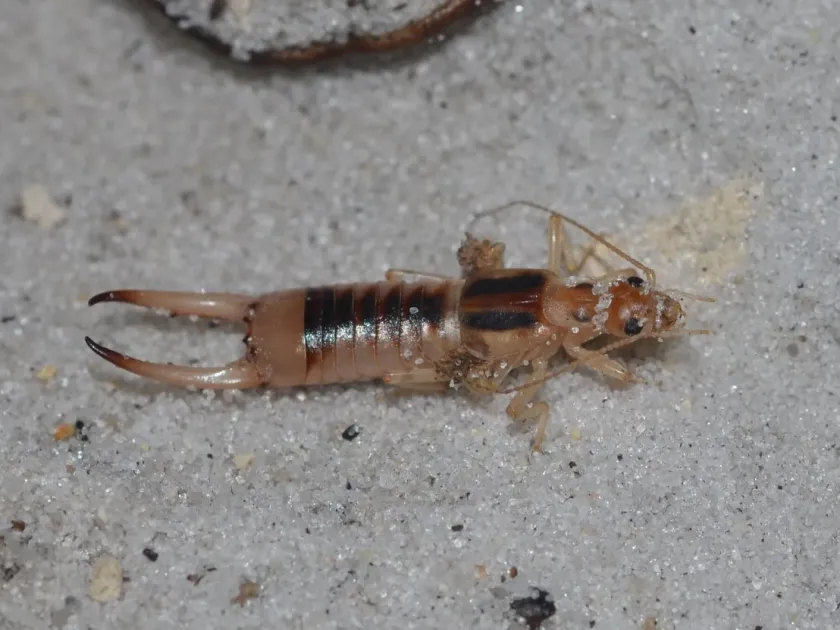
The shore earwig (Labidura riparia) belongs to the order Dermaptera, family Labiduridae. This insect has an elongated, flattened body ranging from 15 to 30 mm in length, typically displaying yellowish-brown or dark brown coloration.
A distinctive feature of this species is the large cerci at the tip of the abdomen, which are significantly more developed and curved in males than in females. They are primarily nocturnal and favor sandy or silty soils, often found near water bodies.
The biology of the shore earwig is marked by advanced maternal care: the female protects her eggs and early-stage nymphs, shielding them from predators and environmental hazards such as mold.
Development occurs via incomplete metamorphosis. Adults possess functional wings and are capable of flight, allowing them to migrate and colonize new areas, especially during warmer months.
While shore earwigs are naturally predatory, acting as beneficial insects that eat other pests, they may switch to feeding on plant tissues when natural prey is scarce or populations become excessively dense.
What it damages
In agricultural settings, shore earwigs cause damage by feeding on tender plant tissues, particularly seedlings and young transplants. They often target vegetable crops, melons, and cereals.
By gnawing on leaves, growing points, and stems, they cause stunted growth or complete plant failure. They are particularly destructive in greenhouses where young plants are most vulnerable.
Beyond physical consumption of plant material, these insects can transmit secondary fungal and bacterial pathogens through the wounds created during feeding.
Damage symptoms include irregular holes in leaf blades and chewed-off leaf edges, which significantly reduce the marketability and vigor of the affected crops.
When infestation levels are high, significant economic losses can occur due to reduced plant stand and damaged crop quality, requiring targeted pest management.
When it appears
Activity begins with the onset of warm spring weather and continues throughout the summer until early autumn. Populations typically reach their peak in mid-to-late summer.
Reproduction takes place in underground nests. Depending on regional climatic conditions, the shore earwig can complete one or two generations per season.
During the day, these insects hide in moist soil, under mulch, or within organic debris, emerging to feed only after sunset.
As temperatures drop in autumn, they burrow deeper into the soil for overwintering. Most individuals survive the winter as adults, though some late-stage nymphs may also overwinter.
Migrations occur when environmental conditions, such as soil moisture levels, become unfavorable for their development or survival, forcing them to search for more suitable habitats.
Signs of infestation
The primary sign of infestation is the presence of jagged holes in foliage, which is characteristic of the feeding activity of nocturnal chewing insects.
Because they are secretive during the day, detecting them requires checking beneath mulch, boards, or other ground-level debris where they congregate.
Using artificial traps, such as moistened cardboard or rolled-up burlap, placed in the field overnight is an effective way to monitor their local population density.
Damage often appears in patches, as these insects tend to aggregate in areas with favorable microclimates and moisture levels.
Inspecting seedlings for damage at the growing tips early in the morning can provide evidence of nocturnal feeding activity by earwigs.
Control measures
Cultural control strategies are essential: regular weeding, removing crop residues, and deep soil tillage disrupt their daytime shelters and overwintering sites.
Reducing the use of organic mulch in close proximity to vulnerable seedlings can help decrease the micro-habitats that earwigs require for survival.
When threshold levels are exceeded, contact or systemic insecticides approved for horticultural use can be applied to mitigate the damage.
Biological control methods include supporting natural predators such as ground beetles, spiders, and birds, which can help maintain earwig populations at acceptable levels.
- Remove boards, stones, and garden debris from the field.
- Use trap-and-collect methods with food-based baits.
- Monitor greenhouse moisture to avoid creating attractive habitats.
Taxonomy
- Latin name
- Labidura riparia
- Family
- Labiduridae
- EPPO code
- LABIRI
Discussion
No discussions yet — be the first.