
Lusitanian leaf beetle
Labidostomis lusitanica
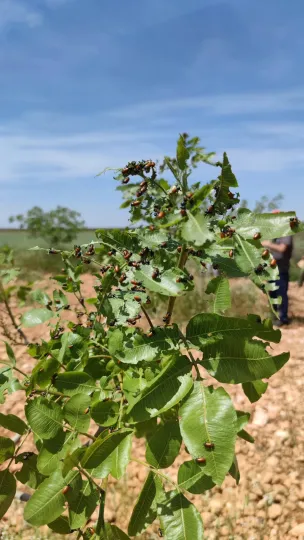
Description
How to identify
Labidostomis lusitanica is a beetle species belonging to the leaf beetle family (Chrysomelidae), specifically the subfamily Cryptocephalinae. These beetles are known for their sturdy build and specific behavioral patterns that make them distinct in agricultural fields.
The adult beetle typically measures between 6 and 9 mm in length. Its body is robust, with a coloration ranging from brownish-yellow to dark metallic tones. A key morphological feature, especially in males, is the development of oversized mandibles used for social interactions and defense.
A fascinating aspect of their biology is the larval stage. Larvae live inside protective cases known as 'cases' or 'cradles,' constructed from their own excrement and bits of plant matter. This allows them to blend into the environment and remain protected from predators.
The life cycle involves complete metamorphosis, moving from egg to larva, pupa, and finally adult. The development process is closely synchronized with the phenology of their host plants, ensuring food availability for the emerging adults.
Understanding their mating behavior is important for pest monitoring, as males are frequently seen patrolling host plants to find females during the active spring and early summer period.
##damage##This pest affects a variety of plants, including fruit trees, grapevines, and various ornamental shrubs. The primary damage is caused by adults, which feed aggressively on the foliage of the host plants.
Adult feeding results in skeletonized leaves, where the soft tissue is removed, leaving behind only the complex vein network. This significantly reduces the plant's ability to photosynthesize, weakening the overall structure and health of the crop.
While the larvae primarily consume leaf litter, their presence in large numbers can lead to collateral damage to the root systems or the base of young stems, especially in nursery settings where seedlings are vulnerable.
In vineyards, the damage is particularly concerning during the bud-burst stage. Beetles feeding on the developing buds can directly eliminate clusters before they have the chance to fully develop, leading to yield loss.
The impact is cumulative; repeated defoliation across seasons stresses the plants, making them more susceptible to drought, secondary pests, and various fungal diseases that thrive on stressed tissues.
##season##The emergence of adult Labidostomis lusitanica usually begins in late spring, around May or June, as temperatures rise sufficiently to initiate their life cycle. Their activity peaks during the first half of the summer.
The beetle follows a univoltine life cycle, meaning one generation per year. Larvae spend the winter in diapause inside their protective cases, hidden in the soil or among organic debris under the plant canopy.
As the soil warms in the spring, the larvae finish their development and pupate. Shortly after, the new generation of adults emerges, immediately starting to feed on the tender vegetation of the host trees.
Weather patterns play a major role in their population dynamics. Warm, dry springs are particularly favorable for this species, often resulting in higher survival rates and more significant population spikes in the following months.
By late summer, adult activity tapers off, and the population transitions back into the larval stage, focusing on survival through the upcoming winter months in sheltered soil environments.
##signs##The most visible sign of infestation is the presence of jagged, irregular holes in the leaves. As feeding progresses, these holes enlarge and converge, leaving the plant looking thin and malnourished.
During the day, adults can often be found resting on the leaves or stems. When disturbed, they typically exhibit a defensive reflex and drop to the ground, which is a classic behavior for this group of beetles.
Searching for the cases of the larvae on the ground or in the lower foliage is a reliable way to confirm the presence of this pest in an area. These cases look like small, hardened debris pellets.
Premature yellowing or wilting of the upper shoots is often a symptom of heavy localized feeding by the adult beetles. If this occurs during the early season, it indicates a need for immediate intervention.
Regular visual inspections of the buds and young leaves in May and June are essential to catch the infestation early before the damage becomes extensive enough to affect the annual yield.
##control##Cultural control is the first line of defense. Keeping the area under trees and vines clean of fallen leaves and organic debris removes the wintering sites for the larvae and limits the next year's population.
When populations reach an economic threshold, the use of contact or systemic insecticides is recommended. The best time to apply these is during the adult emergence phase in late spring, targeting them before mating and egg-laying occur.
Biological control methods include fostering an environment that supports natural predators like birds and beneficial insects, which can help keep the beetle population at manageable levels without heavy chemical intervention.
Autumn tillage (turning over the soil) in the orchard or vineyard rows can disrupt the larval overwintering process, exposing them to environmental extremes and natural enemies, thus reducing their survival rate.
- Monitor plant growth regularly during late spring.
- Apply insecticides specifically during the adult feeding window.
- Maintain orchard sanitation by clearing leaf litter.
- Hand-pick beetles in small-scale gardens or nurseries.
- Use physical barriers for young, highly susceptible seedlings.
Taxonomy
- Latin name
- Labidostomis lusitanica
- Order
- Coleoptera (beetles)
- Family
- Chrysomelidae
- EPPO code
- LABDLS
Discussion
No discussions yet — be the first.