
Keratella cochlearis
Keratella cochlearis
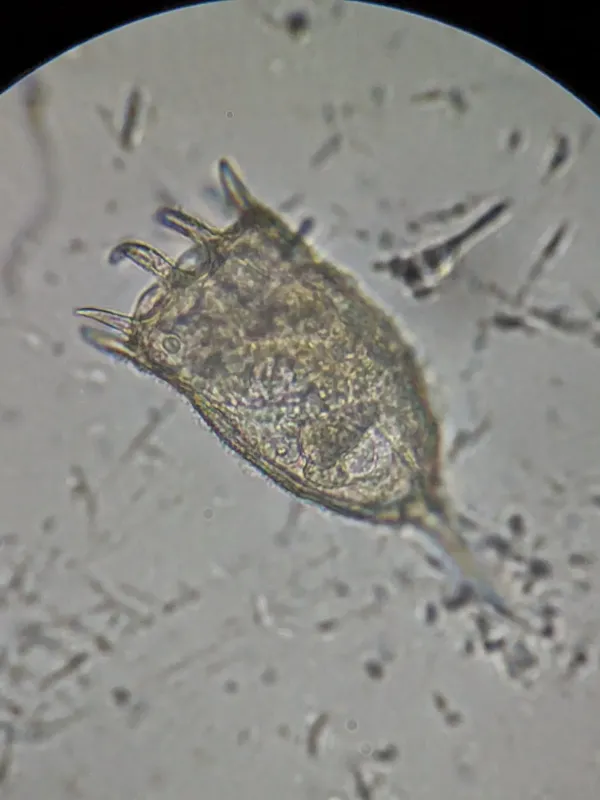
Description
How to identify
Keratella cochlearis is a microscopic organism belonging to the phylum Rotifera, class Monogononta, order Ploima, and family Brachionidae. It is characterized by a pear-shaped lorica (shell) that typically features a prominent posterior spine.
The morphology of these rotifers is subject to cyclomorphosis, where their body shape and size change in response to environmental factors such as temperature and predation pressure.
The organism uses a ciliated structure known as the corona for locomotion and filter-feeding, creating water currents to direct food particles into its mouth.
As a cosmopolitan species, it thrives in a wide range of freshwater habitats, including fish farming ponds, where it is often a dominant component of the zooplankton community.
Identification requires microscopic observation to examine the diagnostic patterns on the lorica, which are specific to the species and its subspecies.
What it damages
While not a traditional agricultural pest, Keratella cochlearis can be highly detrimental in aquaculture, specifically during the larval rearing stage of fish.
The primary damage occurs through intense competition for food, as these rotifers aggressively consume phytoplankton that is essential for the health of the aquatic ecosystem.
By consuming large amounts of microalgae, they disrupt the energy transfer in the food web, which can lead to reduced growth rates and lower survival of fish fry.
Furthermore, their presence in high densities leads to significant fluctuations in water quality parameters, including dissolved oxygen levels and pH, stressing the fish stock.
They can also serve as intermediate hosts for certain parasites, posing an additional sanitary risk that complicates the management of intensive aquaculture systems.
When it appears
The lifecycle of Keratella cochlearis is characterized by rapid parthenogenesis, allowing for explosive population growth during favorable environmental conditions.
The species is most active during the spring and summer months when water temperatures range between 15°C and 25°C, providing optimal conditions for reproduction.
During peak activity, generations can succeed one another within a few days, leading to massive blooms that can dominate the zooplankton biomass.
When the environment becomes harsh or food resources become scarce, the population shifts to sexual reproduction, producing dormant eggs that sink to the sediment.
These dormant eggs allow the species to survive the winter and re-emerge to colonize the pond once conditions improve the following season.
Signs of infestation
A notable sign of high Keratella cochlearis density is a change in water transparency or color, often caused by the depletion of specific algae groups they consume.
Microscopic analysis of water samples typically reveals a high abundance of these rotifers, which appear as active, constantly moving particles under low magnification.
Diminished growth performance and increased mortality among fish larvae, without evidence of bacterial or viral infection, often point toward food competition with rotifers.
Sudden drops in dissolved oxygen levels during the night are often observed in ponds heavily populated by dense zooplankton blooms, including this species.
Regular monitoring of pond water quality and quantitative hydrobiological analysis are the most reliable methods to detect and quantify the presence of this organism.
Control measures
Effective management of Keratella cochlearis in aquaculture requires a combination of biological control methods and proper pond maintenance.
- Strategic fertilization of ponds to promote a diverse community of plankton, preventing any single species from dominating the system.
- Stocking of planktivorous fish species that can naturally regulate the rotifer population density in the pond.
- Implementation of regular pond drying and sediment disinfection cycles to eliminate dormant eggs accumulated in the bottom mud.
- Continuous monitoring of water quality to enable early intervention before population densities reach critical levels.
- Use of selective water treatment methods to adjust the nutrient loading and favor desirable plankton species over undesired rotifers.
Taxonomy
- Latin name
- Keratella cochlearis
- Family
- Brachionidae
- EPPO code
- KERTCO
Discussion
No discussions yet — be the first.