
Keratella
Keratella
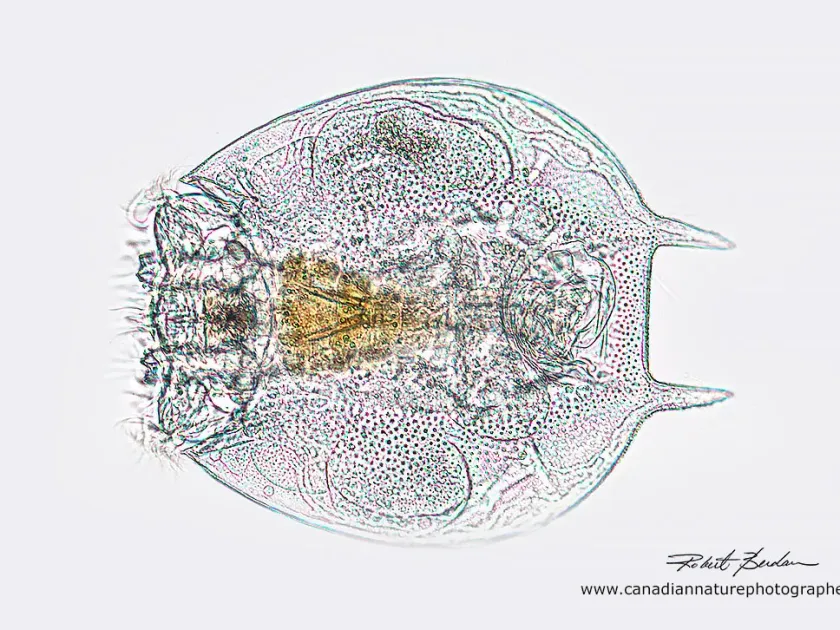
Description
How to identify
Keratella is a genus of microscopic planktonic organisms belonging to the phylum Rotifera. These tiny creatures are common in freshwater ecosystems.
They are characterized by a lorica (a protective shell) that often features distinct spines, which are clearly visible under a standard light microscope.
It is important to clarify that Keratella is not an agricultural pest. They are beneficial components of aquatic food chains, feeding primarily on bacteria, algae, and organic detritus.
Their presence in irrigation ponds indicates healthy biological activity in the water, not an impending threat to crop health.
These organisms do not have any life stages that involve terrestrial plants, and they are strictly confined to the aquatic environment.
What it damages
Keratella does not damage plants. It lacks the specialized mouthparts required to feed on plant tissues, roots, or sap.
There is no evidence in agronomical literature linking this rotifer to any reduction in crop yield or quality.
Mistaking Keratella for a pest usually stems from the accidental observation of these microorganisms in irrigation water samples.
Unlike mites, aphids, or nematodes, which are true plant pests, rotifers are strictly aquatic and pose zero risk to garden or field crops.
The plant damage often attributed to unknown causes should be investigated as pathogen or nutrient-related issues, rather than searching for rotifer activity.
When it appears
The population density of Keratella fluctuates based on water temperature, nutrient availability (especially nitrogen and phosphorus), and light levels.
These organisms typically bloom during late spring and summer months when water temperatures are favorable for rapid reproduction.
In colder seasons, their activity slows down, and they may persist in resting stages until conditions become optimal again.
Their cycle is governed by the dynamics of the aquatic ecosystem, such as the growth of phytoplankton, rather than any crop-specific seasonal changes.
The seasonal presence of rotifers is completely detached from the planting or harvesting cycles of agricultural crops.
Signs of infestation
Since Keratella is not a plant pest, there are no characteristic signs of infestation on plants.
Symptoms such as leaf yellowing, wilting, or spotted leaves are unrelated to the presence of these microorganisms in the water supply.
The presence of rotifers can only be confirmed through microscopy of water samples, where they appear as free-swimming, tiny, armored organisms.
Farmers should look for signs of true pests like insects, fungi, or bacterial infections if plants are showing signs of stress.
There is no visible footprint or biological damage caused by Keratella on any botanical species.
Control measures
No pest control measures are required for Keratella, as they do not threaten crop safety or productivity.
If they become a nuisance by clogging fine irrigation nozzles or drip tape filters, mechanical filtration (sand or disc filters) is the recommended solution.
The use of pesticides, algaecides, or other chemicals to eliminate rotifers is unnecessary and may negatively impact the aquatic environment.
Maintaining proper hygiene in irrigation tanks and minimizing the stagnant water zones will naturally manage the density of aquatic microorganisms.
Focusing on standard irrigation system maintenance is sufficient to prevent any operational issues caused by plankton build-up.
Taxonomy
- Latin name
- Keratella
- Family
- Brachionidae
- EPPO code
- KERTSP
Discussion
No discussions yet — be the first.