
Bandicoot
Isoodon
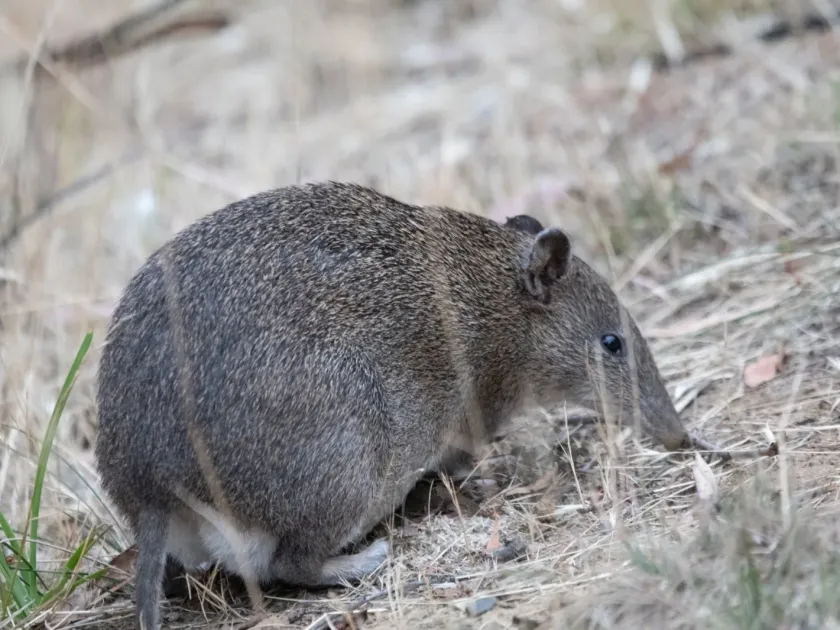
Description
How to identify
Bandicoots (genus Isoodon, family Peramelidae) are small marsupials that resemble large rats with elongated snouts. Adults can weigh up to 1.5 kg and possess a compact body with dense, coarse fur ranging from brown to grey.
They are primarily nocturnal, which makes them difficult to observe directly. Their hind legs are adapted for hopping, while their forelimbs are equipped with strong claws designed for digging in the soil.
Taxonomically, they belong to the order Peramelemorphia. In agricultural settings, they are considered pests due to their high activity levels and their destructive habit of disturbing the soil surface.
Bandicoots can reproduce throughout the year under favorable conditions. This high reproductive rate allows local populations to recover quickly and maintain high densities in suitable habitats.
They possess an excellent sense of smell, which enables them to locate hidden food sources deep within the soil. This trait makes them highly efficient at finding buried bulbs, roots, and soil-dwelling larvae.
What it damages
Although omnivorous, bandicoots cause significant damage in gardens by feeding on tubers and root crops. Potatoes, carrots, and beets are particularly vulnerable to being unearthed and consumed.
In addition to eating crops, they cause mechanical damage to plant root systems. During their digging activities, they often undermine the roots of ornamental and vegetable plants, leading to wilting and death.
They frequently disrupt freshly sown beds by digging up seeds and bulbs. This behavior results in sparse crops and often necessitates replanting over large areas of the garden.
The damage patterns are sometimes confused with those of other rodents, but the distinct cone-shaped pits left by their snout and claws are a key diagnostic feature of bandicoot activity.
In lawns and pastures, they create a network of small holes while searching for lawn grubs. This activity ruins the aesthetic appearance of the turf and compromises the integrity of the soil cover.
Signs of infestation
The most common sign of bandicoot presence is the appearance of numerous cone-shaped pits in the soil, usually 10-15 cm deep. These appear overnight on garden beds and lawns.
Damaged root vegetables typically exhibit bite marks and hollowed-out sections. Remnants of the crops are often scattered around the digging site as the animal feeds quickly.
The presence of small, dark, cylindrical droppings near digging sites is a reliable indicator of their activity. These droppings are often found in clusters along their foraging paths.
Well-trodden, narrow runways through dense vegetation or along fence lines indicate the consistent routes bandicoots take to access their food sources.
Audible cues, such as rustling in bushes or soft grunting noises at night, often betray the presence of these animals as they forage across the garden area.
Control measures
The most effective method for exclusion is the installation of physical barriers. Burying a sturdy wire mesh into the ground to a depth of 20-30 cm prevents bandicoots from burrowing under garden fences.
Ultrasonic repellers can be used to deter them from specific areas, although their effectiveness varies. It is recommended to change the frequency periodically to prevent the animals from habituating to the sound.
Applying repellent substances with strong odors, such as castor oil or botanical essential oils, can make specific vegetable beds less attractive for foraging.
Eliminating nesting sites is crucial for long-term management. Removing debris piles, dense weed growth, and wood stacks denies the animals shelter and encourages them to move to other locations.
- Install wire mesh exclusion fencing.
- Keep the garden free of debris and dense weeds.
- Use olfactory-based animal repellents.
- Deploy ultrasonic sound deterrents.
Taxonomy
- Latin name
- Isoodon
- Family
- Peramelidae
- EPPO code
- ISODSP
Discussion
No discussions yet — be the first.