
New Zealand weevil
Irenimus parilis
Description
How to identify
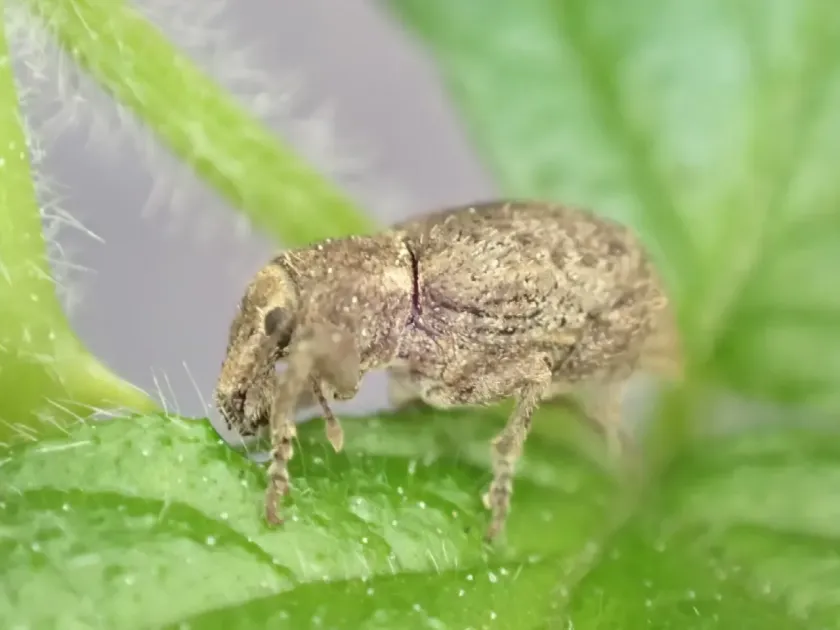
The New Zealand weevil (Irenimus parilis) is a member of the Curculionidae family within the order Coleoptera. Adult beetles typically measure between 5 and 7 mm in length and feature a ground-colored, scaly body that allows them to blend seamlessly with soil and plant debris, acting as natural camouflage.
The most distinctive feature of the adult is its elongated snout (rostrum), which houses the chewing mouthparts at the tip. They also possess characteristic elbowed antennae, a hallmark of the weevil family, which aid them in sensing their environment and selecting suitable feeding sites.
The larval stage consists of legless, C-shaped grubs that are cream or yellowish in color. They feature a well-defined, dark-brown hardened head capsule used to navigate through soil and feed on root tissues. These larvae spend their entire developmental phase underground, rarely surfacing until they transform into adults.
Eggs are minute and oval, typically deposited by females in secluded spots such as the soil surface or the base of stems. This reproductive strategy ensures that the offspring have immediate access to food sources upon hatching while remaining protected from environmental extremes.
Adult weevils exhibit a defensive behavior known as thanatosis, or feigning death. When disturbed, they drop from the plant foliage to the ground and remain motionless, making them incredibly difficult to spot during routine garden inspections.
What it damages
This pest is a polyphagous insect, meaning it feeds on a wide range of agricultural and decorative plant species. The damage is two-fold: adults cause defoliation of the aerial parts of the plant, while larvae cause severe root destruction.
Common host plants include berry crops like strawberries and raspberries, clover, various legumes, and young nursery stock. In nurseries, even a modest infestation can significantly stunt plant growth and reduce the survival rate of young saplings.
Adult weevils typically feed on the margins of leaf blades, creating characteristic semi-circular notches. Under heavy infestation pressure, the foliage can be completely skeletonized, leaving only the veins behind, which severely impairs the plant's photosynthetic capacity.
Below the surface, the larvae feed on the root system, stripping away the outer root tissues and severing small feeder roots. This prevents the plant from absorbing necessary water and nutrients, often leading to rapid wilting and eventual death of the plant.
The root damage caused by larvae often creates entry points for soil-borne pathogens, including various fungal root rots. Consequently, a plant weakened by Irenimus parilis is highly susceptible to secondary infections, which often mask the initial cause of the plant's decline.
When it appears
The lifecycle of Irenimus parilis is closely synchronized with seasonal temperature shifts. Adults emerge and become most active during the spring and summer months, as rising temperatures trigger their reproductive phase and feeding activities.
Egg-laying usually occurs in late spring and early summer. Females prefer moist, loose soil conditions, which provide an ideal environment for the development of the larvae once they hatch, ensuring they do not desiccate before they can begin feeding.
The larval stage spans several months, with grubs actively feeding and growing throughout the summer. The larvae go through several instars within the soil, depending on local weather conditions and the availability of root biomass.
Pupation typically occurs within the soil in late summer or early autumn. Within specialized earthen cells, the larvae undergo metamorphosis, with the new generation of adults emerging soon after to feed and accumulate reserves for the coming winter.
The winter months are spent in diapause, with adults overwintering in the topsoil layers or hidden under dense vegetation debris. This survival strategy allows them to endure cold snaps and emerge early in the following spring as soon as the ground warms.
Signs of infestation
The most reliable sign of a New Zealand weevil infestation is the presence of distinctive, notched patterns along the edges of leaves. These signs are easiest to find during early morning or evening hours when the weevils are actively grazing.
If plants appear to wilt unexpectedly during the heat of the day despite sufficient soil moisture, it is a strong indicator of larval root damage. Such plants can often be easily pulled out of the ground due to the severe reduction of the root system.
To monitor populations effectively, gardeners and agronomists should use the "shaking" method. By placing a white sheet or tray under a plant at night and shaking the foliage, adults can be dislodged and counted to determine if intervention is necessary.
Larvae can be confirmed by carefully excavating the soil around the base of symptomatic plants. Focusing on the root crown area will often reveal the presence of C-shaped grubs huddled in the soil surrounding the damaged root system.
Increased bird activity on the soil surface, especially birds pecking at the ground around the base of plants, may be a sign that they are feeding on the larvae residing in the upper soil layers.
Control measures
Effective management requires an integrated approach that focuses on both physical and biological suppression to keep populations below the economic injury level.
- Frequent soil cultivation in inter-row spaces to disrupt the soil, kill larvae, and expose them to natural predators.
- Application of entomopathogenic nematodes (such as Steinernema species) to the soil to target and parasitize the larvae.
- Maintaining strict weed control to remove alternative hosts that harbor weevil populations in the off-season.
- Using physical barriers or sticky traps on the stems of sensitive woody plants to prevent adults from climbing.
Chemical control should be applied judiciously, timing applications to coincide with the period of peak adult activity on the foliage. Treating the soil for larvae is significantly more challenging and requires precise timing to be effective.
Regular crop rotation is essential, as it forces the pest to migrate or starve, limiting their ability to build up large, persistent populations in one specific area over multiple growing seasons.
Taxonomy
- Latin name
- Irenimus parilis
- Order
- Coleoptera (beetles)
- Family
- Curculionidae
- EPPO code
- IREIPA
Discussion
No discussions yet — be the first.